






 Portuguese
  Spanish


Did you know that not every atomic weapon is ready for use? Understand the three divisions of nuclear warheads and the ranking of countries that control this arsenal.
The global stockpile of atomic weapons is not stored in a single operational block; on the contrary, it is divided into three well-defined logistical categories by defense departments. About 12,000 nuclear warheads exist today in the world, but the public often mistakenly thinks that all are ready for instant launch.
In reality, the arsenal is fragmented between active weapons (already installed in missiles and ready for use), reserve units (stored for replacement in times of crisis), and retired devices, which have been taken out of service but await slow and complex dismantling processes.
The global ranking of destructive power
The distribution of this inventory of mass destruction exposes a huge disparity among nations.
-
Venezuela Faces UN Alert for Hunger, Disease, and Service Collapse After Earthquakes Cause Nearly 2,000 Deaths and $6.7 Billion in Damages

-
Brazil Deploys Navy Field Hospital with ICU, Orthopedics, Pediatrics to Earthquake-Stricken Area in Venezuela, Offering 30 Beds and 150 Daily Consultations
-
European Union Announces €260 Million Investment to Extend EllaLink Submarine Cable to Northern Brazil, Reducing Digital Dependence on U.S. Routes

-
U.S. Women’s History Museum Stalled in Congress Amid Gender Identity and Diversity Debate




Although nine countries are part of the group with atomic capabilities, only two superpowers concentrate almost 90% of the planet’s entire stockpile.
According to the Military Society, the remaining nuclear warheads are currently officially divided among the governments:
- China: About 600 units;
- France: Approximately 290 units;
- United Kingdom: More than 225 units;
- India: Between 160 and 180 units;
- Pakistan: Between 160 and 180 units;
- Israel: About 90 units;
- North Korea: Approximately 50 units.
On the other hand, the United States and Russia retain an impressive 88% of the weapons, inheriting and expanding a force structure inherited from the last century. Being 5,042 units from the USA and 5,420 from Russia.
The strategic functioning of the nuclear triad
To reduce the risk that a surprise attack compromises their entire response capability, the United States and Russia distribute their strategic arsenals across different platforms in a model known as the nuclear triad.
Instead of concentrating all weapons in a single location, the strategy distributes resources among intercontinental ballistic missiles installed in fortified underground silos, long-range strategic bombers positioned at military air bases, and nuclear submarines armed with ballistic missiles, which remain on silent patrol across the oceans.
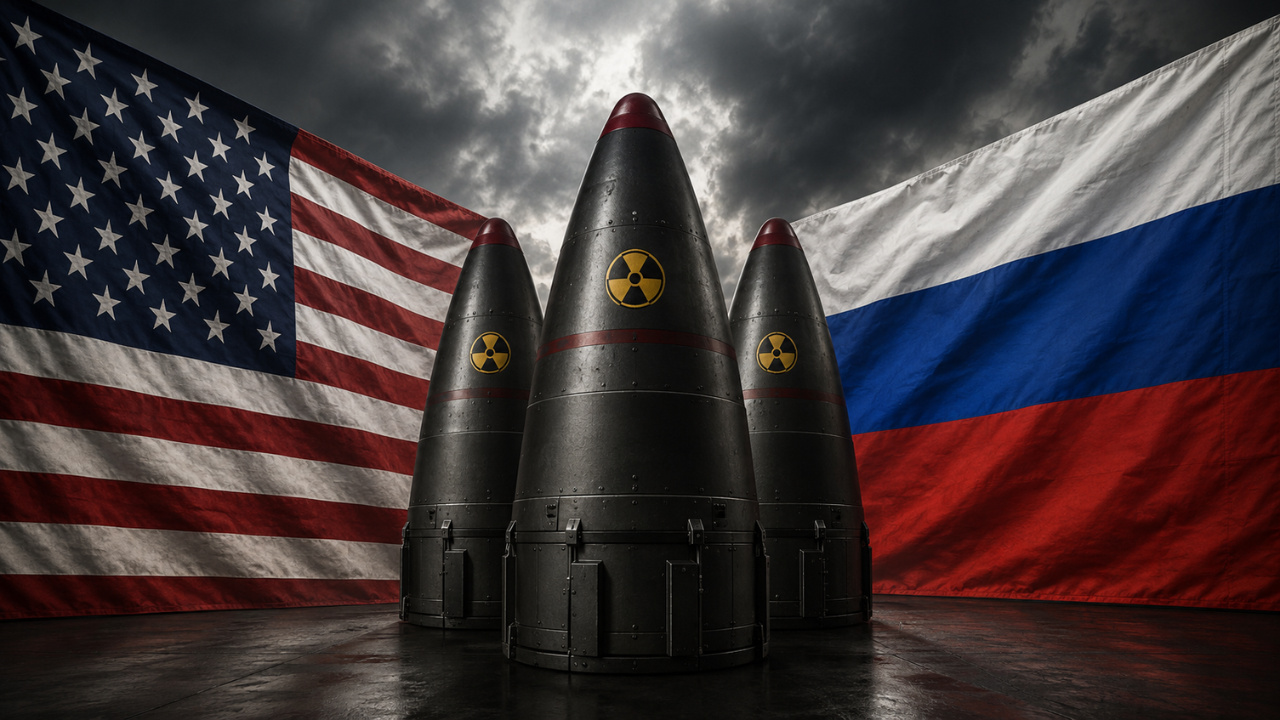
This structure ensures that a significant part of the forces remains capable of responding even after a potential initial attack, preserving deterrence capability and maintaining constant vigilance over possible adversary movements.
The factors driving a new race for nuclear warheads
A profound change in global diplomacy threatens to reverse the trend of gradual disarmament that had been adopted in recent decades.
International analysts warn that the world has entered a phase of severe instability due to the advancement of localized regional tensions in Eastern Europe, Asia, and the Middle East.
In this scenario of mutual international distrust, the main military blocs have returned to injecting billions of resources into their strategic sectors.
The United States sustains large technological upgrade programs, while Russia focuses on the continuous modernization of its missile launch systems.
Meanwhile, China accelerates the physical expansion of its own stockpile, fueling fears that the total number of weapons will grow globally again.
As a result, experts assess that the disarmament period initiated after the Cold War has been formally interrupted, giving way to a dangerous phase of updating atomic deterrence technologies.
With information from Sociedade Militar


