Portuguese
  Spanish


Scientific Research Unraveled The Factors That Led Dinosaurs To Reach Colossal Sizes, Explaining One Of The Greatest Mysteries Of Paleontology.
The long-necked sauropods marked the history of dinosaurs, dominating the continents during the Jurassic and Cretaceous periods. With their colossal sizes, they became the largest land animals that ever existed. One of the keys to this extraordinary growth was a unique respiratory system supported by air sacs that made their skeletons lighter and more efficient.
These air sacs, present in modern birds and extinct dinosaurs, played a vital role. They not only helped in oxygen intake but also in regulating body temperature. In sauropods, these structures were crucial for supporting their gigantic sizes and surviving in hostile environments.
A Look At The Fossils: Post-Cranial Skeletal Pneumaticity
To identify these air sacs in fossils, scientists observe a phenomenon called Post-Cranial Skeletal Pneumaticity (PSP). This characteristic is visible in deep pits in the vertebrae, connected to internal chambers in the bones. While neosauropods, such as titanosaurs, show extensive evidence of PSP, the origins of these adaptations in early sauropodomorphs remain poorly understood.
-
Berries, Strawberries, and Blueberries Could Transform Agriculture in Northeastern Brazil, New Tests Reveal

-
Danish Resident Discovers Six Viking Gold Bracelets Weighing 762.5 Grams, Third Largest Gold Treasure in Denmark

-
Over 200 Cities in Southern Brazil on Storm Alert as Cyclone Near Uruguay Brings Heavy Rain, Hail, and Winds Up to 100 km/h

-
Archaeologists Discover 2,300-Year-Old Beer in Sealed Bronze Vessel from Ancient Chinese Tomb




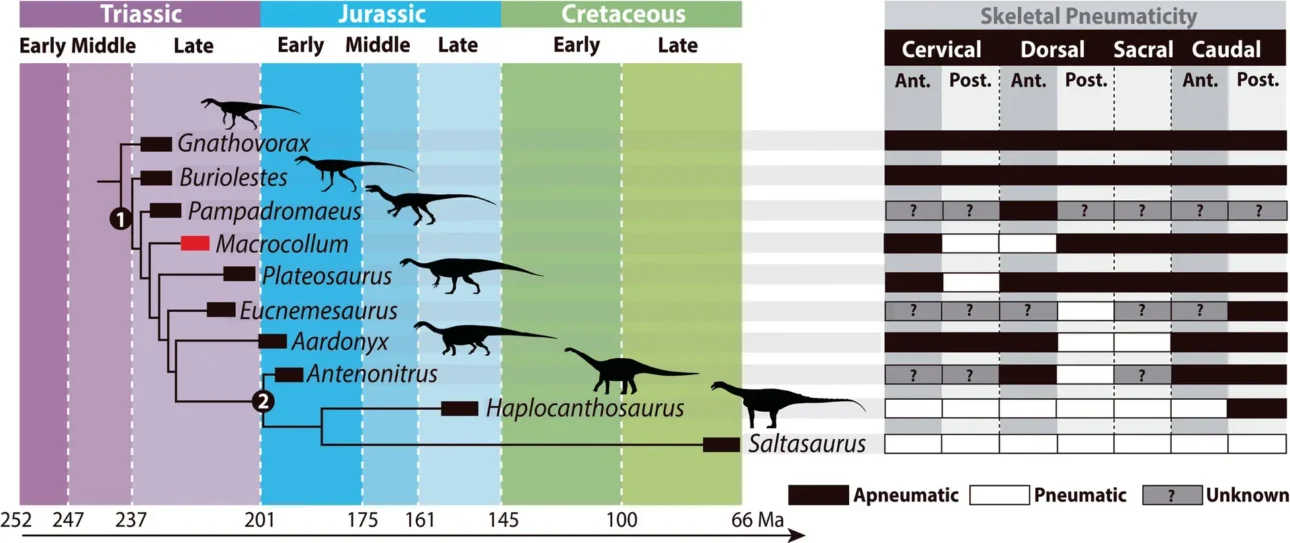
However, a discovery in the Norian Sequence of Candelária, in southern Brazil, changed this scenario. Scientists unearthed a dinosaur named Macrocollum itaquii, a unaysaurid sauropodomorph from 225 million years ago. This is the oldest known dinosaur with air sacs, providing new information about the respiratory evolution of early dinosaurs.
Technology and Science Unite Forces
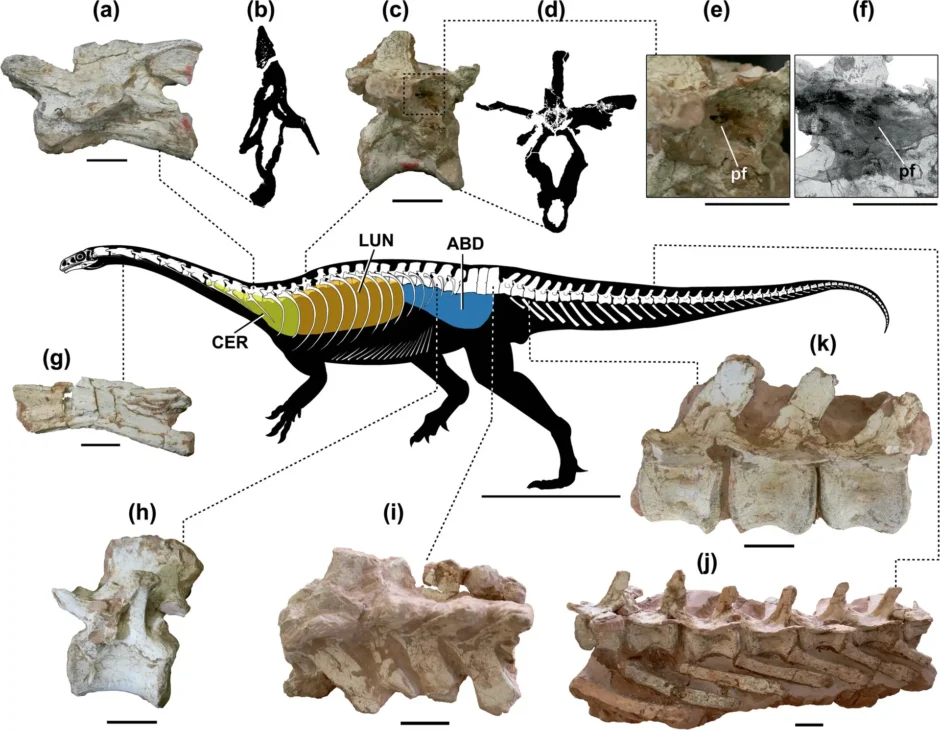
Researchers from the University of Campinas (Unicamp) used micro-computed tomography to study the skeleton of M. itaquii. This technique revealed how air sacs began to develop, providing clues about the evolutionary process that transformed small dinosaurs into giants.
Tito Aureliano, the lead author of the study, highlighted the importance of these structures. “The air sacs made their bones less dense, allowing them to grow over 30 meters in length,” he said. Despite being only 3 meters long, M. itaquii already surpassed its predecessors, which rarely exceeded 1 meter.
The discovery was published in the journal The Anatomical Record, emphasizing the role of air sacs in the rapid size increase of dinosaurs.
A Decisive Evolutionary Advantage
Fresia Ricardi-Branco, another researcher involved, emphasized how these respiratory adaptations provided a significant competitive advantage. “The air sacs gave dinosaurs an evolutionary edge over other groups like mammals, allowing them to diversify rapidly,” she explained.
This innovation also helped primitive dinosaurs such as M. itaquii face challenging climates in the Triassic. Later, they thrived during the Jurassic and Cretaceous periods while expanding their dominance on the planet.
Respiratory Evolution: A Non-Linear Process
Previous research suggested that air sacs evolved independently in three groups of reptiles: theropods, sauropodomorphs, and pterosaurs. M. itaquii is a bipedal ancestor of the quadrupedal giants known for their long necks and small heads. Its discovery fills an evolutionary gap between early dinosaurs and their colossal successors.
The study also challenged old assumptions about air sacs. It was previously believed that these structures started in the abdominal region and only spread to the cervical area in the early Jurassic, around 190 million years ago. However, M. itaquii exhibited air sacs in the cervical and dorsal vertebrae, but none in the abdominal region.
Aureliano explained: “It’s as if evolution had done different experiments until it found the definitive system, where the air sacs extend from the cervical region to the tail. It was not a linear process.”
A Crucial Link in The History of Dinosaurs
Moreover, the study revealed a type of previously unknown bone tissue called “protocamerated.” This intermediate tissue challenges the theory that air sacs evolved from simple chambers to more complex structures called camellae.
“We discovered that this protocamerated form existed first, which completely changes our view of how these structures evolved,” Aureliano stated.
These new pieces of evidence underline the complexity of dinosaur evolution and show how respiratory adaptations were fundamental to their success. M. itaquii serves as a critical link between small Triassic dinosaurs and the giants that walked the Earth millions of years later.
As future studies continue to unravel the mysteries of prehistory, this discovery marks an important step in understanding how dinosaurs dominated the planet for so long. With M. itaquii, the story of evolution gains a fascinating and surprising chapter.