Portuguese
  Spanish


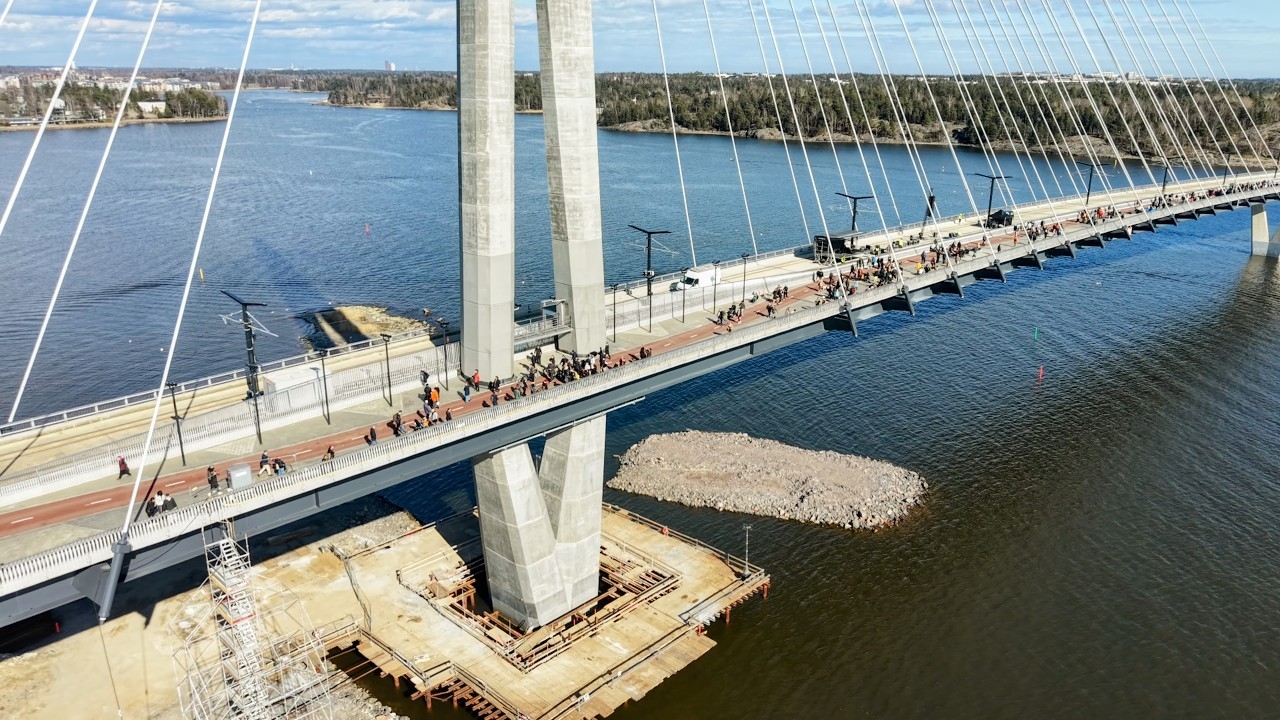


The new Helsinki link changes access between islands and the city center, shortens the journey, bets on car-free mobility, and becomes a symbol of a Nordic capital surrounded by sea, extreme cold, and bold engineering.
Helsinki has just gained a structure that seems straight out of a futuristic project. Amidst the ice, the sea, and the islands surrounding the Finnish capital, a gigantic 1.2-kilometer bridge has been opened to the public and has already become a symbol of a new phase for the city.
What stands out the most is not just the size. The new Kruunuvuori bridge was born with an audacious proposal: no cars will pass over it. The space has been reserved for pedestrians, cyclists, and a light rail, in a radical bet to change urban mobility.
Where is Helsinki and why does this bridge attract so much attention
Helsinki is not among the most well-known destinations for the general public in Brazil, but it occupies a strategic position in Northern Europe. The city is the capital of Finland and is located on the shores of the Baltic Sea, in a region marked by islands, channels, strong winds, and harsh winters.
-
Egypt’s “New Nile”: 170 km Artificial River Aims to Turn Desert into Farmland, but Water Supply Concerns Loom

-
Unable to secure a mortgage as a self-employed single mother, she designed her own floating home from a 20-meter boat and now lives “off-grid” with her two children and solar panels on an English canal.
-
Man Transforms Rusty Shipping Container into Luxury Home with Insulated Walls, Large Windows, and Drywall Finish, Surprising Onlookers

-
“Super Grass” Miscanthus Grows Rapidly Without Pesticides, Replacing Heating Oil in Europe and Now Used in Carbon-Capturing Concrete and Walls in World’s First “Bale House”



This scenario helps explain why the new bridge impresses so much. It is not just about connecting two points on the map. The structure crosses a challenging coastal area, in a city where the sea can freeze during winter and where every construction must face extreme cold, humidity, and severe cycles of freezing and thawing.


The Finnish capital blends sea, islands, and extreme climate
Helsinki spreads across a landscape very different from most major European capitals. The region consists of an urban strip surrounded by water and several islands, making connections between neighborhoods even more important for the daily life of the population.
Moreover, the Finnish capital is known for urban planning, efficient public transport, and a strong concern for quality of life. The new bridge fits perfectly into this model of a city that seeks to reduce car usage and promote more sustainable commuting.
The inauguration became an event and drew crowds for the crossing
The opening of the bridge took place on April 18 and attracted a true invasion of curious onlookers. As soon as the structure was opened, thousands of people began to cross it, turning the location into one of the most sought-after spots in Helsinki.
The atmosphere was festive. There was music, food stalls, performances, and even a bicycle parade. During the opening weekend, over 50,000 people passed through the new link, which quickly ceased to be just an engineering project and became an urban attraction.

A huge, modern bridge with no space for cars
The proposal for Kruunuvuori breaks the mold of large urban bridges. Even with impressive dimensions, it was designed without space for cars, something rare in structures of this size.
This decision reinforces Helsinki’s strategy to prioritize cleaner modes of transport that are more integrated into the city’s daily life. The result is a crossing designed for pedestrians, cyclists, and those who will use the light rail when the system is fully operational.
The project was in discussion for years before it became a reality
The idea for this connection did not emerge recently. The plan has been part of the city’s political agenda since 2002, but construction only truly began in October 2021.
The bridge is part of the Kruunusillat project, or “Crown Bridges,” a set of three structures created to better connect the island of Laajasalo to the rest of the capital. The Kruunuvuori was the last to be completed and also became the most impactful of the entire package.
The structure impresses from high and far
The image of the bridge has already changed the skyline of Helsinki. One of its most striking elements is the diamond-shaped pylon, which reaches 135 meters in height and stands out in the city’s landscape.
This detail is not just for attention. It reinforces the monumental character of the structure and helps transform the bridge into a new postcard of the Finnish capital, in a region that combines modern architecture, water on all sides, and a very particular urban landscape.
Everything was designed to withstand wind, salt, and ice
The engineering of the bridge had to take severe conditions into account. In a coastal area subject to strong winds and extremely low temperatures, every choice of material and design played an important role.
The curved layout helps those crossing to better perceive their destination. The sides were designed to offer more protection against the wind, while the cables received specific solutions to prevent dangerous ice accumulation during colder periods.
The new connection is expected to change the routine of those living on the islands in the region
The importance of the bridge goes far beyond the visual. With the new crossing, the distance between Kruunuvuorenranta and downtown Helsinki drops from about 11 kilometers to approximately 5.5 kilometers.
This reduction should make life easier for residents of the eastern areas of the city, improve access between neighborhoods separated by water, and reduce dependence on private cars. In a capital spread across the continent and islands, this represents a concrete change in urban routine.
The tram is still coming, but the transformation has already begun
Even though it is already open to pedestrians and cyclists, the bridge is still awaiting the full operation of the light rail. The goal is for the passenger service to be operational by the beginning of 2027.
When that happens, the structure is expected to establish itself as one of the main transportation links in the region. The expectation is to relieve pressure on other systems in the city and keep pace with the population growth of new neighborhoods in the surrounding area.
The most astonishing fact is in the lifespan of the structure
If the size is already impressive, the promise of durability makes the project even more extraordinary. The projection is that the bridge will have a lifespan of up to 200 years, something unusual for this type of construction in Finland.
To achieve this goal, the project required materials more resistant to the marine environment and to intense cycles of freezing and thawing. The idea is for the structure to withstand decades of heavy use without losing safety and performance.
Helsinki has bet big and may have created a new symbol of Northern Europe
The new bridge is not just a crossing. It combines mobility, visual impact, urban planning, and a clear message about the future of cities in cold and coastal regions.
In a capital still little known to many Brazilian readers, the project helps to reveal a modern Helsinki, surrounded by sea, islands, and bold solutions. And given the scale of the ambition, this bridge was not built just to impress now. It aims to leave a mark for generations.
Did you like this gigantic project in Northern Europe? Comment on what you think and share it with those who love megaprojects, futuristic cities, and impressive curiosities from around the world.