Portuguese
  Spanish


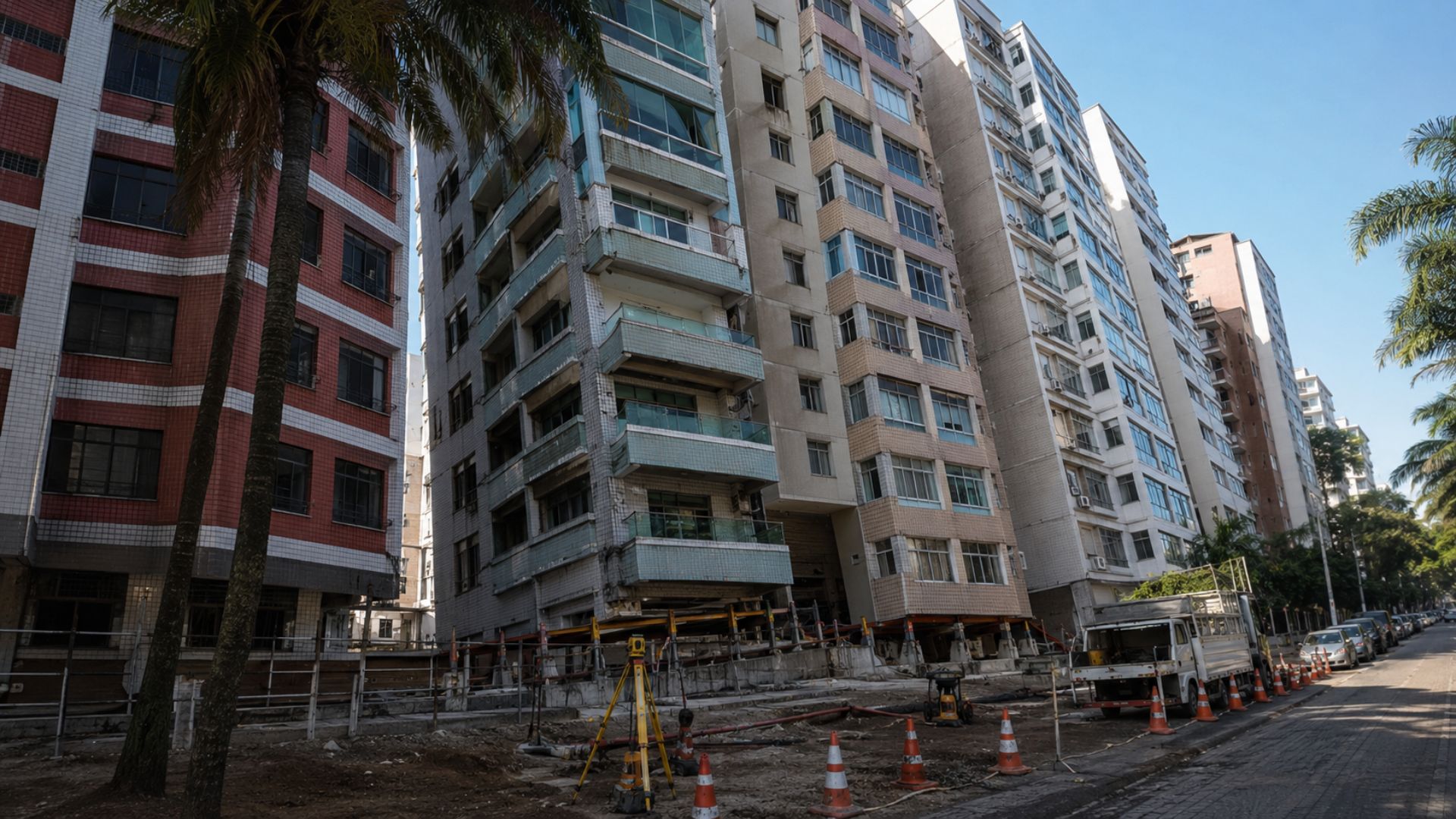

The city of Santos, on the coast of São Paulo, has 319 leaning buildings with some level of inclination, a result of shallow foundations built on former mangroves filled in between the 1950s and 1970s. According to Band Journalism, the correction of each building can cost between R$ 7 million and R$ 22 million, and the city hall is negotiating with BNDES to create an unprecedented line of credit in the country to finance the realignment of these structures.
The urban landscape of Santos bears a mark that few visitors understand at first glance: the city has 319 leaning buildings spread across its neighborhoods, with 65 of them concentrated along the waterfront, between channels 2 and 6, in areas such as Gonzaga, Boqueirão, Embaré, and Aparecida. The buildings were erected between the 1950s and 1970s on former mangroves that had been filled in to make way for urban expansion. The clayey, waterlogged, and low-resistance soil could not support the weight of the constructions over the decades, and the shallow foundations of the time never reached the firm layers of the subsoil.
The result is a set of leaning buildings that began to sink unevenly over time. In some cases, the inclination reaches up to one meter. Reports from the city hall indicate that there is no imminent risk of collapse, but they also do not offer guarantees of long-term stability. The Association of Inclined Building Condominiums, created in 2024, organized to push for solutions and is now negotiating with the city hall and BNDES a financing model that could transform Santos into a national reference for the recovery of inclined buildings.
Why 319 buildings in Santos are leaning

The explanation for the leaning buildings in Santos is literally in the ground. A large part of the city’s urban area was built on land that was originally mangroves, waterlogged ecosystems that were filled in without proper soil preparation. The landfill created a superficially firm base, but beneath it remained layers of soft clay, saturated with water and unable to support the weight of multi-story buildings.
-
Netherlands Builds Road from 218,000 Recycled Plastic Cups and 500,000 Bottle Caps, Featuring Smart Sensors and Promising Triple the Lifespan of Traditional Asphalt

-
Brazil to Convert 80 Public Properties into 11,000 Affordable Homes Across 44 Cities to Address Housing Shortage

-
Brazilian Company Develops Wall Panels from Recycled Refrigerator Foam with Comparable Thermal and Acoustic Performance

-
Brazil’s São Paulo Region Unveils Latin America’s Largest Timber Shopping Mall, Built in 7 Months, Capturing Carbon and Preventing 900 Tons of Emissions


Between the 1950s and 1970s, the real estate boom in Santos led to the accelerated construction of residential buildings along the coast and surrounding areas. The foundation techniques of the time were limited, and many builders opted for shallow foundations that did not go beyond the first layers of soil. Over time, the weight of the structures compressed the ground unevenly, causing one side of the building to sink more than the other. The process was slow but steady, and today it is visible to the naked eye in dozens of buildings.
What it’s like to live inside a leaning building
Wagner Isabel bought an apartment in one of the leaning buildings in Santos two years ago, knowing about the problem. The building he lives in has a one-meter tilt. According to him, the feeling of dizziness and imbalance was overcome over time, but it did not completely disappear. Residents report that objects roll over tables, doors do not close properly, and floors have noticeable unevenness with each step.
For those living in these buildings, the issue goes beyond discomfort. The uncertainty about the future stability of the structure directly affects property values and the peace of mind of families. The Secretary of Government of Santos, Fábio Ferraz, acknowledged that the public authorities cannot invest directly in private properties, but stated that there is public interest in solving the problem. The concern is that, without intervention, the leaning buildings will continue to deteriorate until correction becomes unfeasible or some extreme weather event accelerates the process.
The technique that can straighten the buildings
The proposed solution for the leaning buildings in Santos is called underpinning, an engineering process that involves lifting the entire building with hydraulic jacks, executing a new foundation underneath, and repositioning the structure aligned on this base. The new foundation piles would be approximately 50 meters deep, finally reaching the firm layers of the subsoil that the original foundations never reached.
The reference case presented in negotiations with BNDES is the Núncio Malzoni building, which has already undergone underpinning after registering inclinations greater than 2 degrees in its two blocks. The operation demonstrated that the technique works, but it requires heavy investment, specialized labor, and a period during which residents need to deal with the construction inside the building itself. With the correct geotechnical study, the new foundation will not have the problems of the original.
The million-dollar cost and the negotiation with BNDES


The correction of leaning buildings is not cheap. Estimates from ACOPI indicate that the cost per building ranges between R$ 7 million and R$ 22 million, depending on the degree of inclination, the size of the construction, and the complexity of the work. For the owners, this can mean an outlay of over R$ 200,000 per apartment.
The city of Santos, under the leadership of Mayor Rogério Santos, proposed to BNDES the creation of an unprecedented financing modality: structured credit for interventions in private buildings with public intermediation. In this model, the bank would lend the money directly to the residents, and the city would act as a third-party guarantor, assuming the debt if any condominium owner fails to pay. BNDES pre-approved the negotiations in a meeting held in March in Rio de Janeiro, but the model is still under technical, legal, and operational analysis.
The challenge of financing what has never been financed
The main obstacle in the negotiations is that BNDES does not have any previous financing model for works in private areas with public action. Creating this line of credit requires solving unprecedented issues: how to ensure that all condominium owners in a building agree to the work, how to distribute the costs among apartments of different sizes, and how to deal with default in a partially inclined condominium.
New meetings between the city, ACOPI, and BNDES are scheduled for the coming months. If the model is approved and implemented, Santos could become the first Brazilian municipality to offer public credit for structural correction of private buildings. The scale of the problem, with 319 leaning buildings erected on mangroves with foundations that should never have been so shallow, makes any solution necessarily million-dollar, but the alternative of doing nothing carries risks that grow with each decade of inaction.
Did you know that Santos has over 300 leaning buildings constructed on reclaimed mangroves? Do you think it’s worth spending R$ 200,000 per apartment to straighten a building, or would it be better to demolish and rebuild? Tell us in the comments what you think about this issue.