






 Portuguese
  Spanish


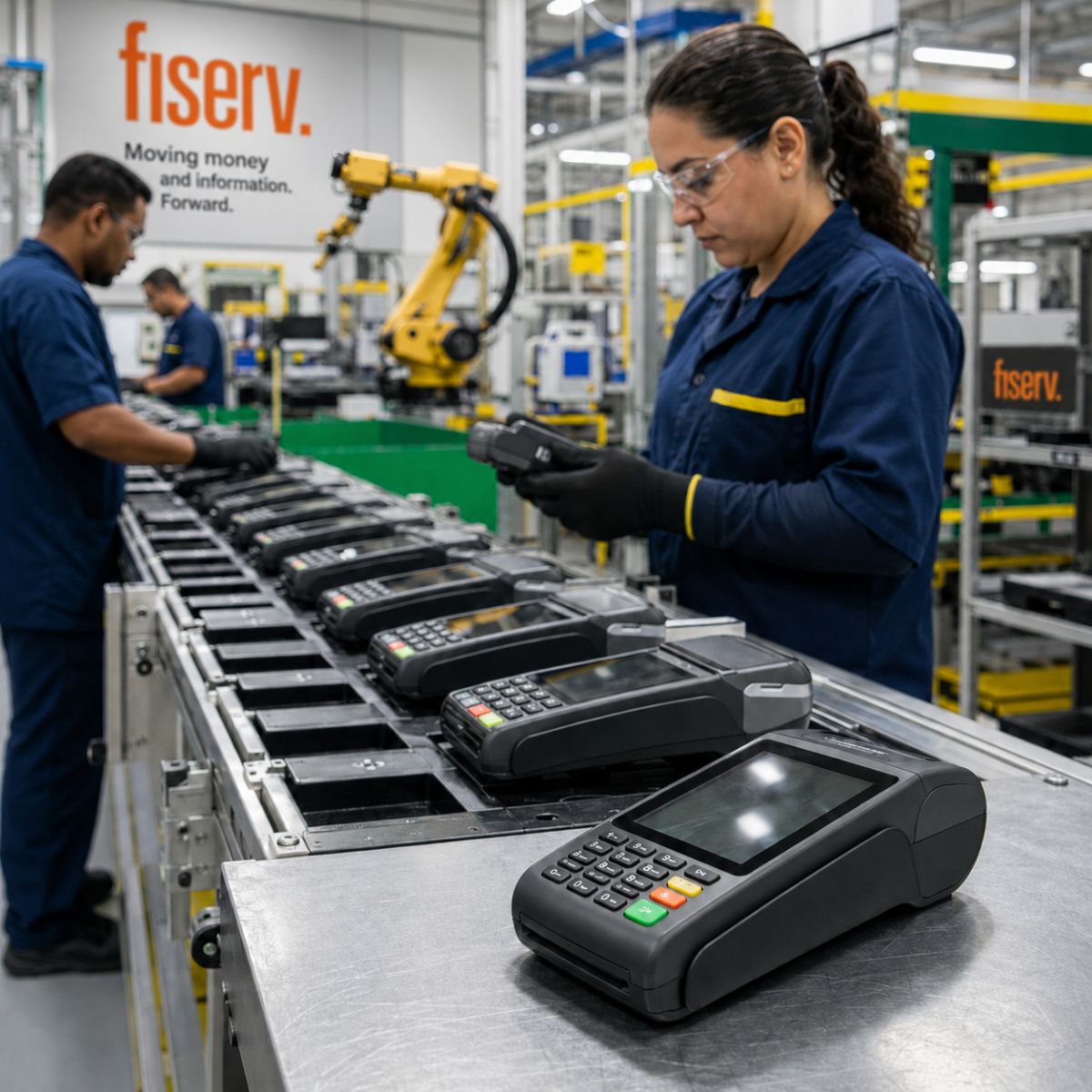
Fiserv, the world’s largest payment processor, inaugurated its first factory outside Asia this Wednesday (6). The unit is located in Betim, in the Metropolitan Region of Belo Horizonte (MG), and will have an annual capacity to produce 100,000 Clover platform payment terminals. According to NeoFeed, the investment is part of a US$100 million package that the American company is allocating to Brazil until the end of 2027, including technology development and commercial expansion. Until now, all Clover equipment was produced in China.
The Fiserv has just inaugurated in Brazil the first factory for payment terminals that the American company is building outside Asia, and the choice of Betim, Minas Gerais, as the headquarters for the operation signals that the world’s largest payment processor sees the Brazilian market as strategic enough to justify local production. The unit will have the capacity to manufacture 100,000 Clover equipment per year, a model that offers not only payment capture but also management features for small and medium-sized retail businesses.
The decision to produce locally is not symbolic: it is economic. Ricardo Daguani, CEO of Fiserv in Brazil, explained that “the factory arrives at a moment when the product is already mature in Brazil and shows some scale,” and that local production reduces logistical costs, delivery time, and increases the availability of the equipment in the country. Models imported from China have been in Brazil since December 2024, and the company already has 100,000 devices in operation that have processed 50 million transactions.
What the Betim factory will produce

The Clover Flex model, which will be produced
The Betim unit will manufacture the Clover Flex, a payment terminal that functions as a transaction capture terminal and at the same time offers business management tools integrated into the device. The model allows merchants to process credit card, debit card, and Pix sales, and also control inventory, issue reports, and manage cash flow directly on the device’s screen, eliminating the need for separate systems.
-
JBS Halts Beef Production for China as Brazil Exceeds 50% of 1.106 Million-Ton Quota; Tariff May Rise from 12% to 67%, Raising Concerns Over Cattle Prices.

-
Brazil’s Social Security Alters Biometric Rules for Pensions and Benefits, Sets 30-Day Deadline, Expands Requirements, and Clarifies Who Is Exempt from Immediate Update

-
Major Brazilian Supermarkets, Including Carrefour and Assaí, May Close Earlier to Prevent Price Increases
-
Coca-Cola Shuts Down 100-Year-Old Factory in the U.S., Impacting 85 Workers and Shaking Local Community with Historic Consequences


The initial capacity of 100,000 equipment per year is modest compared to the total market — estimates point to about 23 million payment terminals in operation in Brazil —, but it represents the first step of a strategy that Fiserv can scale as demand justifies. Until now, all Clover devices sold in Brazil came from China, and import dependence meant longer delivery times, transoceanic freight costs, and exposure to exchange rate variations that affect the product’s competitiveness.
The US$100 million investment and what it covers
The factory in Betim is part of a larger package. Fiserv is allocating US$100 million to Brazil until the end of 2027, a value that includes the construction of the manufacturing unit, actions in technology development, and expansion of the commercial network. The company is also implementing physical stores that function as showrooms for all Clover models, with the first already open in Guarapari (ES) and plans for expansion to regions with a higher concentration of businesses, such as São Paulo.
The investment is justified by the numbers of the Brazilian payments market. According to the Brazilian Association of Credit Card and Services Companies (Abecs), card transactions moved R$ 4.5 trillion in 2025, a 5.4% increase over 2024. Brazil is the third largest market in the world by transaction volume, behind only the United States and China, a position that makes the country irresistible for a company that generates US$ 21.2 billion in revenue globally per year.
Fiserv in the Brazilian market: who are the partners
Fiserv operates in Brazil on two fronts. More than half of the local revenue comes from the acquiring market, a segment in which the company offers POS machines directly to merchants and enables partners to resell the technology. Caixa Econômica Federal is one of these partners: it sells acquiring services to retailers using Fiserv‘s Clover POS machine. Sicredi, a cooperative credit system, has a similar partnership.
The other half of the revenue comes from issuer processing, where clients are financial institutions such as traditional banks and fintechs. Fiserv processes transactions behind the scenes of the financial system, connecting the purchase a consumer makes at the counter with the card-issuing bank, the flag, and the merchant‘s account. Combining the POS machine models and processing, the company operates in approximately 500,000 commercial establishments in Brazil.
Pix as an opportunity and what Fiserv wants to capture
CEO Ricardo Daguani sees Pix as a growth avenue not yet fully explored. According to the Central Bank, 7.4 billion transactions were carried out via Pix in March 2026, but only 8% used a static QR Code and 11% manually entered the key. Most transactions occur through direct transfers between banking apps, a flow that bypasses POS machines.
For Fiserv, capturing these Pix transactions on the Clover device is a matter of convenience and control. Daguani argues that “there is still a lot of transfer in Brazil with the Pix key directly via mobile, instead of using the POS machine technology, which is very secure”, and that for the merchant it is better to register the sale on the equipment to facilitate financial control. If Fiserv manages to migrate part of the Pix transactions to its POS machines, the volume processed by each device increases without the number of equipment needing to grow proportionally.
The challenges: high interest rates and fierce competition
Fiserv does not operate alone in the Brazilian POS machine market. Competitors such as Stone, PagSeguro, Cielo, Rede (Itaú), Getnet (Santander), and Safrapay dominate the segment with an installed base of millions of devices and a capillary presence that extends from the capital to the interior. Entering with local production gives Fiserv a cost advantage and replacement speed, but gaining significant market share requires more than a factory: it requires a commercial network, technical support, and competitive financial conditions.
Daguani acknowledges that the interest rate of 14.75% per year is a point of concern. “High interest rates do not help growth, because they reduce credit”, he stated, noting that there is justification for inflation control. For retail that depends on credit to run its business, high interest rates mean less consumption, fewer transactions, and less demand for new POS machines. Fiserv bets that the downward trend in interest rates throughout 2026 and 2027 will release pent-up demand that the Betim factory will be ready to meet.
Fiserv’s size in the world and what Brazil represents
Fiserv ended 2025 with global revenue of US$ 21.2 billion, up 3.6% over the previous year, and net income of US$ 3.5 billion. The company has a market value of US$ 30.5 billion on Nasdaq, although its shares have accumulated a depreciation of 14.7% in 2026. Brazil is among the company’s top ten markets, although Fiserv does not disclose revenue by country.
The inauguration of the factory in Betim places Brazil alongside China as the only country outside the United States with local production of Clover equipment. For the Brazilian market, the message is that Fiserv is not just passing through: the US$100 million investment until 2027 indicates a long-term commitment to a country that processes trillions in payments and has room to grow.
Do you use a Clover payment terminal or know someone who does, or do you think Stone and PagSeguro have already dominated the Brazilian market to the point where there’s no room for another? Tell us in the comments what you think about Fiserv manufacturing payment terminals in Brazil and if this could change prices for merchants.




Be the first to react!