Portuguese
  Spanish


Fish farming in Brazil has ceased to be a discreet activity and has started to attract attention within agribusiness, with the advancement of tilapia, expansion of production hubs, new investments, and an increasingly professionalized chain.
The next big leap in Brazilian agribusiness may not come from the pasture, nor from the chicken coop, nor from the pig farms. It may be growing silently in the water, in tanks, ponds, and nets spread across the country. Brazilian fish farming is no longer a distant promise and is beginning to emerge as one of the new billion-dollar frontiers of protein production in Brazil.
The strength of this movement is impressive. The fish chain already moves around R$ 11 billion per year, attracting cooperatives, investment funds, feed factories, and producers who see in water an opportunity similar to what cattle, chicken, and pigs represented at other times in national agribusiness.
The fish that became a billion-dollar business
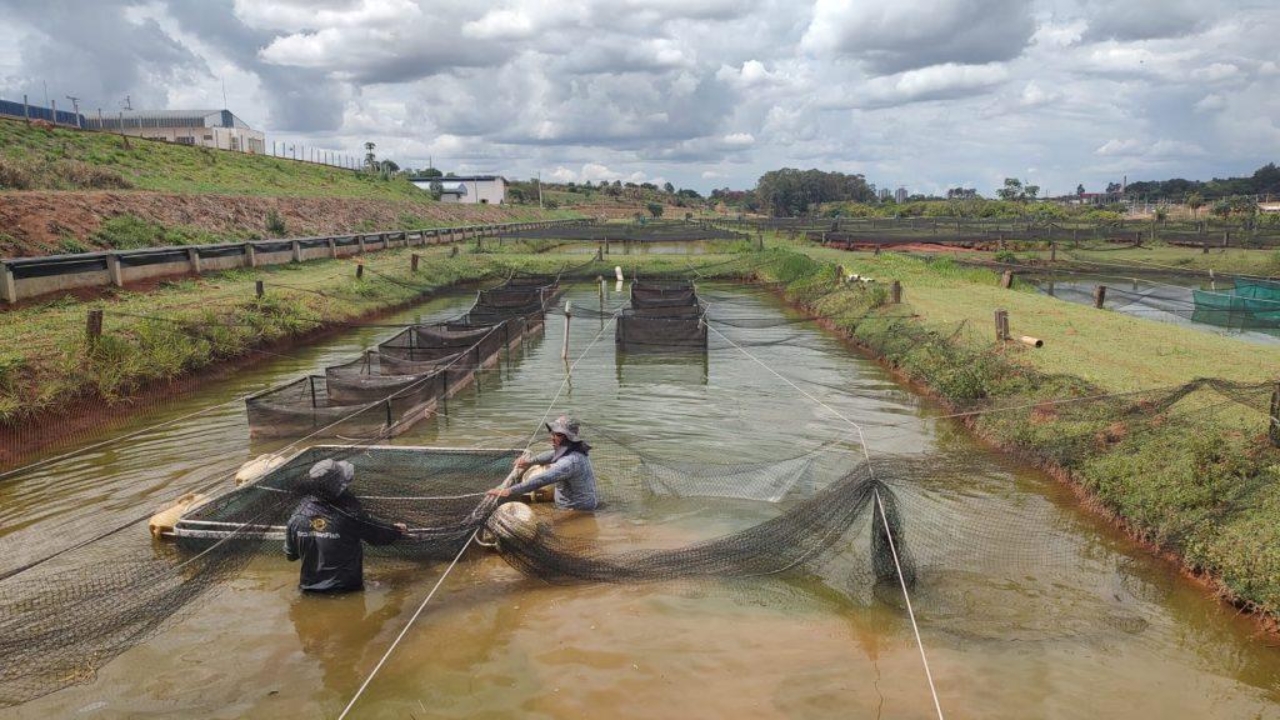
The turnaround did not happen by chance. Surveys by Peixe BR indicate that national fish farming surpassed for the first time the mark of 1 million tons of farmed fish in 2025, reaching 1,011,540 tons. In a decade, the sector advanced 58.6%, consolidating a transformation that is already changing the landscape of various producing regions.
-
Producer receives news and had to cull almost the entire herd, bounced back with the help of compensation, and is now producing 450 liters of milk per day in SC.

-
Quail Eggs Reveal a “Secret Code” on Their Shells Explaining Unique Patterns and Colors

-
Rare Tropical Fruit Canistel, with Egg Yolk Color and Caramel Flavor, Gains Interest from Researchers and Small Producers in Brazil
-
Brazilian Farmers Develop Wheeled Metal Lever to Ease Cassava Harvesting Without Heavy Machinery


The number is striking because it shows that farmed fish has moved from the periphery of agribusiness and entered a new phase. Once seen by many as a complementary activity, fish farming now competes for space in debates about productivity, export, genetics, animal nutrition, processing, and food safety.
The big star of this change is tilapia, a species that dominates Brazilian tanks and has become a symbol of expansion. In 2025, 707,495 tons were produced, equivalent to about 70% of all farmed fish in the country.
Tilapia takes off and becomes the queen of the tanks
Few proteins have grown so much in such a short time. The production of tilapia in Brazil advanced 148.2% in ten years, rising from a level that the sector describes as close to 280 thousand tons to more than 700 thousand tons annually.
This leap helps explain why many already call tilapia the “water ox”. The comparison is strong, but it makes sense in the agro imagination: it is a protein with a fast cycle, increasing presence on the consumer’s table, a production chain in professionalization, and potential to gain industrial scale.
Another point that draws attention is the return time. In well-managed systems, tilapia can reach commercial weight in a few months, making the activity attractive for producers seeking a faster turnover of invested capital.
Brazil has already moved from promise to power
The progress also appears in official data. The IBGE recorded a growth of 10.3% in fish production in 2024, when the country reached 724.9 thousand tons and moved R$ 7.7 billion just in fish production. Tilapia accounted for 68.9% of this volume.
The regional concentration shows where this revolution has already gained scale. Paraná appears as a tilapia powerhouse, accounting for 38.2% of the national production of the species in 2024, with 190.5 million kilos. The result reveals how well-structured production hubs can transform a previously scattered activity into a robust agro-industrial chain.
The country also stands out in the global scenario cited by the sector, occupying the fourth place among the major producers. The ambition now is even greater: to transform Brazil into a heavyweight global competitor in cultivated fish.
The billion-dollar dispute also has risks
But the accelerated growth does not come without pressure. An investigation by AgFeed showed that the sector expects a new advance of 10% and is already discussing challenges such as external tariffs, international competition, and imports of tilapia fillet from Vietnam.
This is a sensitive point. Representatives of the chain claim that the imported product can arrive in Brazil up to R$ 6 per kilo cheaper, creating a direct competition with national producers. For an activity that invests in feed, health, genetics, energy, labor, and processing, this difference matters.
At the same time, exports show that there is space outside the country. In 2025, Brazilian fish farming reached US$ 60 million in external sales, with an increase of 2% in value. The number is still small compared to other agricultural proteins, but it indicates an open door for Brazilian fish to gain new markets.
The new agro may be underwater
Brazilian fish farming is experiencing a rare moment: it is growing in domestic consumption, attracting capital, expanding scale, improving technology, and beginning to compete in foreign trade. The combination of affordable protein, fast cycle, and technical production helps explain why the sector has started to be observed with such attention.
The big challenge now is to transform this progress into a stronger chain, capable of competing with imports, winning new consumers, and adding value to Brazilian fish. This involves modern slaughterhouses, branding, logistics, health, credit, and greater presence in supermarkets.
What once seemed like a rural niche now approaches a new frontier in agriculture. If Brazil built its export strength with beef, chicken, soy, and corn, the next surprise may come from the tanks. Fish farming no longer seems just a promise. It is beginning to behave like a new billion-dollar giant in Brazilian agribusiness.