Portuguese
  Spanish


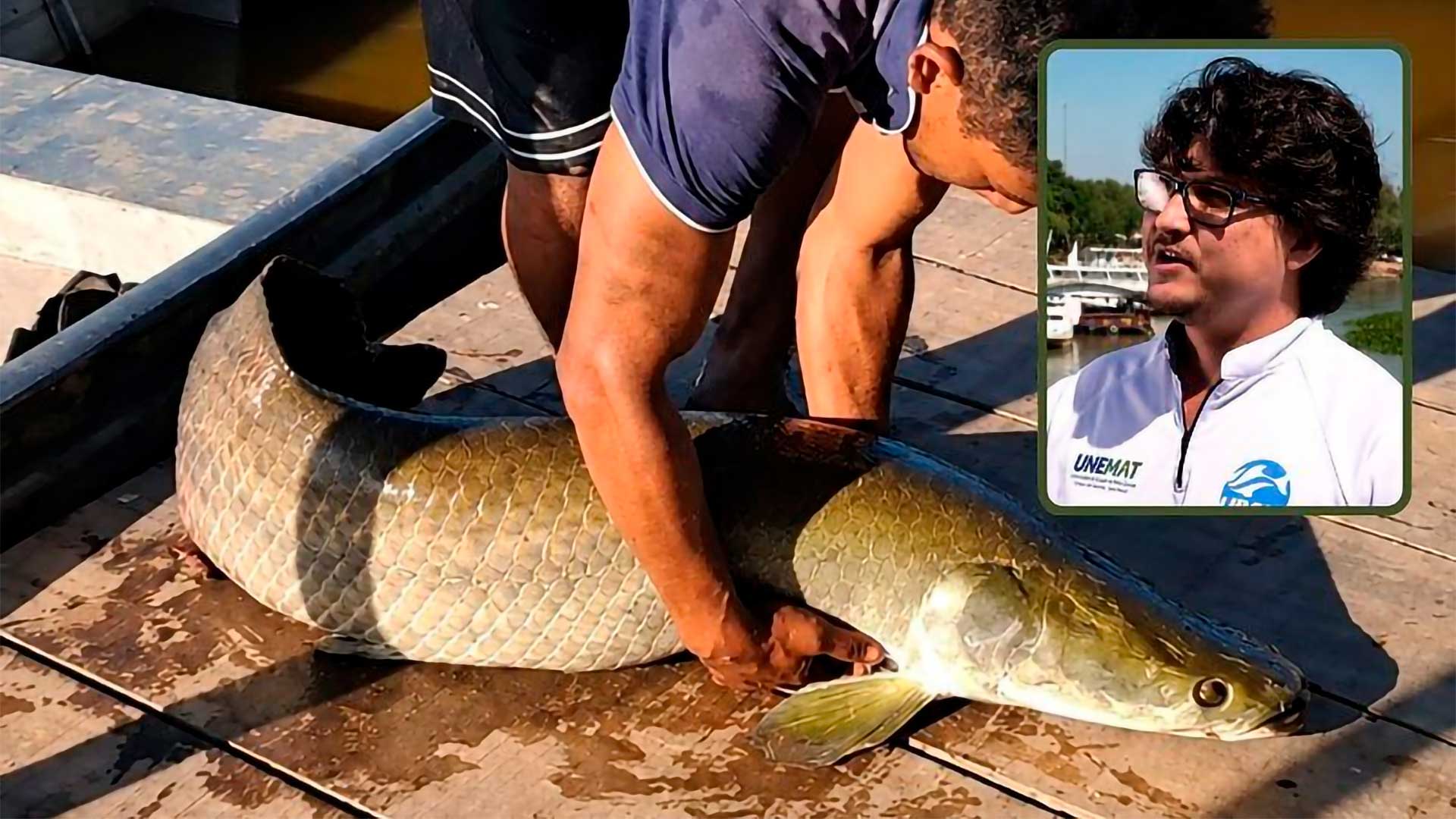

The appearance of species like pirarucu and tucunaré in the Pantanal raised an alert about failures in fish farming, floods in tank areas, and the risk of ecological imbalance in the Upper Paraguay Basin
The capture of a pirarucu in the Paraguay River, in Cáceres, Mato Grosso, reignited an old concern among Pantanal researchers. The fish, typical of the Amazon region, does not naturally belong to the Upper Paraguay Basin and may pose a risk to native species.
The case gained momentum after experts pointed out that the presence of the animal should not be seen as an isolated episode. It would be part of a larger process, linked to fish farming in tanks without sufficient control, floods in vulnerable areas, and the clandestine release of species for sport fishing.
According to information from Unemat, on June 8, 2026, researcher Derick Victor de Souza Campos, from the Northern Pantanal Environmental Investigation Laboratory, relates the invasion of exotic species to a problem that has been developing since the early 2000s. The alert involves pirarucu, tucunaré, tambaqui, and hybrids that can alter the Pantanal’s food chain.
-
400 km² of Greenhouses in Almería, Spain, Astonish American Visitor by Producing Millions of Tons of Produce for Cold-Weather Markets

-
Antarctic Volcano Emits Microscopic Gold Particles That Travel Up to 1,000 Kilometers Across the Continent
-
Little-known Japanese factory is the world’s largest zipper manufacturer, producing 7 billion pieces annually and closing half the world’s pants.

-
Brazilian Factory Recycles One-Third of the Country’s Styrofoam Waste, Matching European Levels with 51,000 Tons Reused Since 2007


The situation raises an uncomfortable question for fishermen, producers, and environmental agencies. To what extent can fish farming without traceability and catch-and-release of invasive species compromise one of Brazil’s most important biomes?
The capture in the Paraguay River put the Pantanal on alert
The pirarucu was captured in the Paraguay River, in Cáceres, on June 2, 2026, in an episode that quickly drew attention for involving a large fish outside its natural area. According to a report by Primeira Página, the animal was caught by a local fisherman and ended up being returned to the river.
This detail increased environmental concern because experts argue that invasive exotic species should not be released again when captured in areas where they do not belong. In the case of the Pantanal, the risk lies in these fish’s ability to prey, compete for food, and reproduce in environments where native fish have not evolved to face them.
The pirarucu, scientifically known as Arapaima gigas, is recognized as one of the largest freshwater fish on the planet. According to National Geographic Brazil, the species can reach large dimensions and naturally lives in rivers, lakes, and flooded areas of the Amazon Basin, which reinforces the alert when it appears in the Paraguay River system.
Tanks in Flood-Prone Areas Help Explain the Invasion of Exotic Fish
The introduction of species from other basins into the Pantanal is directly related to the expansion of fish farming without adequate infrastructure in flood-prone areas. Since the 2000s, according to researchers interviewed by Unemat, many tanks have been installed in regions vulnerable to floods, without barriers strong enough to contain the fish during extreme events.
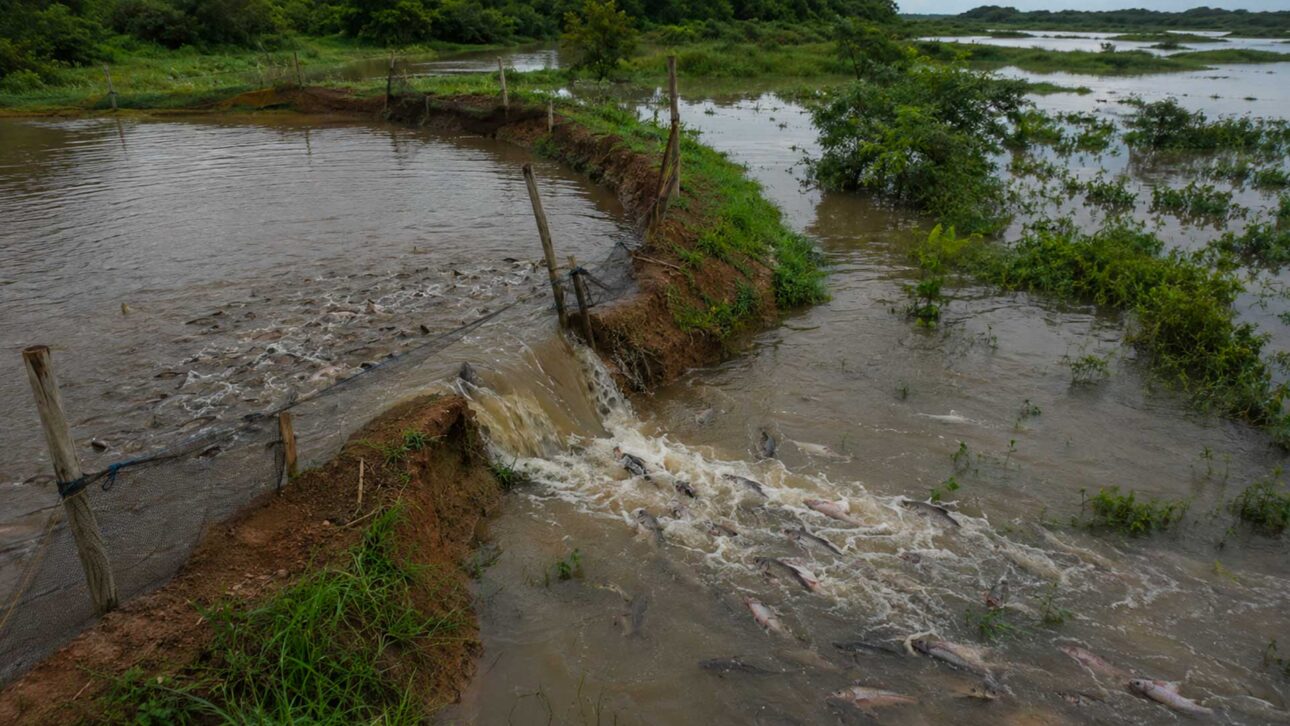
When a flood breaks or overflows these tanks, the fish raised in captivity can escape into streams, marginal lagoons, and rivers connected to the Upper Paraguay Basin. From there, control becomes much more difficult because the Pantanal functions as a living network of waters, with channels and floodable areas that connect at certain times of the year.
The problem is not limited to the pirarucu. Species like tucunaré, tambaqui, tambacu, tilapia, and pirapitinga also appear on watch lists when they are outside their natural area. Some are economically valued but can exert intense pressure on native fish when they escape into open environments.
Another factor cited by specialists is the clandestine release of fry to create recreational fishing spots. This practice may seem harmless to those looking to attract sport fish, but it alters the natural composition of environments and creates populations that are difficult to eliminate once established.
Predators with Biological Advantage Can Disrupt the Food Chain
The ecological risk increases because some exotic species have reproductive and behavioral advantages over native fish of the Pantanal. The pirarucu and tucunaré, for example, exhibit parental care, meaning they protect eggs, larvae, and young for longer.
This behavior improves the survival of the young and accelerates the occupation of new environments. In comparison, several native species of the Pantanal rely on reproductive strategies linked to the flood pulse, releasing eggs at specific times and becoming more exposed to predators in the early stages of life.
In practice, this can reduce the supply of traditional species for fishing, affect the balance between predators and prey, and change the dynamics of lagoons and streams. The tucunaré, being an efficient predator, can feed on small native fish and compete for space with species already under pressure from drought, changes in water regimes, and environmental degradation.
There is also concern about hybrids, such as the tambacu, resulting from the crossing of commercially interesting species. When these animals reach natural rivers, they can compete for food and interfere with the reproductive processes of local fish, creating a problem that goes beyond the simple presence of a fish out of place.
The health risk is concerning because diseases can arrive with the fish
Besides ecological competition, there is a less visible and equally important risk. Fish coming from hatcheries without sanitary control may carry pathogens, fungi, parasites, and other agents capable of affecting native populations.
This type of impact is difficult to predict because local species may not have natural resistance against organisms brought from other environments. In a biome connected by floods and ebbs, a disease introduced at one point can spread more easily to lagoons, bays, and streams.
Rule guides capture and transport of invasive species in Mato Grosso
The official response to part of the problem appears in Resolution No. 02/2024 of Cepesca of Mato Grosso. According to the regulation, published in March 2024, the capture and transport of exotic fish are authorized in the hydrographic basins of the Paraguay, Amazon, and Araguaia-Tocantins in the state, except during the closed season.
The resolution defines as exotic the fish whose occurrence is not natural in that basin or river, including allochthonous, hybrid species, or Brazilian ichthyofauna that cause negative interference in native populations. In the list of the Upper Paraguay Basin appear, among others, blue peacock bass, yellow peacock bass, tambaqui, tambacu, tilapia, pirapitinga, and pirarucu.
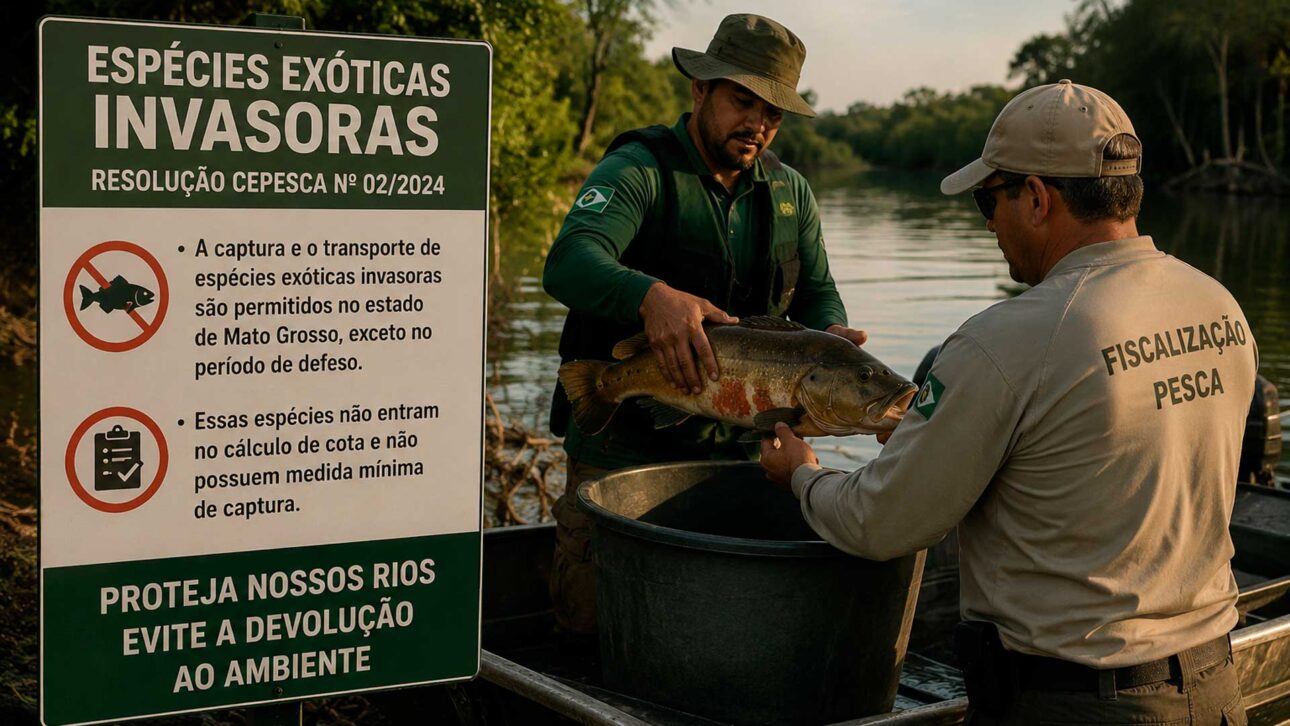
Another important point is that these specimens are not included in the quota calculation nor depend on minimum size when captured under the conditions provided by the rule. The logic is simple. If the fish represents a risk by being out of its natural area, returning it to the river could worsen the problem.
Even so, the measure creates conflict with some sport fishing practitioners, especially those who follow the catch and release philosophy. In the case of native species, this practice may have conservation value. In the case of invasive species, however, experts state that returning them to the environment helps maintain and expand the invasion.
Prevention may be more efficient than trying to remove fish later
Controlling invasive species in natural environments is expensive, time-consuming, and often limited. Once the fish spreads through bays, lagoons, and connected rivers, removing all specimens becomes practically impossible.
Therefore, prevention takes a central role. According to the Ministry of the Environment, the National Strategy for Invasive Exotic Species aims to guide actions to prevent introduction and dispersion, reduce impacts on Brazilian biodiversity, and control or eradicate species when possible.
In the case of the Pantanal, this involves monitoring tanks, stricter environmental licensing, controlling the purchase and sale of fingerlings, and tracking production. It also involves preventing the installation of fragile structures in flood-prone areas and encouraging the farming of native species with commercial value, such as pacu, pintado, cachara, and dourado.
The discussion is especially sensitive because it involves economy, fishing, regional tradition, and environmental conservation. Fish farming can generate income, but without planning, it can transfer the ecological cost to rivers and communities that depend on the natural balance of the Pantanal.
Pantanal faces pressure that goes beyond a giant fish
The image of an arapaima in the Paraguay River draws attention due to the size of the animal, but the real problem is less visible. The risk lies in the formation of stable populations of invasive fish in a biome that depends on delicate relationships between floods, ebbs, reproduction, and migration of native species.
The Pantanal already suffers from changes in water regime, fires, silting, agricultural pressure, and alterations in spring areas. The arrival of predators from other basins adds another layer of pressure on a system that needs balance to maintain its natural productivity.
In the medium and long term, professional fishermen, riverside communities, fishing tourism, and biodiversity itself may be affected. If invasive species reduce stocks of native fish, the impact ceases to be only environmental and starts to have economic and social repercussions.
The warning left by the arapaima case is clear. The Pantanal not only needs to react when a giant fish appears on the hook but to prevent poorly planned tanks, clandestine releases, and lack of control from turning exceptions into routine.