Portuguese
  Spanish


Discover The History Of The Flatiron Building, The Iconic Skyscraper That, With Its Unique Shape, Became An Emblem Of New York’s Landscape And Innovative Spirit.
In the early 20th century, the Flatiron Building emerged in New York. Originally called the Fuller Building, its unique triangular shape quickly set it apart. The silhouette, resembling the bow of a ship, turned it into one of the city’s most recognizable symbols. This article explores the genesis and cultural impact of this architectural landmark.
The Rise Of The Fuller Building
New York was bustling at the beginning of the 20th century. Urbanization and prosperity fueled a “skyscraper race.” Companies sought prestige with tall and impressive buildings. In this setting, the Fuller Company of Chicago, under the direction of Harry S. Black, planned its new headquarters. The goal was to create a new commercial district to the north of Wall Street. The building would be named Fuller Building, in honor of George A. Fuller, the founder of the company.
The chosen site was unique: a triangular plot at the confluence of Fifth Avenue, Broadway, and 22nd and 23rd Streets. Popularly, the lot was already called “Flat Iron” due to its shape. Daniel H. Burnham, of D.H. Burnham & Co., assisted by Frederick Dinkelberg, was the commissioned architect. Completed in 1902, the public nicknamed it the “Flatiron Building.” The shape of the lot dictated a dramatic and memorable architecture, different from the rectangular buildings of the time. The choice of a Chicago architect and a bold vertical design represented a statement of modernity.
-
The day Japan crossed the Pacific, took two icy islands in Alaska, and put the United States on full alert in World War II.

-
Son of farmers, he started at the age of 12 working in a pharmacy in the countryside of Paraná, saw his partner declare the company “bankrupt” and leave, and today he runs a supplement brand present in 83,000 pharmacies, investing R$ 67 million towards R$ 500 million.

-
From a motorcycle sold for R$ 146 million: he used to blend açaí in his home kitchen, left informal work, and now runs a network of 140 stores in 12 states.

-
He almost went bankrupt during the pandemic and drove his own delivery truck to keep the ice cream shop open, created the “ice cream wholesale” and now sells 1.3 million popsicles per month starting at R$ 1, with 32 stores and a goal of R$ 100 million.


The Nautical Metaphor: Design And The Iconic “Bow”
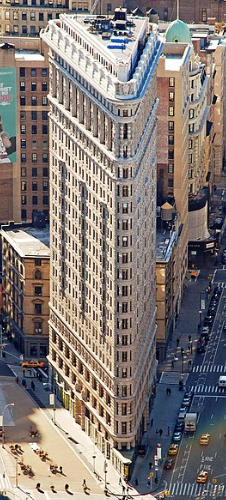
The design of the Flatiron is a direct response to the triangular site. Burnham maximized the use of the “odd-shaped lot.” The northern vertex, where the facades converge, is only about 2 meters wide. This tapered end, standing at 87 meters tall, is crucial to its nautical analogy.
Stylistically, the Flatiron combines Beaux-Arts with the Chicago School. The Beaux-Arts influence is seen in the tripartite organization of the facade (base, body, capital) and in the rich ornamentation with limestone and terracotta. Burnham conceived it as a “vertical Renaissance palazzo.” The Chicago School influence appears in the structural expression and strong verticality, rising directly from the street, unlike other skyscrapers.
Its northern vertex, the “bow,” defines its identity. The New York City Landmarks Preservation Commission, in 1966, compared it to “a great ship sailing down the Avenue.” H.G. Wells, in 1906, admired “the bow of the Flat-iron Building… cutting through traffic.” Alfred Stieglitz saw it “move… like the bow of a monstrous ocean steamship.” The building is covered in ornamentation, creating a tension between modern form and traditional decoration. The analogy of the “ship bow” suggests movement and progress, aligning with the energy of New York.
Building The Skyscraper
The construction of the Flatiron in New York demonstrated the engineering brilliance of the time. It utilized a steel skeleton structure, a revolutionary concept. This allowed for height and stability on the narrow site. The construction was rapid, with a new floor erected each week.
The slender profile posed challenges, especially against wind forces. Engineers Purdy and Henderson implemented a robust steel bracing system. It was designed to withstand winds four times greater than expected. This addressed concerns about the building’s stability.
Despite the solid engineering, the Flatiron faced skepticism. Many feared its collapse. It earned the nickname “Burnham’s Folly.” Newspapers speculated about a “dangerous wind tunnel effect.” The New York Tribune called it a “sliver of mean pie.” The New York Times considered it a “monstrosity.” There were complaints about cramped offices and lack of women’s bathrooms. However, the structure proved strong. The controversy increased its notoriety, transforming it from “folly” into an icon.