Portuguese
  Spanish


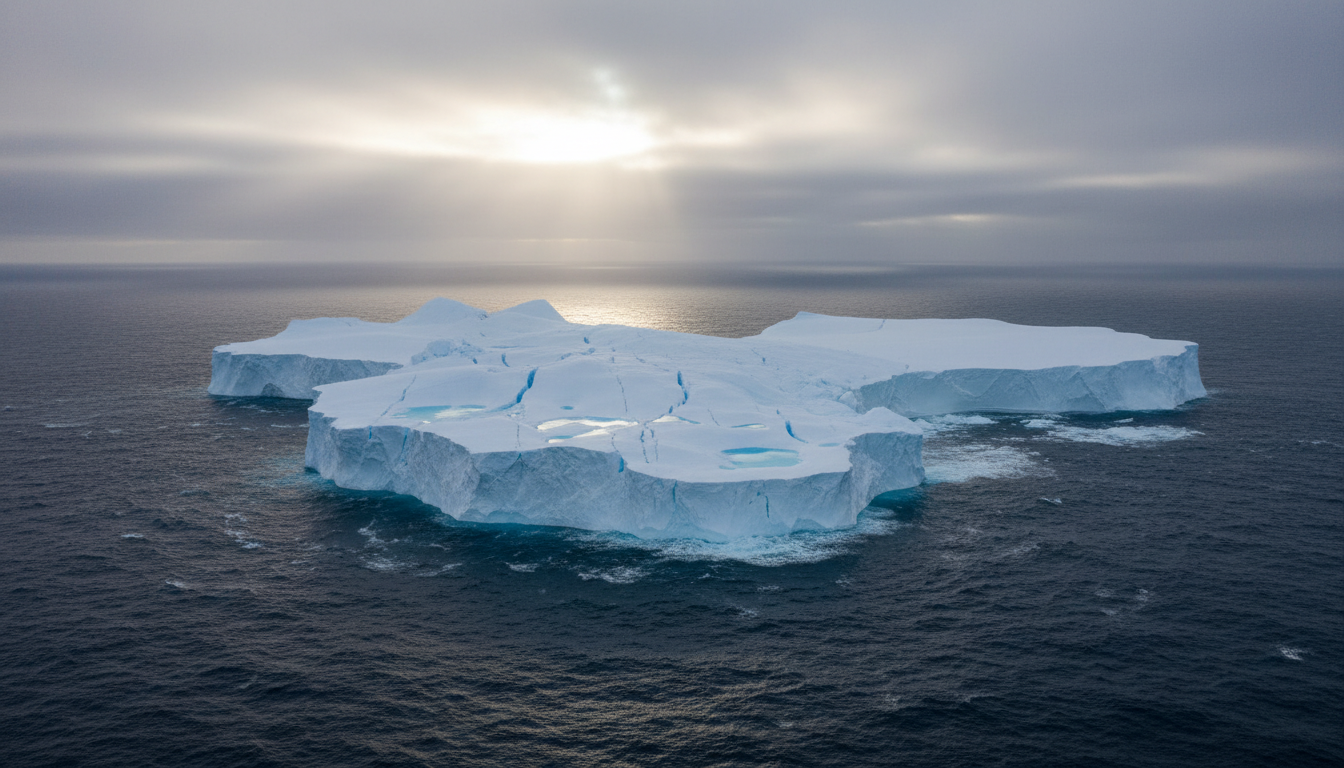

The world’s largest iceberg lost 99% of its mass in four years: the A-23a went from 6,000 square kilometers in 2020 to just 170 square kilometers on March 27, 2026, according to NASA’s Earth Observatory.
The iceberg A-23a broke off from the Filchner-Ronne ice shelf in Antarctica in 1986 and remained anchored in the Weddell Sea for almost 34 years.
According to the NASA Earth Observatory, the block began to move freely in 2020.
According to the European Copernicus program, in January 2026 the iceberg still had 1,182 square kilometers.
-
14-Year-Old Girl Develops Solar-Powered Water Purification System for India, Eliminating Need for Electricity or Chemicals

-
Forgotten Canadian Machine Harnessed Waterfall Power to Supply Mines with Compressed Air for 70 Years Without Motors or Electricity
-
Berries, Strawberries, and Blueberries Could Transform Agriculture in Northeastern Brazil, New Tests Reveal

-
Danish Resident Discovers Six Viking Gold Bracelets Weighing 762.5 Grams, Third Largest Gold Treasure in Denmark



Later, in March 2026 the area dropped to just 170 square kilometers.
In other words, the block that was once larger than the city of São Paulo is now smaller than the municipality of Cubatão.
On the other hand, fragments of the A-23a continue to drift between South Georgia and South America.
The history of iceberg A-23a spans from 1986 to its final disintegration in 2026
In August 1986, the A-23a broke off along with two other icebergs (A-22 and A-24) from the Filchner-Ronne shelf.
The three blocks totaled 11,500 square kilometers at the time of the glacial calving.
According to the British Antarctic Survey, the A-23a soon ran aground on the bottom of the Weddell Sea due to its 350-meter draft.
According to glaciologists, the block remained immobile until 2020, when it began to drift slowly.
In 2024, the A-23a entered a counterclockwise rotation due to a Taylor column.
As a result, it kept spinning in the same spot between the Antarctic continent and the South Orkney Islands.
The historical dimensions of iceberg A-23a since calving
According to the United States National Ice Center, the A-23a was 4,000 km² when it separated from the shelf.
In 2020, after losing edges for decades, it still measured 4,029 km².
According to ESA measurements, in August 2025 it dropped to 3,500 km² after shedding the A-23c piece.
In September 2025 it lost more of the A-23d and was left with 2,000 km².
In January 2026, 1,182 km² remained after the detachment of the A-23e.
Later, in March 2026 the giant reached the current 170 km².
- 1986: 4,000 km² (calving from Filchner-Ronne)
- 2020: 4,029 km² (begins to drift freely)
- Jan/2026: 1,182 km² (after losing A-23c, A-23d, A-23e)
- Mar/2026: 170 km² (99% drop in 4 years)
- Original draft: 350 meters below sea level

The intense blue color indicates that iceberg A-23a is in final disintegration
In January 2026, Copernicus satellites recorded an intense blue coloration on the block’s surface.
According to glaciologists, this indicates the accumulation of meltwater in the depressions on top of the iceberg.
According to the Earth Observatory, the blue water absorbs more solar radiation and accelerates melting from above.
Firstly, this effect is rare in Antarctic icebergs due to the extreme cold.
Secondly, the A-23a entered water at 3°C, enough to melt the block quickly.
Therefore, experts project complete dissolution in the coming weeks, still in May or June 2026.
The ecological impact passes through South Georgia and threatens king penguin colonies
South Georgia Island is home to 450,000 king penguins, the largest colony in the world.
According to the British Antarctic Survey, the approach of the A-23a in 2025 changed the penguins’ feeding routes.
According to the Royal Society, leopard seals and humpback whales also altered behavior in the region.
On the other hand, the final drift of the block will release nutrients for the local phytoplankton.
As reported by the BBC, the melting releases iron and silicon accumulated in the block for 40 years.
Subsequently, the increase in phytoplankton can benefit krill and the regional food chain.

The shrinking of the A-23a opens maritime routes and alters tanker traffic
The Weddell Sea was blocked for commercial navigation because of the block four years ago.
According to the IMO, now 27 alternative routes have become viable again.
In other words, research ships and cargo ships can resume access to Chilean and Argentine ports.
According to the Brazilian Navy, the Brazilian Antarctic Program (Proantar) uses the region with research aboard the ship Almirante Maximiano.
Similarly, the Argentine and Chilean Navy fleets resume exercises in the area.
On the other hand, some warn of the risk of small fragments still drifting in 2026.
The CPG collection covers Antarctic melting and its impact on sea level
The CPG recently published about Antarctic melting and ocean levels, in the site’s collection.
Subsequently, the site also published an analysis of Arctic maritime routes and world trade, with data from the IMO.
In other words, the saga of the A-23a is a chapter of a large-scale climate transformation.
On the other hand, some scientists argue that the calving is part of a natural cycle of centuries.
Next steps: the A-23a is expected to disappear completely by July 2026
Firstly, what remains of the block will continue drifting north.
Next, the warmth of tropical waters will melt the rest in a few weeks.
Finally, fragments below 10 km² lose the status of a giant iceberg and stop being tracked.
However, some point out that remaining pieces may reach the Cape of Good Hope before dissolution.
Nevertheless, most should disappear in the coming weeks. Still, the A-23a enters history as the iceberg that lasted 40 years and disintegrated by 99% in its last year of life.