






 Portuguese
  Spanish
  5 min of reading
  0 comments


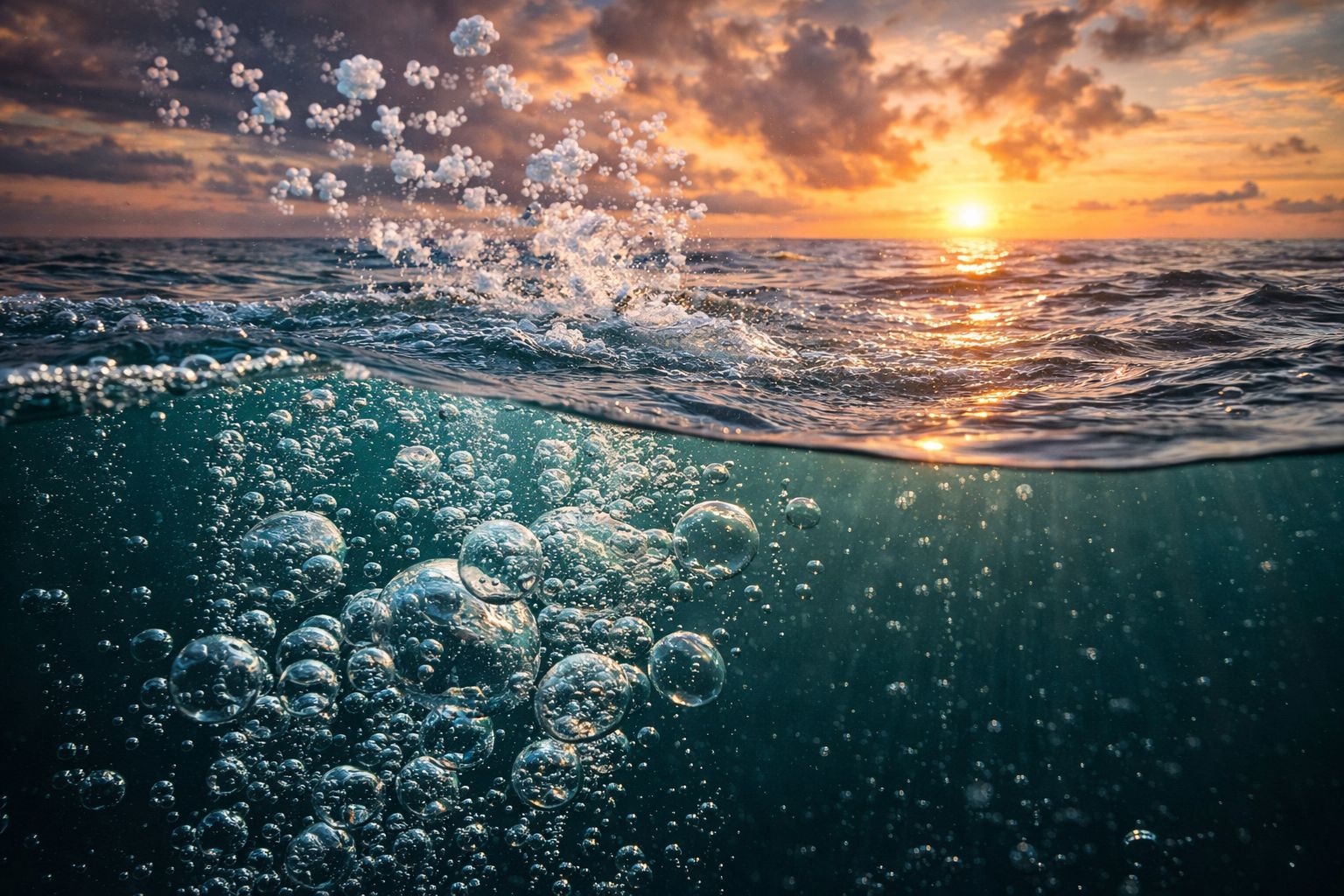
Researchers at the University of Rochester discovered why oxygen-rich surface waters produce methane, a mystery that has intrigued science for years. The answer lies in bacteria that decompose organic matter when phosphate is lacking. With global warming reducing nutrient mixing, methane production may increase, creating a climate feedback loop not yet included in current models.
For years, the methane released from the ocean’s surface has been one of the most persistent mysteries in climate science. Surface waters contain abundant oxygen, and methane is typically produced in low-oxygen environments, such as swamps and deep ocean sediments. So where was the methane consistently coming from that the sea surface was releasing into the atmosphere? Researchers at the University of Rochester, led by Professor Thomas Weber, published the answer in the Proceedings of the National Academy of Sciences: certain bacteria produce methane by decomposing organic matter when there is a shortage of phosphate, an essential nutrient. And the alarming part is that global warming is creating exactly the conditions that make these bacteria produce more methane.
The discovery has implications that go far beyond scientific curiosity. Methane is an extremely potent greenhouse gas, capable of warming the atmosphere dozens of times more than CO₂ over short time scales. If the ocean is becoming an increasing source of methane as it warms, the planet enters a dangerous feedback loop: warmer oceans produce more methane, which further warms the atmosphere, which heats the oceans even more. This cycle, researchers warn, is not yet included in most climate models that governments use to plan their environmental policies.
The mystery of methane coming from oxygen-rich waters
The contradiction that intrigued scientists was simple to state and difficult to resolve. Methane is typically produced by microorganisms that live in anaerobic environments, that is, without oxygen, such as the bottoms of swamps, landfills, and deep ocean sediments. The surface waters of the ocean are the opposite of this environment: rich in oxygen, exposed to sunlight, and constantly stirred by winds and currents. They should not produce methane.
-
Helicopter Drops 180 Tons of Sand and Gravel on Swedish River to Revive Ecosystem Damaged by Decades of Exploitation

-
Brazilian Company Launches Retro Smartphone with 48 MP Camera, T9 Keyboard, and Privacy Features for Social Media-Free Use

-
Self-Taught Chinese Farmer Builds 5-Ton Submarine from Scrap, Launches It in Anhui River
-
Invisible Induction Technology Enables Wireless Power for Blenders, Coffee Makers, and Air Fryers, Reducing Countertop Cables




However, consistent measurements showed that these waters were releasing methane into the atmosphere. Scientists called this phenomenon the “oceanic methane paradox”, and for years the explanations were partial or unsatisfactory. Some suggested that the methane came from bubbles rising from the depths, while others proposed non-biological chemical mechanisms. Weber’s team decided to investigate using a global dataset and computational models that could test hypotheses on a planetary scale.
How bacteria produce methane at the ocean surface
The answer found by the researchers is elegant and concerning at the same time. Certain marine bacteria produce methane as a byproduct of the decomposition of organic matter, but this process only occurs when there is a scarcity of phosphate, an essential nutrient that is normally available in surface waters through mixing with deep waters. When phosphate is lacking, these bacteria activate an alternative metabolic mechanism that releases methane as a result.
“This means that phosphate scarcity is the main controlling factor for methane production and emissions in open water,” explained Weber. The discovery reshapes the way scientists think about methane in the ocean: instead of being a rare and localized phenomenon, methane production in oxygen-rich waters may be common in any region where phosphate levels are low. And this is where global warming comes in as a catalyst.
Why ocean warming increases methane production
The connection between ocean temperature and methane production involves the physics of vertical mixing of waters. Climate change is warming the ocean from the top down, which increases the density difference between warm surface waters and cold deep layers. The greater this density difference, the harder it is for the nutrient-rich deep water, such as phosphate, to rise and mix with the surface.
The result is predictable. With less vertical mixing, less phosphate reaches the ocean surface, creating increasingly favorable conditions for the growth of methane-producing bacteria, according to the model developed by Weber’s team. In a warming world, the ocean surface becomes progressively poorer in phosphate, which activates methane production on a planetary scale. With each degree of warming, the ocean not only absorbs less carbon but also begins to emit more methane.
The feedback cycle that could accelerate global warming
The most concerning implication of the discovery is the potential for a climate feedback cycle. Warmer oceans produce more methane, which is an extremely potent greenhouse gas, further warming the atmosphere, which in turn heats the oceans even more, producing even more methane. Each step of the cycle intensifies the next, creating a self-reinforcing spiral of warming that can be difficult to interrupt once it reaches critical mass.
Researchers are cautious to emphasize that the cycle still needs to be quantified more precisely. However, the fact that this methane production mechanism is not included in most climate models that governments and international organizations use to plan environmental policies is, in itself, alarming. If the models underestimate methane emissions from the ocean, the warming projections may be more optimistic than reality justifies.
Why this discovery about methane changes climate forecasts
Thomas Weber summarizes the importance of the study with a statement that connects marine microbiology to global climate policy. “Our work will help fill a fundamental gap in climate forecasts, which often overlook the interactions between environmental changes and natural sources of greenhouse gases in the atmosphere”, he stated. In other words, current models predict the future climate without considering that the ocean may become an increasing emitter of methane.
Incorporating this mechanism into climate models could significantly alter warming projections for the coming decades. If oceanic methane production increases as the team’s model suggests, the remaining carbon budget to limit warming to 1.5°C or 2°C may be smaller than imagined, which would make the goals of the Paris Agreement even harder to achieve. The ocean, which has always been considered an ally in combating climate change by absorbing CO₂ and heat, may be becoming part of the problem.
Scientists have discovered that the ocean produces more methane as it warms, creating a cycle that accelerates global warming. Do you think climate models need to be revised? Does this cycle concern you? Leave your opinion in the comments.





Be the first to react!