Portuguese
  Spanish


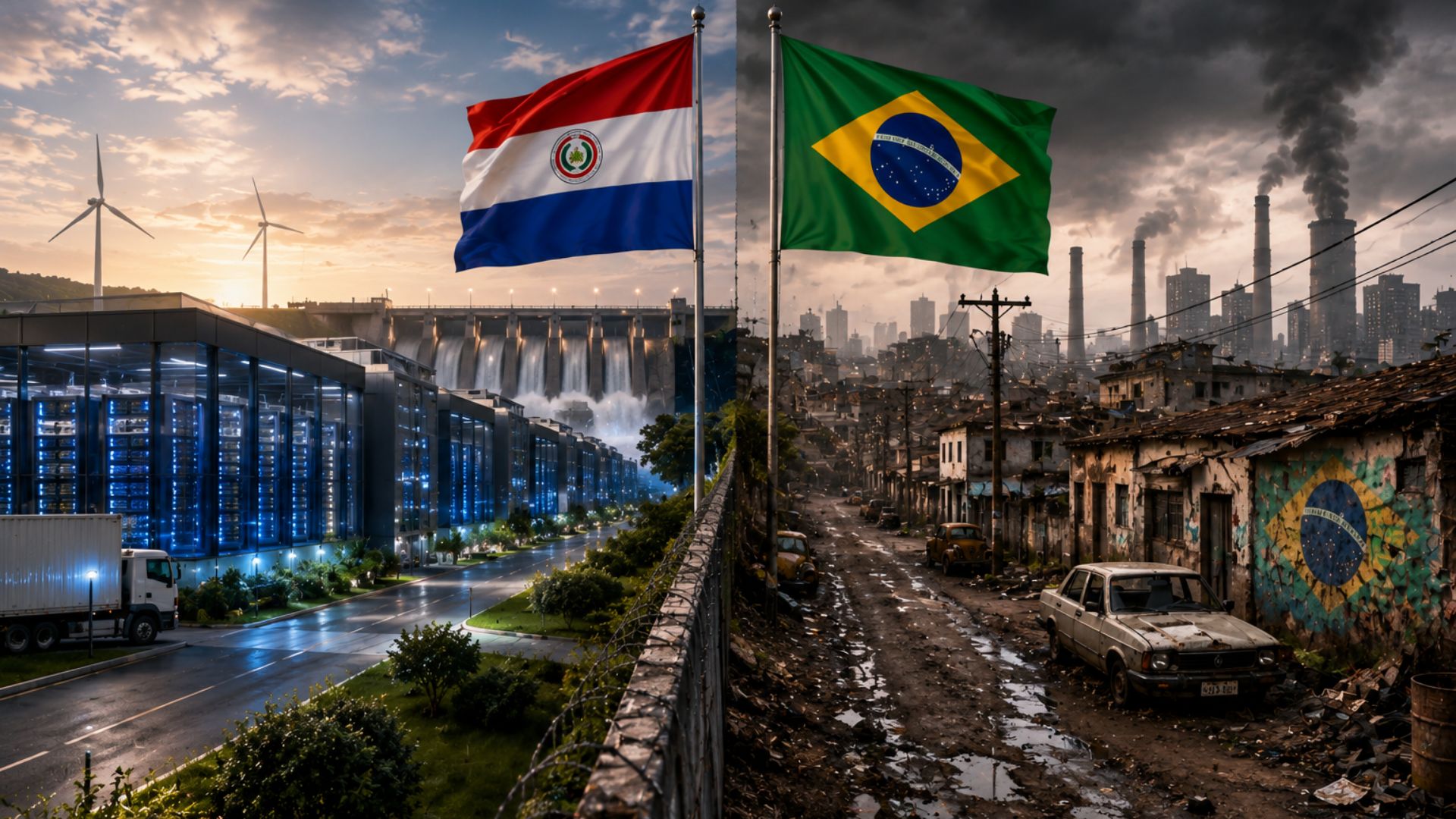

Cheap energy, reduced taxes, and industrial advancement place Paraguay at the center of the dispute for artificial intelligence data centers, while Brazil faces high interest rates, loss of competitiveness, and difficulties in transforming its energy potential into regional technological leadership.
By combining abundant hydroelectric energy, reduced tax burden, and macroeconomic stability, Paraguay has begun to occupy a growing space in the global race for artificial intelligence data centers, a scenario that has amplified international attention on the country in recent months.
In contrast to this movement, according to an analysis by the newspaper Folha de S. Paulo, Brazil still faces high interest rates, a relative loss of industrial participation, and difficulties in transforming its renewable matrix into a competitive advantage capable of attracting large technological projects.
At the heart of this strategy is Itaipu, whose clean energy production is no longer seen merely as a source of regional supply but has become a strategic asset for companies that depend on abundant electricity for artificial intelligence operations.
-
Swiss glaciers melting fast enough to fill an Olympic pool every 6 seconds, France confirms 3,700 heatwave deaths, and WMO predicts strong El Niño intensifying extremes until 2027

-
Sudden Sea Recession in São Paulo Sparks Tsunami Alert and Online Debate on Giant Wave Risks in Brazil

-
China Launches World’s First 307-Meter Floating Wind Platform to Supply Oil Rigs, Aiming to Cut 35,000 Tons of CO2 Annually
-
Japan Deploys Offshore Concrete Factory, Constructs Massive Caissons in 8 Days, Revolutionizing Port Construction with Industrial Efficiency


Itaipu energy boosts international interest
In May 2025, U.S. Secretary of State Marco Rubio stated in a U.S. Senate hearing that countries with energy surpluses, such as Paraguay, could attract AI-focused facilities.
The statement reinforced external interest in using Paraguayan energy for data-intensive processing operations.
This movement gained greater dimension after the announcement by X8 Cloud, a U.S.-based company, which revealed plans to develop an artificial intelligence data center project in Paraguayan territory with estimated investments of up to US$ 50 billion over three decades.
Although the value depends on future expansion stages, energy availability, and regulatory approvals, the initiative placed Paraguay in a prominent position in a regional dispute increasingly linked to the supply of clean, predictable, and cheap energy for AI operations.
Cryptocurrency strategy opened space for large data centers
Before targeting large data processing centers, Paraguay had already begun to attract operations related to crypto-asset mining, a sector known for its high energy consumption and the need for stable electrical infrastructure.
With this experience, the country began to test its energy and regulatory capacity to receive more robust computational infrastructure projects, while consolidating a simplified tax environment aimed at attracting foreign companies.
In this model known as “Triple 10”, reference rates revolve around 10% for corporate tax, personal income, and VAT, although certain activities have specific rules and tax exceptions.
Industrial model strengthens Paraguayan economy
In the industrial sector, progress also occurred through the maquila regime, a mechanism created to stimulate export-oriented companies and expand Paraguay’s integration into regional production chains in segments such as auto parts, food, textiles, and light manufacturing.
World Bank data indicates that manufacturing accounted for approximately 19% of Paraguay’s GDP in 2024, while in Brazil, the share was approximately 12.4%, widening the contrast between the two economic models.
Investment grade widens difference for Brazil
In addition to its energy and industrial strategy, Paraguay has also improved its international risk perception in recent years, a move that helped the country increase the confidence of foreign investors and reduce part of the cost of financing the economy.
Moody’s granted investment grade to the country in 2024, while S&P raised Paraguay’s sovereign rating to BBB- with a stable outlook in December 2025, although Fitch still maintained the classification one level below this threshold.
In Brazil’s case, the situation remained different, as the country continued without investment grade from the three main risk rating agencies and still faced doubts related to the fiscal scenario.
In May 2025, Moody’s maintained Brazil at Ba1, a rating below investment grade, and changed the outlook from positive to stable, citing fiscal difficulties and a worsening capacity to pay public debt.
This contrast directly influences the cost of capital, as Paraguay managed to operate with more controlled inflation and less restrictive monetary policy, despite the existing structural and scale differences between the two economies.
Economic growth reinforces technological advancement
Growth indicators also began to reinforce Paraguay’s narrative of economic advancement, whose estimated expansion of 6.6% in 2025 was driven mainly by domestic consumption, investments, agriculture, and energy generation.
For the following years, economic projections remained above the regional average, with an expected growth of around 4.3%, a performance superior to that observed in most South American countries.
Meanwhile, the International Monetary Fund projected growth of 2.3% for Brazil in 2025, a scenario accompanied by high basic interest rates, a condition that usually affects credit, private investments, and industrial expansion decisions.
Another indicator closely monitored by international organizations was the reduction of poverty in Paraguay, which fell from over 50% about two decades ago to approximately 16% in 2025, according to data released by the World Bank.
Brazil and Paraguay follow distinct economic paths
Despite the frequent comparison between the two countries, the difference in economic and population scale remains significant, as Paraguay has about 6 to 7 million inhabitants, while Brazil exceeds the 200 million mark.
In addition to a much larger consumer market, Brazil also boasts a more complex productive park, global companies, universities, and a predominantly renewable electricity matrix, factors that theoretically could enhance its technological competitiveness.
Even so, Paraguay began to market economic predictability, low operational cost, and clean electricity as central elements of a strategy focused on the digital economy, gaining ground in an international dispute related to artificial intelligence and the expansion of computational infrastructure.