






 Portuguese
  Spanish
 3 min of reading
  0 comments


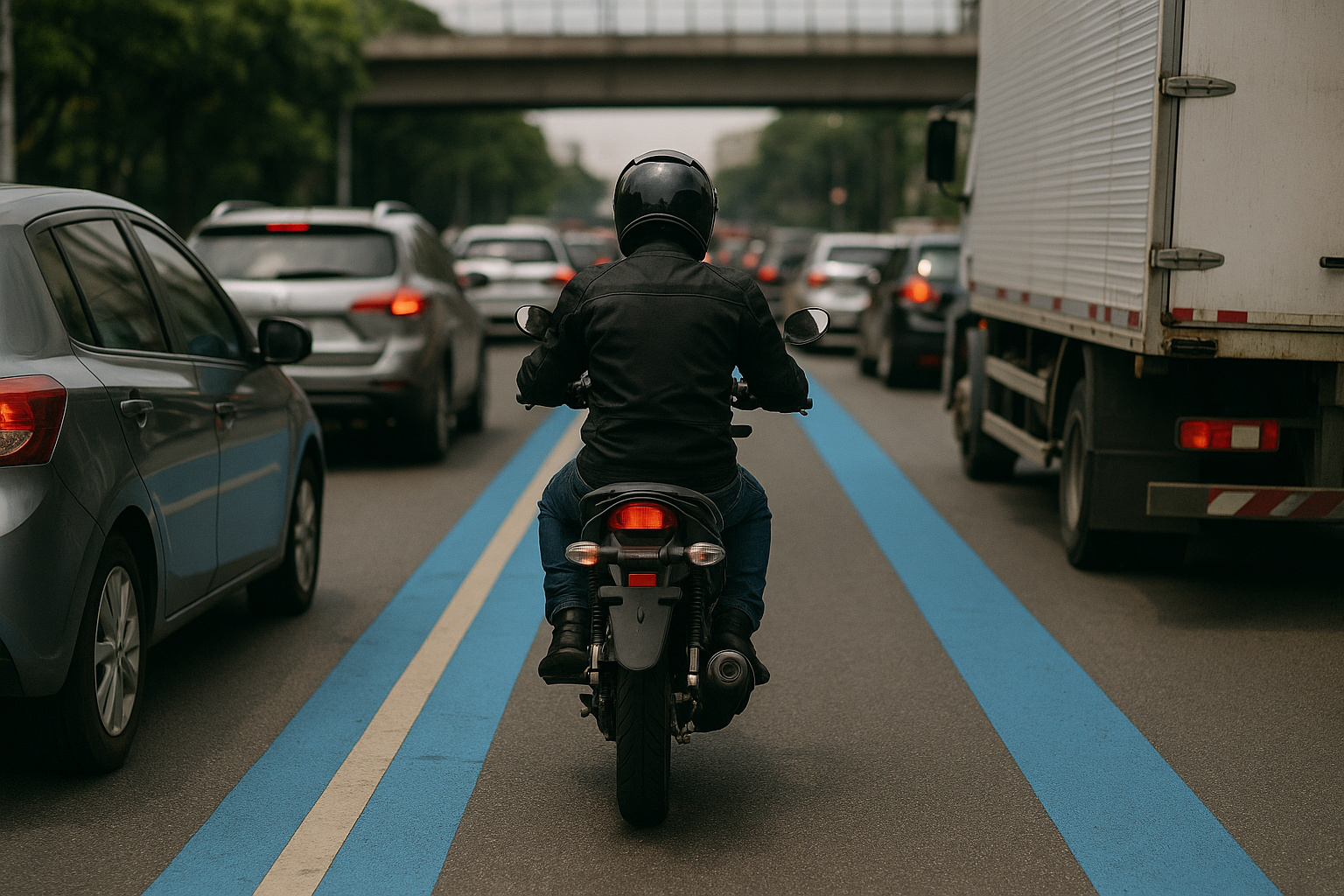
With Authorization from Senatran, Fortaleza Will Be One of the First Capitals in the Northeast to Test Blue Lanes for Motorcycles on Four Avenues by March 2026; Project, Created in São Paulo, Divides Opinions Among Technicians and Road Safety Experts
Fortaleza has begun preparations to test the so-called blue lanes, a structure that prioritizes motorcycle traffic in exclusive corridors between traffic lanes. The measure was authorized by the National Traffic Secretariat (Senatran) and is set to be implemented, on an experimental basis, by March 2026 on four main avenues in the capital of Ceará: Alberto Craveiro, Humberto Monte, Santos Dumont, and Presidente Costa e Silva.
The project, developed by the Traffic Engineering Company (CET) of São Paulo in 2022, aims to reduce the number of deaths and organize the flow of motorcycles, which often weave between vehicles. In São Paulo, initial results indicated a nearly 50% decrease in traffic deaths in 2024, according to CET data.


Experts Urge Caution and Point Out Risks of High Speed
Despite the optimism regarding the reduction of incidents, road safety experts warn that it is still early to claim that blue lanes are effective. According to technical evaluations, misuse by motorcyclists, especially speeding, can nullify potential benefits and increase the risk of collisions.
-
Driver who “holds” the left lane can receive a hefty fine and 4 points on their driver’s license even if they think they are going at the correct speed for the road.

-
São Paulo Government puts R$ 343 million on the table and releases 31 km of duplication, 9.84 km of third lanes, 4 reinforced viaducts, and 8 grade-separated returns.

-
Volvo FH 2026 truck automatically reduces speed in risk areas in Brazil with GPS, activates engine brake without driver intervention, and combines safety with aerodynamics capable of saving up to 3% of diesel in some operations.

-
A viaduct over 40 years old in a city in Minas Gerais was closed due to the risk of collapse, blocked routes for months, exposed maintenance failures, and now requires a R$ 1.7 million project to prevent a collapse in the urban heart for decades.



“Driver behavior is crucial. Many end up using the lane as if it were exclusive to motorcycles and travel at speeds above the limit, which can make the project dangerous,” explained Renato Campestrini, a traffic and mobility specialist.
According to an article published by Diário do Nordeste, the very regulatory project for the blue lane recommends its use only in slow or congested traffic, and not on free-flowing roads.
Structure and Technical Characteristics in Fortaleza
The blue lanes in Fortaleza will have a width between 1.1 and 1.2 meters, adjusted to the maximum permitted speeds on each road — 50 km/h or 60 km/h. They will be positioned between the left and middle lanes, following the standards set by Senatran.
The implementation will occur in the following sections:
- Avenida Alberto Craveiro: about 2.7 km each way;
- Avenida Humberto Monte: 1.6 km between José de Pontes and Rio Grande do Sul streets;
- Avenida Santos Dumont: 1 km, between Eng. Santana Júnior and Prof. Otávio Lobo;
- Avenida Presidente Costa e Silva: 4 km between Juscelino Kubitscheck and Godofredo Maciel avenues.
According to the Ceará State Department of Transit (Detran-CE), motorcycles represent 30.9% of the city’s fleet, and the number is expected to grow. In the first half of 2025 alone, there were 14.6 thousand new registrations, an increase of 29.08% compared to the same period the previous year.
Safety Data and Concerns About Impact on Statistics
A study conducted by Vital Strategies, in partnership with USP, UFC, and Instituto Cordial, analyzed 190 km of blue lanes in São Paulo and identified a 33% increase in incidents involving motorcyclists at intersections. Additionally, seven out of ten drivers exceeded the speed limit on roads with blue lanes — compared to only one in ten on roads without the structure.
For the national coordinator of road safety at Vital Strategies, Dante Rosado, the blue lane may create a false sense of security, diverting attention from more effective measures. “We cannot say that it reduces incidents. It is necessary to increase enforcement and treat the project as a test, not as a definitive policy,” he states.
The organization emphasizes that the experiment is unprecedented and must be monitored with more complex research, taking into account not only the number of deaths but also serious, minor injuries, and property damage.
What do you think, can blue lanes really reduce accidents and organize traffic in Fortaleza, or can high speed turn the proposal into another risk for motorcyclists?





Be the first to react!