






 Portuguese
  Spanish


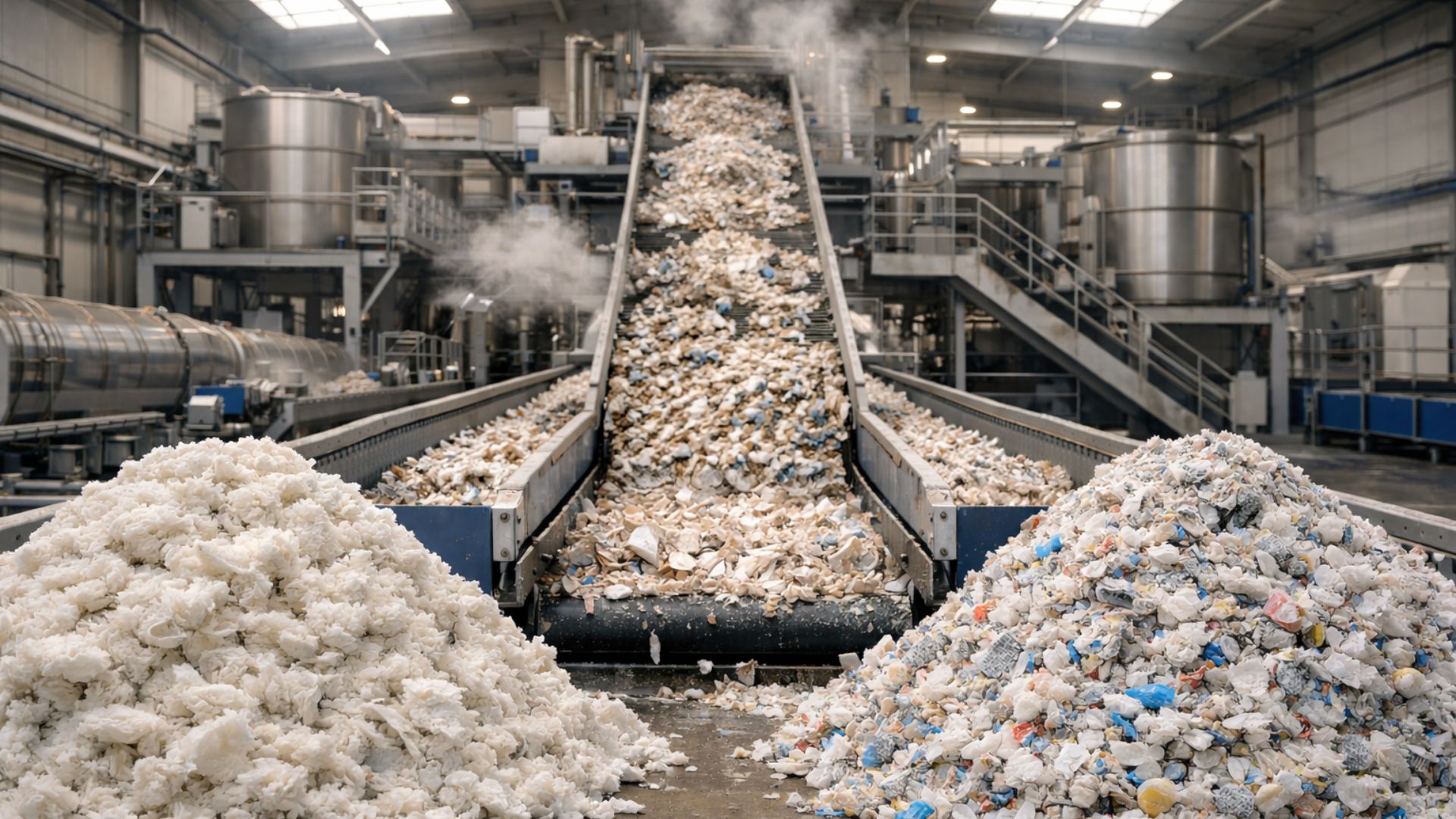


European Plant Transforms Disposable Diapers Into Industrial Raw Material While Testing Large-Scale Recycling, With Separation of Fibers and Plastics and Logistical Challenges Involving Collection, Sanitation and Market for Recovered Materials.
A demonstration plant in Europe was designed to process 70,000 tons per year of disposable diapers and incontinence products, separate materials such as fibers and plastics, and attempt to transform a waste historically destined for landfilling or incineration into industrial inputs.
In urban waste, diapers and pads often disappear in bags mixed with organic scraps and packaging, but the volume and moisture of this discard turn the subject into an infrastructure problem when the industry tries to treat it as raw material.
The central barrier is double and happens simultaneously: separating different layers of polymers and fibers with industrial quality, while processing needs to limit health and environmental risks related to the presence of fluids and organic matter.
-
Volcanic Soils from Destructive Eruptions Turn into Million-Dollar Crops: Ashes Nourish Grapes in Lanzarote, Bananas in the Canary Islands, Blood Oranges on Mount Etna, and Cacti in Mexico, Showcasing How Lava-Formed Lands Sustain Rare Harvests in Seemingly Barren Regions

-
In the Caucasus Mountains, a Community Preserves a Language So Rare Few Outsiders Can Understand It

-
Slovakia’s Ice Cave Holds Over 110,000 m³ of Frozen Wonders, Boasts Walls Up to 27 Meters Thick, and Was Among the First Electrified Caves Globally

-
Street Cleaner Accidentally Receives $200,000 Transfer, Returns Unexpected Fortune to Rightful Owner



Industrial Capacity and Scale of 70,000 Tons Per Year
In the LIFE program of the European Union, an old project on recycling diapers and incontinence materials reports that the demonstration plant, installed in Arnhem, Netherlands, was conceived with a capacity of 70,000 tons annually after analyses indicated that a smaller scale would not be sustainable.

This same report describes the typical composition of the treated flow as predominantly wet, with approximate percentages of water, wood fiber, plastic, and a smaller fraction of superabsorbent polymer, as well as contaminants, which helps explain why household sorting alone does not solve the problem.
When bringing this material to an industrial line, the project reports that it recovered a large portion of the fibers and all the plastic, with the water directed to biological treatment on-site, in an attempt to close the operational cycle.
Still, the report points out that part of the flow was not recovered and that research was ongoing to also recover the superabsorbent, showing that “recycling” this waste can mean recovering specific fractions, not necessarily everything.
Selective Collection and Sanitary Challenges in the Recycling of Absorbers
A plant of this size depends on continuous supply, which requires agreements with municipalities, operators, and institutional generators, as well as clear rules for storing and transporting a heavy, wet waste that is sensitive for workers and neighbors.
In practice, the material arrives with variations in brands, sizes, and compositions, and still carries different degrees of contamination depending on the source, which increases the pressure for standardization of what enters the factory to ensure predictability of what comes out.
Industry associations have insisted that the difficulty lies not only in the machine, but in the system, because the selective collection of absorbent waste involves public perception, hygiene, and cost, which often stalls projects even before they reach the “factory floor.”
In a 2023 report commissioned by EDANA, the consulting firm Ramboll estimates that hygiene absorbent product waste accounts for about 7.4% of urban waste in Europe and that recycling is still minimal, with only up to 0.2% treated sustainably.
Market for Recycled Fibers and Plastics
The transition from “waste” to “raw material” occurs when recovered fibers and plastics meet specifications, documentation, and regularity because buyers do not purchase environmental narratives, but rather a material with repeatable characteristics, traceable and with a defined industrial destination.
The LIFE project describes that the recovered fiber was marketed to the paper industry, while the plastic fraction, made up of common types like LDPE and PP, sought applications as plastic products, indicating that the value of the process depends on both the output and the input.
When this market does not consolidate, the economic risk appears quickly, and EDANA itself records that several initiatives mapped globally have been discontinued, partly due to limitations of technical maturity, insufficient economic data, and challenges with effluent treatment.
For this reason, companies and consortia advocating the industrial route tend to emphasize closed processes and sanitation stages, as the acceptance of recovered material goes through environmental and health standards, as well as licenses, oversight, and occupational safety.
New Plants and the Test of the Circular Economy at Real Scale
In July 2025, the city of Treviso, Italy, opened a demonstration plant linked to the EMBRACED project, funded by Circular Bio-based Europe, with the proposal to transform used diapers and other absorbents into secondary raw materials.
According to the European program’s announcement, the project claimed to have demonstrated the recovery of cellulose and plastics at the end of the work in 2022, and the scaled technology declares to meet environmental and health standards with certified steam sterilization.
This type of announcement helps shift the agenda from curiosity to industrial governance, because replication in other cities depends on collection contracts, regulatory stability, and operation engineering capable of handling odor, storage, and biological risk without improvisation.
At the same time, the sector recognizes that there is no “perfect solution” available to recycle absorbent waste in the short term with guaranteed technical and economic success, which keeps the discussion open between recycling, energy, and disposal.
If the challenge involves technology, collection, and market at the same time, what usually fails first in the place where you live: the organization to collect this separated waste, the capacity to process it safely, or the lack of buyers for the recovered material?





O passado nos mostra que e possível usar outros materiais no lugar de fraldas descartáveis e quanto ao uso de absorventes existem hoje tecnologias e produtos ecológicos, basta quererem utiliza Los .
Ao invés de eliminar o plástico de uma vez por todas da humanidade, estão querendo fazer as pessoas usarem mais lixos. É um absurdo como a ganância cresce em um ritmo acelerado, deixando a ética de lado e destruindo a população e a natureza. É lamentável.
É possível que aumentamos este poderio na reciclagem de fraldas, começando a fazer com que as fabricantes as recebam para o tratamento devido.