





 Portuguese
  English
  Spanish
  4 min of reading
  0 comments


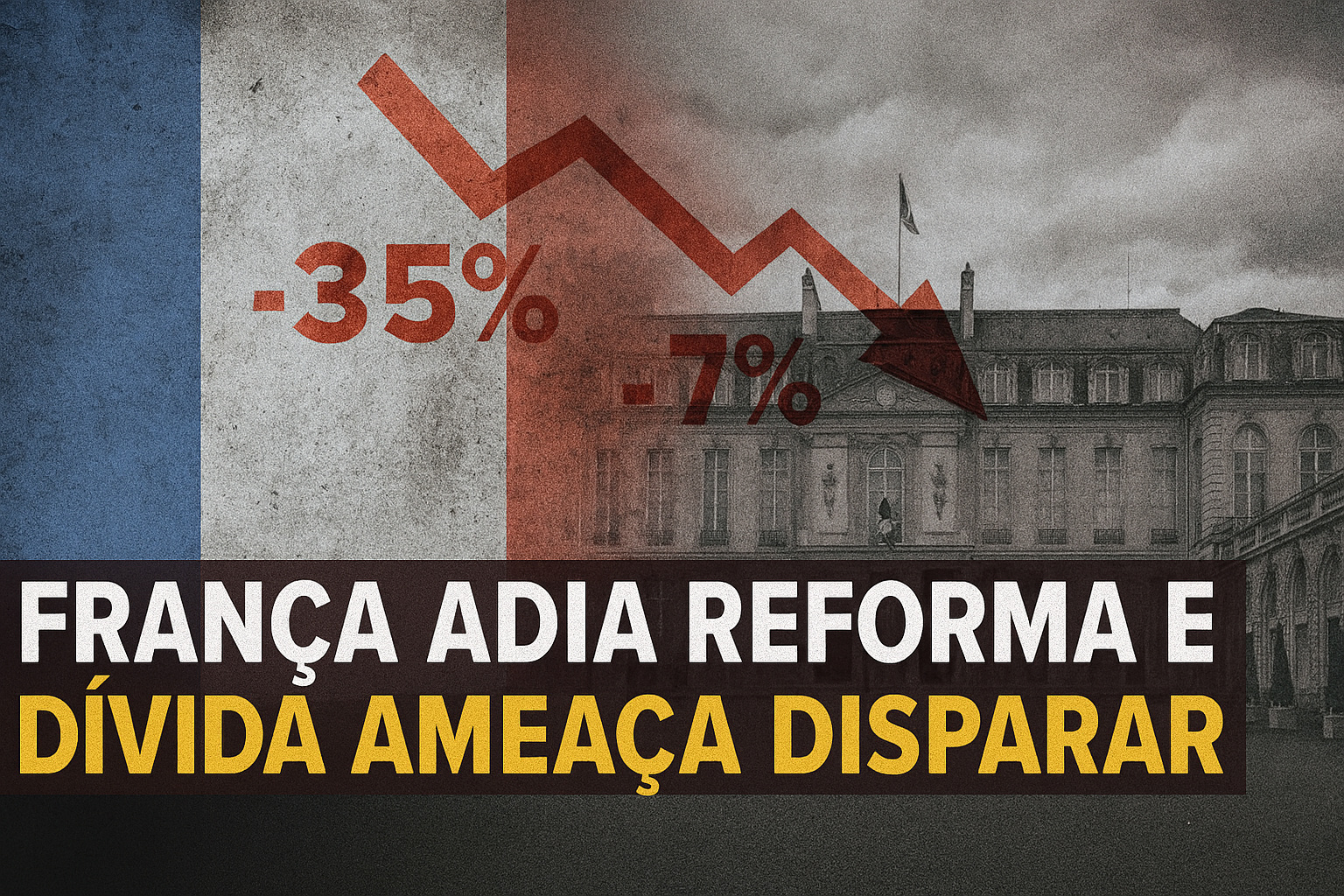
France Delays Pension Reform Until 2027 and Raises Fiscal Alarm: Debt Could Exceed 115% of GDP, According to Projections from Bloomberg and the EU.
The French government decided to push the controversial pension reform to 2027, delaying one of the most awaited and also the most unpopular measures in the country. The announcement, made on October 15, 2025, by Prime Minister Sébastien Lecornu, marks an important political shift in the management of the French economy and raises alarms about the sustainability of public finances.
According to reports from Reuters, Bloomberg, and Financial Times, Lecornu chose not to alter the pension plan ahead of the upcoming presidential elections, fearing a new wave of protests and political instability similar to what paralyzed the country in 2023, during the Macron government. The decision, however, comes at a high price: without structural adjustments, France’s public debt could exceed 115% of GDP by 2027, jeopardizing investor confidence and that of the European Union itself.
The Cost of Delaying an Unpopular Decision
The reform, which aimed to gradually raise the minimum retirement age from 62 to 64 years, was considered one of the main fiscal anchors of the French government.
-
Attacks on refineries in Iran release a gigantic toxic cloud with 33,000 tons of sulfur dioxide, crossing 2,000 kilometers in just two days and triggering an environmental alert compared to a large-scale volcanic eruption.

-
The USA and Ukraine signed an agreement in 2025 that gives Washington priority access to lithium, titanium, uranium, and rare earths in exchange for military aid. The country, which has one-third of Europe’s lithium reserves and 7% of the continent’s titanium, is negotiating sovereignty over resources worth trillions using geological maps made by the Soviet Union 60 years ago.

-
The USA classifies PCC and Comando Vermelho as terrorists, targets asset freeze and material support, but the decision opens a diplomatic crisis with Brazil and reignites alert over sovereignty, sanctions, and the fight against organized crime in a year of national political tension.
-
China, European Union, Mexico, South Korea, Canada, and other markets tighten the siege against Brazilian agribusiness: soybeans, beef, chicken, eggs, and live animals are targeted by sanitary barriers, environmental rules, and requirements that expose Brazil’s billion-dollar dependence on foreign buyers.




The suspension of the measure until 2027, according to estimates from Bloomberg Economics, would cost about €400 million in 2026 and up to €1.8 billion in 2027, widening the budget deficit at a time when France is already exceeding the EU fiscal limits.


In Brussels, the Executive Vice President of the European Commission, Valdis Dombrovskis, characterized the suspension as “costly, but manageable,” as long as Paris adopts alternative measures to contain public spending.
“The decision to delay the pension reform must be accompanied by cuts and budget reviews to keep the fiscal trajectory within European rules,” Dombrovskis stated at a press conference.
Macron’s Legacy and Lecornu’s Political Dilemma
The delay is seen as the symbolic end of Emmanuel Macron’s agenda, which has made pension reform a political banner since 2017. Lecornu, who took over the government after a period of institutional tension, is trying to balance the discourse between social stability and fiscal responsibility.
“France cannot afford new clashes in the streets on the eve of a presidential election. The country needs stability,” Lecornu stated in his address to the National Assembly.
However, political analysts point out that the cost of this stability will be paid in the medium term. Fitch Ratings has already warned that France’s fiscal trajectory is “one of the most concerning in the eurozone,” and delaying reforms could further pressure the country’s sovereign rating, which is currently AA-, with a negative outlook.
Rising Debt and Limited Fiscal Space
France’s public debt reached 112.5% of GDP in September 2025, according to France’s National Treasury (Agence France Trésor). The country holds the second position among the highest debts in the European Union, second only to Italy.
The 2026 budget, presented in September, already projected a fiscal deficit exceeding 5.1% of GDP, well above the 3% ceiling required by the European Stability Pact.
Lecornu’s decision to delay the pension reform was seen as a response to popular pressure, but also as a short-term move that increases the vulnerability of public finances. “France is facing a classic dilemma: make the reform and face political chaos, or delay it and pay more later,” stated French economist Jean Pisani-Ferry from the Bruegel Institute to Bloomberg.
Reactions from Markets and the European Union
Investors reacted cautiously to the announcement. French ten-year bond yields rose to 3.36%, the highest level in three months, reflecting perceptions of fiscal risk.
The euro, in turn, recorded a slight depreciation against the dollar, and the credit market priced in an increased probability of a downgrade of the sovereign rating.
In Brussels, the delay was met with concern. The European Union had been demanding a concrete fiscal adjustment plan from Paris by the end of 2025. Without the pension reform, the French government will have to present alternative measures — such as subsidy cuts and freezing public hiring — to avoid sanctions.
The Political Weight of the Delay
The political context also helps to explain the decision. Lecornu, appointed in August 2025, took on the mission of rebuilding bridges with unions and reducing the polarization left by Macron.
Recent polls show that more than 60% of French people oppose pension reform, and any attempt to resume it before the elections could result in mass protests and loss of parliamentary support.
“Delaying the reform does not mean giving up on it,” Lecornu stated in an interview with France 24. “But the country needs to breathe before a new political cycle.”
What’s at Stake
European economists warn that the delay of the French reform could create a domino effect on other eurozone countries, especially at a time when the European Union is trying to consolidate a new, stricter fiscal framework.
France’s credibility as a economic pillar of the bloc is directly linked to its ability to control spending and keep debt under control.
“France has always been Germany’s counterpoint. If Paris loses the confidence of the markets, the entire eurozone feels the impact,” explained analyst Carsten Brzeski from ING Bank.
The decision also has geopolitical implications. With the United States and China ramping up stimulus policies and strategic investments, France risks losing industrial competitiveness if fiscal costs rise.
The French Ministry of Economy itself recognizes that debt interest already consumes more than €60 billion per year, surpassing spending on education and defense.
“Without adjustments, French debt could become unpayable in ten years,” Brzeski warned.







-

1 person reacted to this.