






 Portuguese
  Spanish


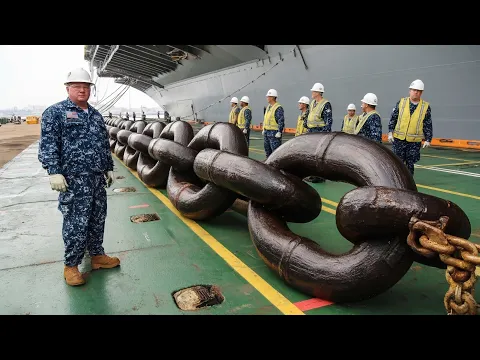
High-precision industrial process transforms raw steel into giant maritime chains capable of withstanding forces over 2,400 tons and ensuring the safety of ships and global cargo
The transformation of a simple steel bar into a gigantic chain of up to 500 meters is one of the most impressive industrial processes of modern engineering. Far beyond a simple mechanical task, this production involves a precise combination of extreme heat, colossal pressure, and rigorous technical control. Moreover, each link of this chain carries a huge responsibility: ensuring the safety of vessels transporting billions of dollars in cargo and thousands of human lives.
The information was disclosed by “specialized industrial technical documentation,” based on detailed records of the manufacturing process of maritime chains and anchoring components used in the global naval industry. According to these data, a failure in just one link can result in catastrophic consequences, reinforcing the importance of each production step.
How raw steel is transformed into giant links weighing over 100 kg
-
In the Caucasus Mountains, a Community Preserves a Language So Rare Few Outsiders Can Understand It

-
Slovakia’s Ice Cave Holds Over 110,000 m³ of Frozen Wonders, Boasts Walls Up to 27 Meters Thick, and Was Among the First Electrified Caves Globally

-
Street Cleaner Accidentally Receives $200,000 Transfer, Returns Unexpected Fortune to Rightful Owner
-
Australian Space Agency Investigates Six Mysterious Metal Spheres Found on Queensland Beach, Isolating Area Over Possible Space Debris Risk




The process begins with massive high-strength steel bars, carefully selected for their durability and chemical composition. Then, operators use overhead cranes to transport these bars to the start of the production line. Soon after, the first critical stage begins: cutting.
The bars are taken to an automatic band saw, which performs precise cold cuts. Each resulting segment, known as an ingot, weighs over 100 kg and is about 5 inches thick. Subsequently, these blocks are stored until they are directed to the next phase.
Next, the ingots enter induction furnaces, where they are heated by magnetic fields until they reach approximately 1,600°F. At this point, the steel becomes malleable, acquiring an intense reddish glow. Soon after, each piece is placed in an industrial press, which molds the material into a “J” shape with extreme precision.
Following this, one of the most critical moments occurs: closing the link. An operator inserts the molded piece into the previous link of the chain and positions the set in a horizontal press. With hundreds of tons of force, the machine presses the ends, forming a closed ring.
However, the process is not yet complete. To ensure maximum strength, the link undergoes resistance welding. In this method, copper electrodes apply intense current, generating enough heat to fuse the metal at the contact point. This procedure, known as resistance butt welding, creates an extremely strong molecular bond.
After welding, the link presents solid burrs that need to be removed. For this, a new press comes into action, cutting the excess material and leaving the surface smooth and uniform. Thus, the link is ready to withstand extreme loads.
The role of studs, extreme heat, and resistance tests in the process
Parallel to the production of the links, the manufacturing of the so-called studs occurs, which are internal bars inserted in the center of each link. These components are essential because they prevent deformations and significantly increase the structural strength of the chain.
The studs also undergo high-temperature forging, being quickly molded in industrial presses. After that, they are inserted into the still-hot links. At this moment, the temperature difference between the cold stud and the hot link creates an extremely firm fit. As the metal cools, contraction occurs, generating pressure of thousands of tons, securing the component with maximum safety.
Additionally, an extra weld is applied to eliminate any possibility of internal movement. This care ensures stability even under extreme conditions at sea.
Another essential component is the bow shackle, responsible for connecting the chain to the anchor. This item starts as a steel block of approximately 265 pounds, which undergoes forging under pressure of up to 6,000 tons. After several stages of heating above 2,200°F, the material is molded with millimetric precision.
Subsequently, parts like pins and nuts are manufactured from 130-pound ingots. These elements undergo machining, threading, and heat treatment in three stages: heating above 1,500°F, oil quenching, and tempering at about 400°F. This process transforms the steel into a strong yet less brittle structure.
Extreme tests, corrosion protection, and application in global transportation
After assembly, the chains undergo extremely rigorous tests. First, they are subjected to magnetic inspections, capable of detecting flaws invisible to the naked eye. Next, the tensile test occurs, where machines apply forces of up to 24 megajoules, equivalent to over 2,400 tons.
Moreover, each link must withstand stresses greater than real usage conditions, without showing permanent deformations. Only after passing these tests does the chain proceed to the final finishing.
At this stage, the material undergoes shot blasting with metal spheres, removing impurities and preparing the surface. Soon after, it receives a protective coating, such as zinc bath at over 800°F or water-based asphalt application, creating a flexible and corrosion-resistant layer.
This process is essential, as saltwater can quickly deteriorate steel. With this protection, the chains can last decades in extreme environments.
In terms of cost, the production of these chains ranges from 750 to 1,300 dollars per ton. A single 90-foot segment, known as a shot, can be worth up to 7,500 dollars. Considering that a ship can use up to 1,600 feet of chain, the complete system easily exceeds 100,000 dollars.
Finally, each section receives a serial number for full traceability. After that, the chains are transported to ports and installed on ships that can carry between 200,000 and 240,000 tons of cargo.
Therefore, these structures not only support anchors but also ensure the functioning of global trade. Without them, safe navigation would be impossible.
Did you imagine that a single chain could carry so much responsibility and withstand such absurd forces in the middle of the ocean?


