






 Portuguese
  Spanish


Highly technological agricultural structures use LED, hydroponics, and total environmental control to produce millions of kilograms of food per year with maximum efficiency and sustainability
Vertical farming is no longer just a futuristic concept but is becoming a concrete and highly efficient reality. On just half an acre of land, a modern vertical farm can produce the equivalent of what a traditional 250-acre farm would produce. That is, an impressive 500 times greater efficiency in land use. This technological advance, therefore, not only redefines food production but also raises an inevitable question: why is this model not yet widely adopted?
The information was released by “Undecided,” a channel specializing in technology and innovation, which presented in detail one of the most advanced vertical farming facilities located near Portland, Maine, in the United States. According to the content, annual production reaches about 3.5 million pounds of food, a volume sufficient to supply tens of thousands of people, considering that the average annual vegetable consumption per person in the US is around 155 pounds.
How a vertical farm works and why it is so efficient
-
Warm water hidden deep in the ocean has been moving towards Antarctica for 20 years, potentially accelerating glacier melting from below.

-
U.S. Offers Nearly $200,000 to Combat Invasive Mussels Threatening Waterways and Hydroelectric Plants
-
Cigarette Butts Pollute Brazilian Beaches, Sparking Debate on Coastal Environmental Protection Measures
-
App Drivers Unite in Major Solidarity Effort to Aid Venezuela Earthquake Victims, Mobilizing the Brazilian Amazon with Donation Campaign


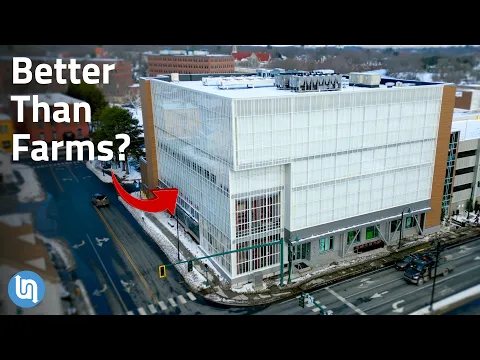

Unlike traditional agriculture, vertical farms use the concept of CEA (Controlled Environment Agriculture). In this model, absolutely all environmental factors are controlled, from temperature to lighting and CO₂ levels. This ensures constant, predictable, and high-quality production 365 days a year, 24 hours a day.
Furthermore, the system uses hydroponics, meaning cultivation occurs without soil, with nutrients dissolved in water. This method drastically reduces the consumption of natural resources. In fact, about 95% of the water used is recycled within the system. At the same time, the vertical structure allows hundreds of cultivation trays to be stacked, maximizing space utilization.
Another fundamental point is the exclusive use of artificial lighting. Unlike what many imagine, there is no direct sunlight used. This is because natural light creates thermal variations and microclimates that harm production uniformity. Therefore, each plant receives light from specific LEDs, with a predominance of red and blue tones — precisely the most efficient spectra for photosynthesis.
In total, the facility has approximately 42,000 individualized lighting points, ensuring uniform growth across all trays. However, this level of control comes at a cost: the operation consumes about 1.5 megawatts of energy, with lighting being the largest contributor to energy consumption.
Why vertical farming hasn’t yet dominated the world
Despite all its efficiency, vertical farming still faces significant challenges. The main one is high energy consumption. While in traditional agriculture the sun provides light and heat for free, in vertical farms everything needs to be artificially generated.
Furthermore, the model is still limited in terms of the types of crops cultivated. Currently, most production focuses on leafy greens such as lettuce, arugula, basil, kale, and bok choy. This is because these foods have a rapid cycle, low weight, and high added value. In contrast, crops like wheat, rice, and corn require a lot of space and are not economically viable in this system.
Another important factor is operational complexity. The system involves rigorous control of water, nutrients, airflow, and CO₂ levels. In fact, the facility consumes almost 30 tons of CO₂ per month to maintain plant growth. Without this supply, growth would simply stop.
Furthermore, the entire environment needs to be extremely clean and controlled. Any contamination can compromise the entire production. Therefore, there are advanced water filtration systems with 50-micron meshes, UV light treatment, and constant biofilm monitoring.
Where vertical farming makes the most sense and what the future of this model is
Despite the challenges, vertical farming proves to be extremely advantageous in specific scenarios. Especially in dense urban areas, regions with extreme climates, or locations where the food logistics chain is long and vulnerable.
In these contexts, producing food locally reduces transportation costs, increases product shelf life, and improves food security. In addition, proximity to the consumer allows food to reach shelves much fresher, potentially lasting weeks longer.
Another relevant point is the social impact. Some of these farms, like the one presented in the study, have about 40% of their employees with some type of disability, demonstrating that the model can also be inclusive and socially transformative.
Finally, although still in its expansion phase, vertical farming already shows potential to become a key piece in the future of food production. By uniting technology, sustainability, and efficiency, this model can fill gaps where traditional agriculture cannot operate.
Do you believe this type of farm can replace traditional agriculture in the future, or do you still see limitations in this model?