






 Portuguese
  Spanish


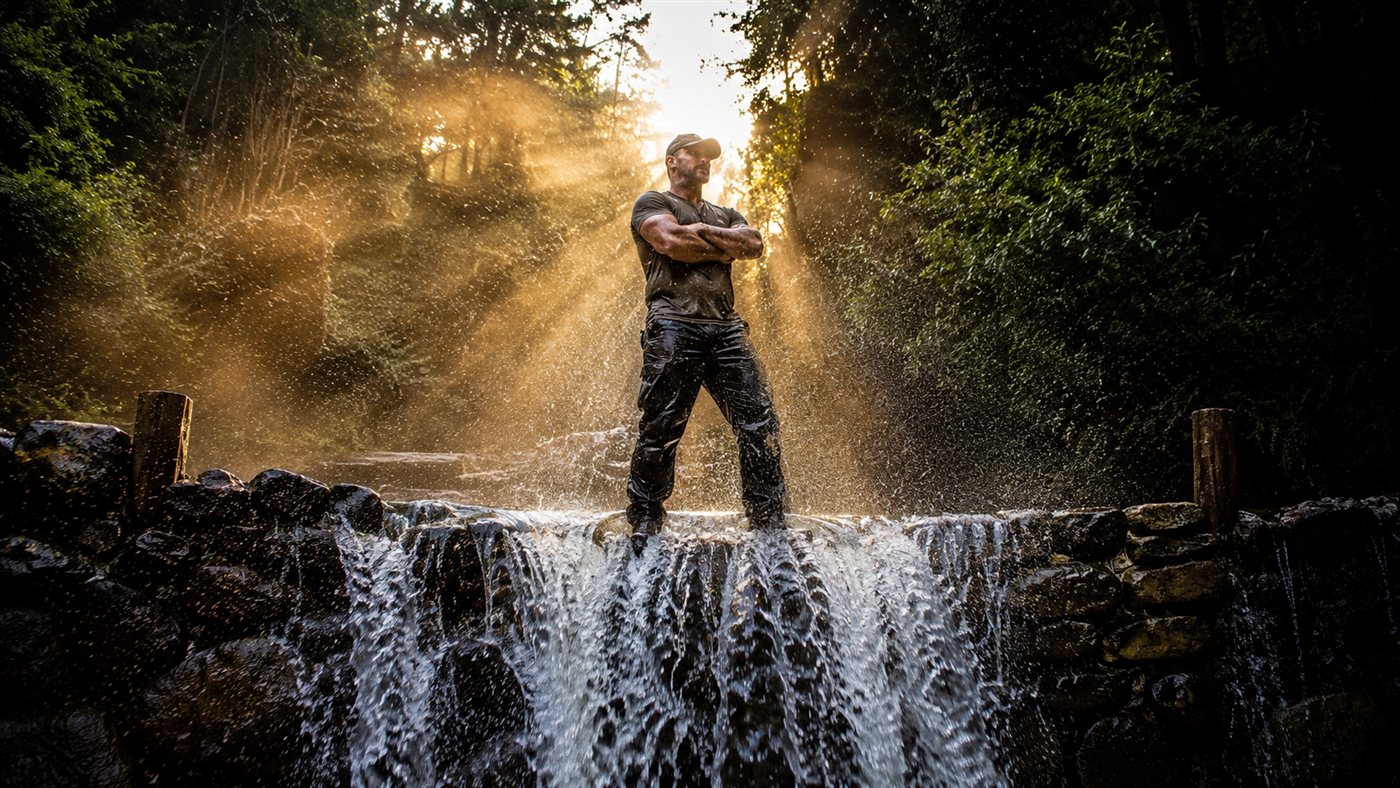

In the 1 hour and 7 minutes video from the channel Off Grid w/ Ana & Jack, which premiered on May 14, 2026, and already exceeds 483 thousand views, Jack stacks stone by stone a reinforced dam, with channel, mold, and turbine, to never be in the dark again
Living off the grid has a cost that few people calculate: when your own energy system breaks down, there is no utility company to call. This was Jack’s routine until he decided to solve the problem once and for all, in a project recorded on video that premiered on May 14, 2026, on the channel Off Grid w/ Ana & Jack, on YouTube, which is of interest to any Brazilian dreaming of producing their own energy.
According to the channel Off Grid w/ Ana & Jack, the couple’s old hydroelectric system was far from the farm and was destroyed by floods every rainy season. Jack’s response was to build from scratch, with stone, sand, and concrete, a robust dam with a hydroelectric turbine, designed to withstand the water pressure that always knocked down the previous one.
The flood that destroyed the energy every year
The problem repeated like clockwork. As the channel Off Grid w/ Ana & Jack reports in the recording, whenever the river overflowed, the old dam collapsed, and Jack had to travel long distances over dangerous terrain just to fix the system.
-
7,500-Year-Old Salt Production Traces in Bosnia Uncover Rare Prehistoric Technology and Shed Light on Food History

-
Man Discovers 2,000-Year-Old Roman Cistern with Drone in Brazil

-
Abandoned Mansion in Brazil Unveils 4 BMWs, Home Theater, Indoor Pool, and Numerous Apple Computers
-
One of Brazil’s Most Beautiful Beaches Faces Severe Pollution as River Contamination Exceeds Safe Limits by 50 Times, Fines Could Exceed $10,000


It was an expensive cycle in every sense. Each flood season meant days of repair, physical risk, and an entire farm operating without electricity until the repair was completed. For those who depend on their own infrastructure, this type of fragility is not an inconvenience; it is a direct threat to their way of life.
The decision that changes history is simple to state and difficult to execute: instead of patching up the old system again, build something permanent, close to home, strong enough to withstand the rainy season without collapsing.
The plan: a permanent dam near the farm
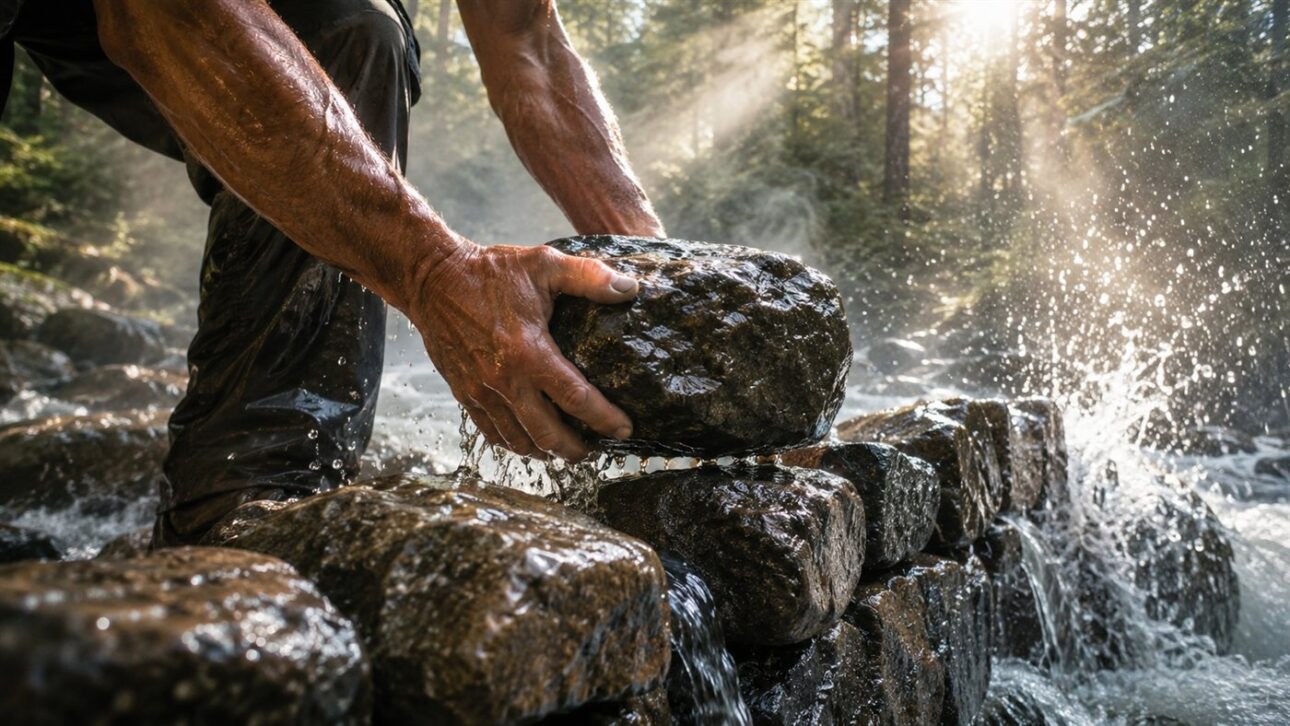
The first step was choosing the right place. According to the channel Off Grid w/ Ana & Jack, the couple explored a stream near the property and found the ideal spot to erect a definitive hydroelectric system, eliminating the long walks to the old system.
The location solves two problems at once. Close to home, maintenance stops being an expedition and becomes routine, and daily monitoring allows action before any small damage turns into disaster. It’s the kind of engineering decision that doesn’t show up on the material bill but determines if the project survives.
Stone, sand, and concrete: the artisanal engineering of the dam
The material recipe is nothing exotic. As shown by the channel Off Grid w/ Ana & Jack in the video, Jack used large stones, sand, and concrete, applied with artisanal engineering techniques, to build a structure designed to withstand the force of water during floods.
The method is shown in detail in the recording: solid stones stacked layer by layer, reinforced walls, and each step checked before the next. The artisanal dam doesn’t compete with a professional reinforced concrete construction but applies the same physical principle: mass and geometry in favor of the structure, so that the water pressure meets resistance instead of weakness.
It’s also a lesson in constructive humility. The previous structure failed because it wasn’t sized for the worst day of the year, and the new project is born exactly from the size of the problem it needs to overcome.
Channel, mold, and turbine: the path of water to light
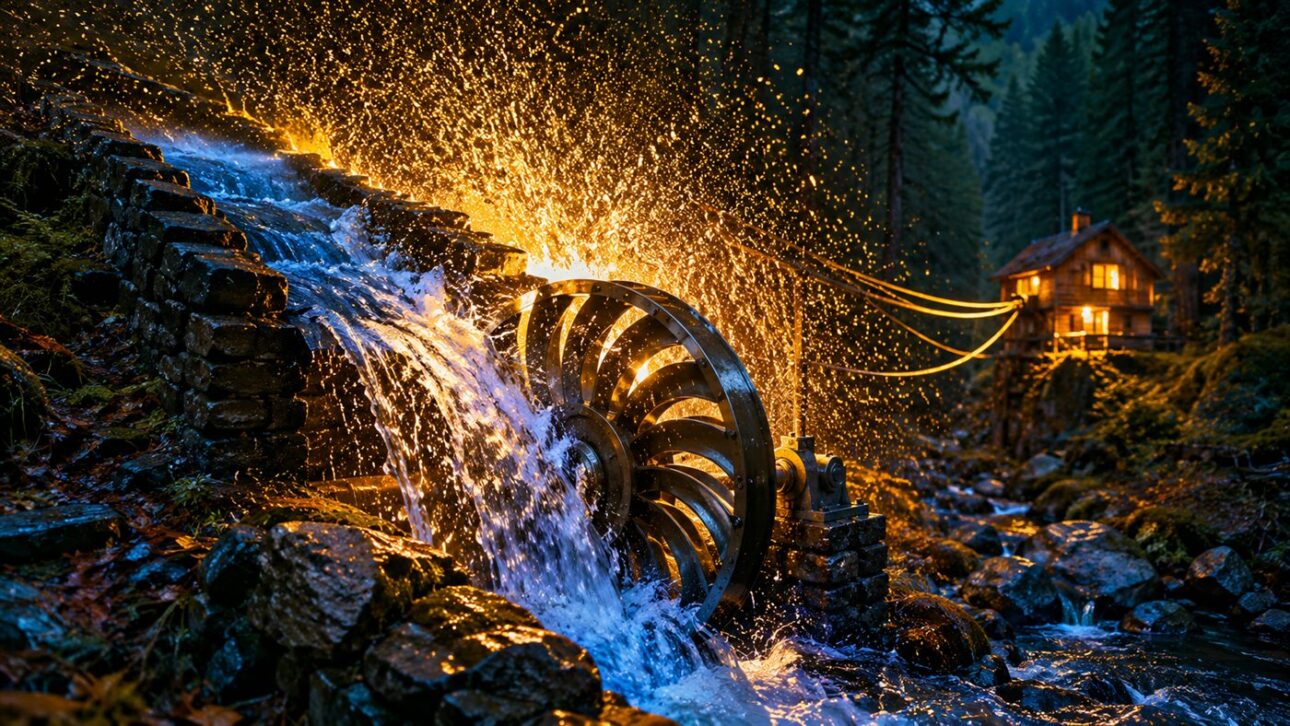
Ready dam is only half of the system. According to the channel Off Grid w/ Ana & Jack, Jack created a channel to conduct the water, built a mold to house the turbine, reinforced the dam walls, and installed the new hydroelectric turbine set.
Each piece has a clear function. The channel controls the volume and speed of the water reaching the equipment; the mold positions the turbine at the exact point of greatest utilization; and the reinforcement of the walls ensures that the entire structure remains standing when the stream turns into a current. It’s a complete micro power plant, from damming to generation, executed with simple tools and patience.
The moment when the lights turn on
After days of hard work, comes the scene that sums up the project. The water starts to flow through the channel, the turbine spins, and the house lights turn on, all recorded in the channel Off Grid w/ Ana & Jack.
The symbolism is strong, but the gain is practical. For the first time, the couple crosses strong storms without fear of losing electricity, because the new system was designed precisely for the moment when the old one failed. Energy that only works in good weather is not infrastructure, it’s a lottery, and it’s this lottery that the project ends.
The public responded: the video, with 1 hour and 7 minutes of documented work, has 483,000 views and 3,400 likes, numbers that show the global appetite for self-sufficient energy projects.
The self-sufficient farm that energy sustains
While Jack was building the dam, the other half of the project remained active. According to the channel Off Grid w/ Ana & Jack, Ana maintained the routine of the self-sufficient farm: harvesting vegetables, taking care of the garden, and preparing meals that sustain the couple.
The detail matters because it shows what electricity means in this context. The turbine’s energy does not feed luxury, it feeds the operation of a property that produces its own food, preserves food, pumps water, and keeps tools running. In an off-grid life, a stopped generator means stopped production, and that’s why reliability is worth more than power.
There is also a technical advantage that explains the choice of water over other sources: a stream runs day and night, with or without sun. While panels depend on light and batteries age, a well-positioned turbine in constant flow delivers continuous generation 24 hours a day, exactly the consumption profile of a property that never completely shuts down.
What off-grid life teaches rural Brazil
The story takes place far from here, but the dilemma is familiar in rural Brazil. Properties far from the grid pay dearly for line extension or rely on combustion generators, and small hydraulic developments are a real alternative where there is a waterfall and constant flow.
The lesson from the video is doubly valuable here: small-scale hydraulic development is accessible technology, but it requires a project sized for the flood, not for the calm day. In Brazil, any damming in a watercourse, even small, also needs to respect the state’s environmental and water resource regulations, a step that separates the lasting solution from the future problem. Once the homework is done, renewable energy from a stream can sustain an entire property, as the video itself proves.
Watch the complete dam construction in video
The entire project, from the first stacked stone in the stream to the lights on in the house, is fully documented by the channel Off Grid w/ Ana & Jack, which publishes their off-grid life projects on their YouTube page.


After seeing the turbine spin and the house light up, the question arises: if a man with stone, sand, and concrete retired the floods that knocked out his power, how many Brazilian properties could do the same with the streams that already cross their lands? Tell us in the comments: would you trade your electricity bill for a micro-hydroelectric plant on your property?


