Portuguese
  Spanish


Created at the University of Seville, in Spain, a new hydrogel uses algae and shrimp shells that would go to waste. In tests, the material absorbs up to 60 times its own weight in water and keeps the soil moist for longer, a cheap promise to save crops from drought.
In Spain, a waste that almost always becomes trash can become an ally of the field. Researchers at the University of Seville have created a hydrogel made from algae and shrimp shells that absorbs a lot of water and helps keep the soil moist, as reported by El Independiente. The idea is to tackle drought in crops.
The biodegradable material can absorb up to 60 times its own weight in water, according to Agronews. Presented as an alternative to petroleum-based gels, it is still in the research phase but promises to retain moisture in the soil and release it gradually to the plants.
The idea combines two wastes into one solution. From the algae comes the alginate, and from the shrimp shells comes the chitosan, two natural compounds that, along with a bit of calcium, form the hydrogel. All from material that is usually thrown away.
-
Scientists Discover Unexpected Intelligence in Solitary Octopus During Jar-Opening Challenge

-
Brazilian Public School Students Develop Biofilter Using Arapaima Bones, Earn National Honorable Mention

-
The Axolotl: The Rare Amphibian That Can Regenerate Its Brain, Heart, and Limbs, Baffling Scientists Worldwide
-
Storm Chasers Get Too Close to Oklahoma Tornado, Record 128.8 mph Winds, and Attempt Drone Launch to Measure Pressure and Speed in Dangerous Operation


Next, see what the hydrogel made from algae and shrimp shells is, how it absorbs up to 60 times its own weight in water, why it can replace petroleum gels, and what this research has to do with drought in Brazil.
What is the hydrogel made from algae and shrimp shells
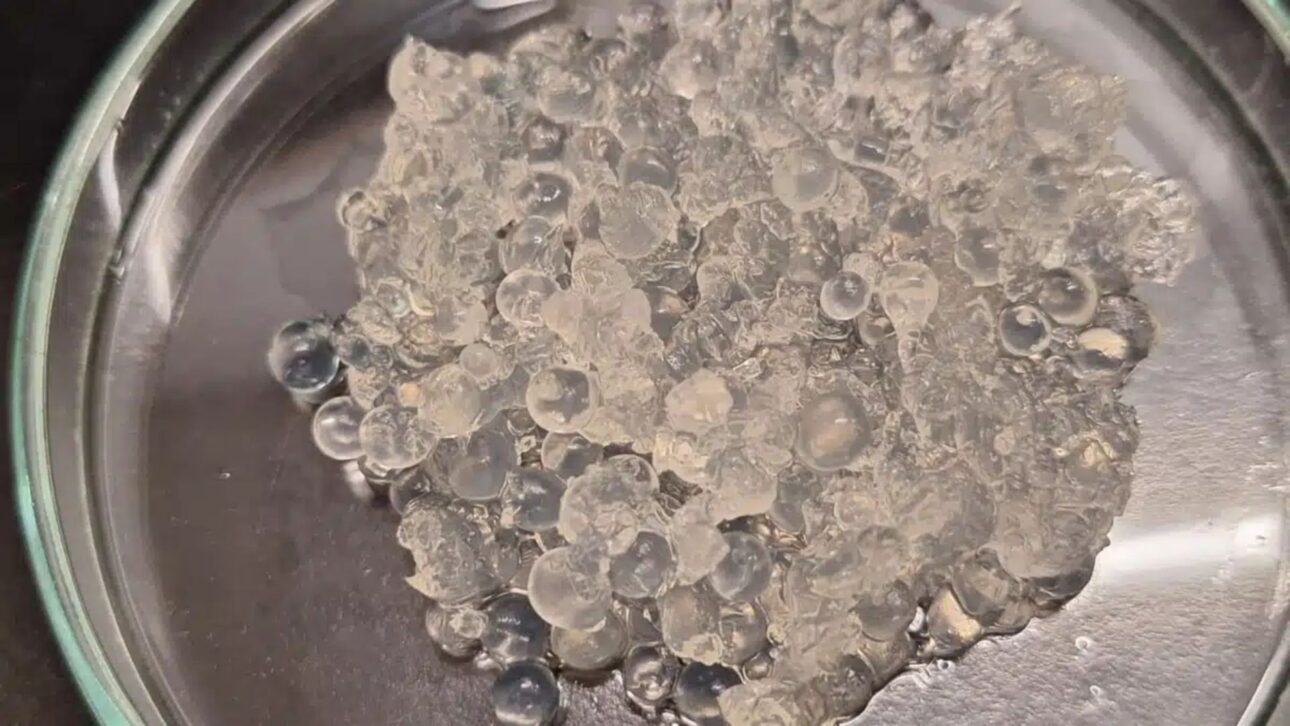
The product is a superabsorbent material of natural origin. Developed by researchers from the University of Seville, the hydrogel combines compounds extracted from algae and shrimp shells, two abundant residues that gain a new function in this project.
The chemical base comes from two known polymers. Alginates are extracted from algae, and chitosan comes from shrimp shells, both natural and biodegradable. A bit of calcium acts as a stabilizer, giving structure to the hydrogel that holds the water.
Behind the work is real science. Researcher Carmen María Granados is among those responsible for the study, published in an international scientific journal, which shows that the hydrogel from algae and shrimp has undergone technical evaluation and is not just an improvised laboratory promise.
The goal is to tackle a huge problem. By storing water and releasing it gradually into the soil, the hydrogel aims to help plants endure periods of drought, when rain disappears and crops suffer. It’s a simple response to an increasingly common challenge.
The choice of raw materials is no coincidence. Algae and shrimp shells are natural sources of polymers that have already been studied for other uses, from dressings to packaging. Here, these substances were combined to hold water, taking advantage of what nature offers.
How does the hydrogel absorb up to 60 times its own weight in water?
Performance is what draws the most attention. According to the study, the hydrogel can absorb up to 60 times its own weight in water, a number that helps explain why it sparks so much interest in agriculture under water stress.
The secret lies in the structure of the material. When dry, the hydrogel has a very porous structure, similar to a sponge, full of empty spaces. When it comes into contact with water, these pores fill up and the material transforms into a gelatinous network.
Once filled, it acts as a reservoir. The captured water is trapped in this network and is gradually released as the soil dries. Thus, instead of the water running off or evaporating all at once, it remains available to the roots for a longer time.
It is worth noting that the value is a ceiling, not a fixed rule. The material absorbs “up to” 60 times its own weight, which depends on the conditions. Even so, even smaller numbers would already represent a significant gain in soil moisture during drought.
Another interesting point is reversibility. The hydrogel can swell when it receives water and shrink when the soil dries, repeating the cycle several times. This ability to fill and empty is what allows the material to be used throughout a season, not just once.
From seaweed and shrimp shells that would go to waste
The starting point of the research is reuse. Both seaweed and shrimp shells are usually treated as waste, whether from fishing or seafood processing, and end up polluting or filling up the trash.
Transforming this waste into a product changes the logic. Instead of spending money to discard shrimp shells and seaweed, it is possible to extract from them the compounds that form the hydrogel, adding value to a material that previously had no use.
This cheap origin is part of the appeal. Since the raw material comes from leftovers, the cost of the hydrogel tends to be lower than that of products made from noble inputs, which is essential for a solution designed for the field, where the margin is usually tight.
There is also a double environmental gain. By using discarded seaweed and shrimp, the project removes waste from the environment and still creates a useful item, in the spirit of the circular economy, where the waste of one process becomes the input of another.
The volume of this type of waste is enormous. Fishing and seafood farming generate tons of shrimp shells per year, and a good part of the seaweed collected on beaches and farms also ends up discarded. Finding a destination for this material is already a gain in itself.
How the hydrogel keeps the soil moist against drought
The central function of the material is to retain moisture. Mixed with the soil, the hydrogel absorbs the water from rain or irrigation and keeps it stored, preventing it from being lost quickly through evaporation or runoff.
The effect appears when rain is lacking. On dry days, the soil tends to dry out and plants suffer, but the hydrogel gradually releases the stored water, acting as a reserve that sustains the crop until the next watering.
This mechanism can reduce water usage. If the soil retains more moisture, the farmer needs to irrigate less frequently, saving water and energy, two resources that are expensive and increasingly scarce in many producing regions.
The potential goes beyond simple irrigation. According to researchers, in the future, the hydrogel could be loaded with fertilizers or micronutrients to release them gradually, combining water retention with controlled plant nutrition.
In practice, the use is simple. The hydrogel is usually mixed with the soil at the time of planting, near the roots, where it is most effective. Then, it is up to the rain or irrigation to supply the material, which starts to function as an underground sponge full of water.
A biodegradable alternative to petroleum-based hydrogels
The main difference is the origin of the material. Most superabsorbent hydrogels used today come from petroleum-derived polymers, which take a long time to decompose and can leave plastic residues in the soil for long periods.
The hydrogel made from algae and shrimp proposes the opposite path. Being made from natural compounds, it is biodegradable, meaning it tends to decompose in the environment without leaving the same plastic trace that petroleum products usually leave.
This point is increasingly important. Spreading tons of plastic material in the soil to retain water can solve one problem and create another, that of waste accumulation, and it is precisely this dilemma that the algae and shrimp version tries to avoid.
It is no coincidence that the research presents itself as sustainable. Replacing a petroleum gel with one made from algae and shrimp shells is substituting a fossil and polluting material for another that is renewable and waste-based, maintaining the same function of holding water in the soil.
The concern with microplastics makes this urgent. Synthetic gels can fragment and leave plastic particles in the soil, which then enter the food chain. A biodegradable hydrogel made from algae and shrimp avoids this risk, offering a similar function without the environmental liability of petroleum.
Still research: what is needed to reach the field
It’s important not to confuse promise with reality. The hydrogel made from algae and shrimp is, for now, a research result published in a scientific journal, and not a product that is already being sold or used on a large scale in fields.
There are steps needed before widespread use. The researchers themselves point out that tests in real cultivation conditions will still be necessary, as well as the evaluation of biodegradation and ecotoxicity, that is, verifying if the material does not cause undesirable effects in the environment.
This caution is what separates serious science from exaggeration. Only after proving that the hydrogel works in the field, and not just in the laboratory, can it be produced on a scale and reach the hands of those who plant, with safety and affordable price.
Even so, the path is encouraging. Having a cheap, waste material capable of retaining water in the soil and still decomposing without polluting is exactly the type of solution agriculture seeks to tackle drought without multiplying waste.
It’s worth remembering that the research had public support. The study received funding from science bodies and European funds, which usually accelerates development. Even so, turning a laboratory result into a shelf product takes time and more investment.
None of this detracts from the merit of the advancement. Even in its initial phase, the hydrogel made from algae and shrimp points to a concrete path to combine drought combat with waste reduction, and it is this type of research that usually becomes useful technology a few years later.
Why Drought Threatens Crops
The lack of water is one of the greatest risks in the field. Without rain at the right time, the soil dries out, roots cannot sustain themselves, and production plummets, causing losses for the farmer and pressure on food prices.
Climate changes exacerbate the situation. Longer and unpredictable droughts have become common in various parts of the world, leaving crops at the mercy of waterless periods that were previously less frequent or shorter.
In this context, retaining moisture becomes a priority. Storing the water that falls and keeping it in the soil for longer can be the difference between losing or saving a harvest, especially in regions where irrigation is expensive or simply doesn’t exist.
Simple tools make a difference in these times. A cheap and efficient hydrogel, mixed with the soil, is the kind of resource that can help small and large producers get through drought without relying solely on the luck of rain.
The topic is about food security. When droughts destroy crops, food shortages occur, and prices rise, affecting both producers and consumers. Therefore, retaining water in the soil has become not just a field issue but a concern for everyone.
What This Has to Do with Brazil
Brazil is closely acquainted with the problem of drought. The semi-arid region of the Northeast faces long periods without rain, and even other agricultural regions suffer from droughts that punish crops, making water retention solutions in the soil very welcome here.
Brazilian science is already focusing on the topic. Research centers and universities have been studying gels and biopolymers for years to retain water in the soil, including from agricultural waste, showing that the country has the technical basis to develop its own hydrogel.
The country also has an abundance of raw materials. Brazil is strong in shrimp farming, especially in the Northeast, and has a coastline full of algae, which means there are residues available to, in theory, produce a hydrogel similar to the one developed in Spain.
Moreover, the use of hydrogel in agriculture is not a national novelty. Producers and nurseries already use gels to retain water in seedling planting and reforestation, which shows there is a market and knowledge to adopt more sustainable versions.
The Northeast, by the way, brings together both ends of the problem and the solution. It is the region that suffers the most from drought and, at the same time, a hub for shrimp farming, which generates a lot of discarded shells. Utilizing this local residue would make double sense.
Finally, there is the fit with the circular economy. Utilizing shrimp shells and algae left over from fishing and industry, turning this waste into a product that retains water and helps the soil, is the kind of idea that Brazil could develop and adapt to its own reality.
And you, would you plant with a hydrogel made from shrimp shells?
The Spanish research shows how waste can become an ally against drought. Made from algae and discarded shrimp shells, the new hydrogel absorbs up to 60 times its own weight in water and keeps the soil moist for longer, all with a biodegradable and cheap material.
More than a laboratory trick, it is a purposeful bet. By replacing petroleum gels with one made from natural residue, researchers aim to help crops face water scarcity without filling the soil with plastic, even though there is still a long way to go for large-scale use.
And you, would you plant using a hydrogel made from shrimp shells and algae to use less water and protect the crops from drought? Do you think Brazil should invest in such solutions for the field? Share your opinion here in the comments and share with those who understand planting.