Portuguese
  Spanish


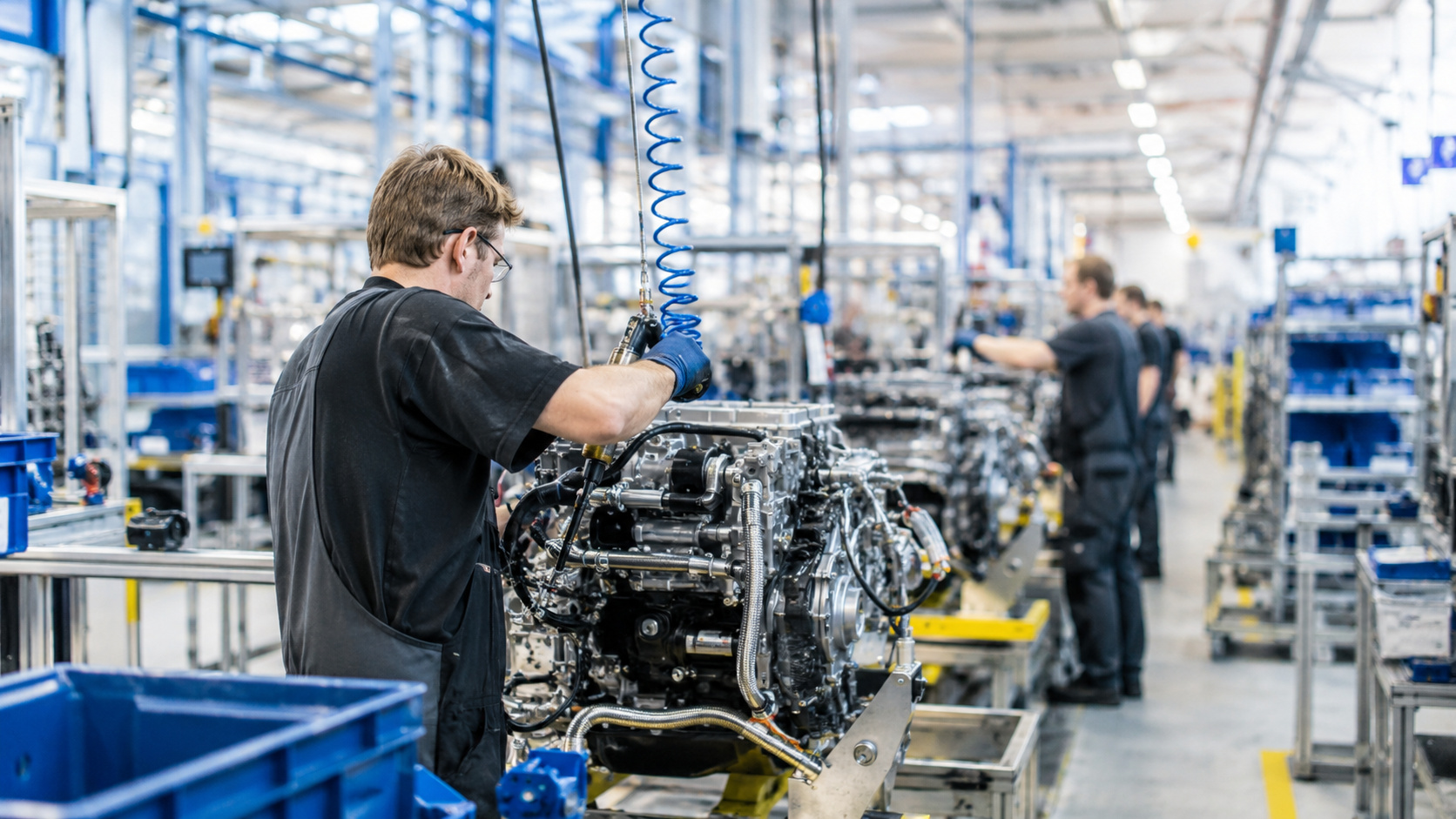

Increase interrupts negative sequence, but official data reveals that the German industry still faces cost pressure, unstable demand, and limited growth
Germany’s industrial production grew again in April 2026, according to official data released by Destatis, the German federal statistics office. The 0.4% increase compared to March was the first positive result of the year and interrupted a sequence of declines that began in November. The performance brought some relief to the production sector, but it still did not indicate a consistent turnaround for Europe’s largest economy. Analysts assess that the monthly improvement was concentrated in a few segments and that the industrial base remains pressured by high costs, smaller orders, and economic uncertainty.
Technical review reveals limited industry progress
The growth in April was mainly driven by construction, which advanced 2.4% on a monthly comparison and helped avoid another negative result in industrial production. Exports also performed positively, with a 0.9% increase in April, following a 0.5% increase in March. However, the trade balance almost did not change because imports grew at an even faster pace. This behavior shows that the main figure improved, but the recovery remains fragile. For Carsten Brzeski, ING’s global chief economist, the April advance was too small to indicate a trend change.
Economic and productive impacts of the result
The German industry remained practically stagnant in the first four months of 2026, according to ING’s assessment. Production is still about 12% below pre-pandemic levels, which reinforces the gap between the positive monthly result and a structural recovery. The environment that seemed more favorable at the beginning of the year, with confidence in recovery, stronger orders, and expectations of investments in defense and infrastructure, has lost momentum. Consequently, the German economy still lacks a solid ground to support a broad industrial recovery.
-
Entrepreneur Sells Car to Launch Healthy Meal Business, Now Runs Mr. Fit with 880 Stores in 3 Countries and $40 Million Annual Revenue

-
End of an Era: Renault Plans Major Overhaul, Cutting Jobs to Compete with Chinese Rivals and Transform Engineering by 2027
-
Brazil’s Largest Grain Port Faces Delays in the Hinterlands, Missing Rail Link Costs Agribusiness Billions

-
Egg Prices Drop Due to Weak Demand as Poultry Producers Increase Purchasing Power


Drop in orders causes apprehension among companies
New orders in the manufacturing industry fell by 3.8% in April, according to provisional figures released by Destatis on the eve of production data. The automotive sector was among the hardest hit, with orders dropping by more than 5%. Machinery and electrical equipment also recorded significant declines. Orders from abroad decreased by more than 4%, while domestic orders fell by almost 3%. This movement marked a strong reversal after the growth period observed following last summer in Europe, when industrial orders had advanced for several consecutive months.
Expensive energy increases pressure on the German industry
Germany remains among the largest net energy importers in Europe, according to analyses by ING. About 6% of the country’s oil imports come from Middle Eastern nations, increasing the economy’s exposure to external shocks. Energy-intensive sectors employ nearly one million people and represent approximately 17% of the industry’s gross value added. The rise in energy costs, therefore, directly affects the competitiveness of factories and limits the productive sector’s ability to react.
Inflation and GDP put recovery in a broader context
Germany’s annual inflation rose to 2.9% in April 2026, the highest level since January 2024. Energy products were more than 10% above the prices recorded a year earlier, which reinforced the pressure on companies and consumers. The German government also halved its growth forecast for 2026, now estimating an increase of only 0.5% in GDP. This adjustment shows that the expected recovery for the year has lost momentum in the face of high costs, lower demand, and supply chain bottlenecks.

The future of the German industry
The Federal Ministry for Economic Affairs of Germany assesses that the normalization of industrial activity will take time, especially due to the accumulated damage to productive capacity and the obstacles related to energy and raw materials. The boost generated by defense stocks and early orders in supply chains lost momentum throughout 2026. The 0.4% increase in April, therefore, interrupted a negative sequence but has not yet confirmed a solid recovery. Europe’s largest economy remains in a period of caution, with weak production, smaller orders, and persistent costs.
Do you believe that Germany will be able to recover its industrial strength in the coming months, or will expensive energy and declining orders continue to limit the country’s growth?