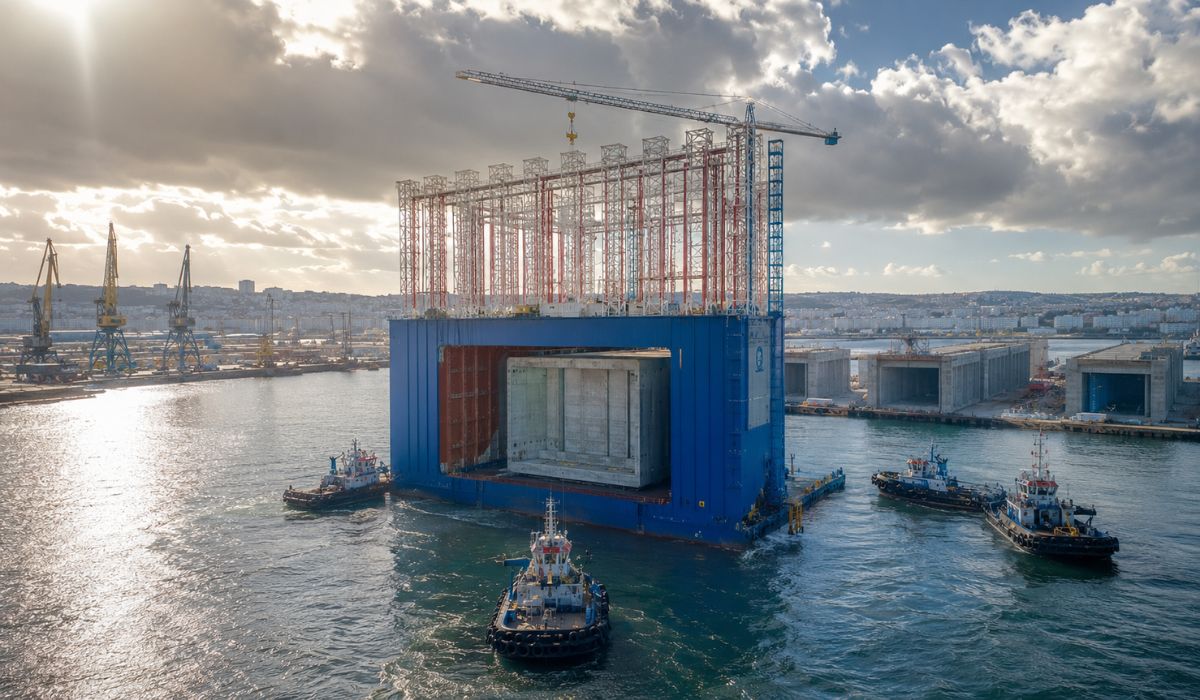

56-meter floating dock shows how large port works can move from fixed sites and advance over the sea, with concrete modules used in piers, quays, and breakwaters.
A floating structure of 56 meters in height, comparable to an 18-story building, was used at the Outer Port of A Coruña, Spain, to produce large concrete pieces directly in the port environment.
The Kugira dock, owned by ACCIONA, manufactured six concrete caissons between 2021 and 2022, in an operation that reduced dependence on a distant traditional shipyard.
The case is not a recent novelty, but it remains relevant within the maritime engineering sector because the technology continued to be applied in subsequent projects by the company.
-
AI-powered toys that talk, recognize faces, and collect data face scrutiny from Brazilian government over children’s privacy concerns

-
4,000-Year-Old Child’s Skull Unveils Ancient Burial in 7,500-Year-Old Norwegian Rock Shelter, Impressing Archaeologists

-
Norway Defeats Brazil in World Cup but Invests Billions to Preserve the Amazon, Strengthens Amazon Fund, and Joins Brazil in Leading Global Effort Against Tropical Deforestation

-
Denmark Constructs Its Largest Breakwater with 175 Concrete Blocks and World’s Largest Excavator to Combat 8-Meter Waves, at a Cost of $156 Million



In May 2026, ACCIONA announced that it had started the production of concrete caissons for the Ravenna breakwater in Italy, with the Kugira II, and stated that it began operating two floating docks of this type simultaneously: Kugira I, in Valencia, and Kugira II.
The operation in A Coruña helps explain how large port works can gain efficiency when part of the construction is carried out near the area of use of the structures.
Instead of manufacturing pieces on land and transporting them over long distances, the floating dock allows for the assembly of reinforced concrete caissons close to the point of embarkation, launch, or installation.
How the Kugira floating dock works
The name Kugira means “whale” in Japanese, a reference associated with the dimensions of the structure.
According to ACCIONA, the dock is 56 meters in height and was designed to build reinforced concrete caissons used in docks, piers, and breakwaters.
These pieces are large hollow blocks, with internal cells, that can be sunk and filled to form part of the maritime infrastructure.
In practice, they function as structural modules used in works that require strength, stability, and installation in a coastal environment.
In the operation carried out at the Outer Port of A Coruña, ACCIONA manufactured six concrete caissons of 60 meters in length by 24 meters in width.
Each piece weighed about 15 thousand tons, a dimension that helps explain the need for a port with specific conditions of depth, operational area, and cargo logistics.
The process begins with the execution of the caisson base.
Then, the walls are erected using a sliding form, a technique that allows the structure to be concreted continuously as the body of the caisson gains height.
As the concrete progresses, the assembly undergoes controlled submersion.
When the structure is ready, it can be moved by tugs or vessels suitable for the type of operation.
At the final point, the caisson is positioned, flooded by its internal cells until it touches the bottom, and then filled with granular material.
From this stage, the piece acts as a fixed part of the port structure.
![Kugira is the large floating dock of the company Acciona. [Image: Acciona]](https://clickpetroleoegas.com.br/wp-content/uploads/2026/07/Design-sem-nome-2026-07-07T231856.822.jpg)
Outer Port of A Coruña was chosen for its draft
ACCIONA reported that it chose the Outer Port of A Coruña because the operation required 30 meters of draft, a condition available in few Spanish ports.
Draft is the depth required for a vessel or floating structure to operate safely, especially in large-scale maneuvers.
The work began in early October 2021 and was completed in the first quarter of 2022.
In March of that year, the Kugira left the Outer Port towed by the Hispania, after completing the manufacture of the six concrete caissons.
According to ACCIONA, the operation generated about 300 direct and indirect jobs.
The number was reported by the company in the context of the installation of the floating dock and the production of the pieces in the Spanish port.
The scale of the work required a subsequent logistical stage.
In May 2022, ACCIONA reported that the Boka Vanguard, described by the company as the largest semi-submersible cargo ship in the world, collected the six caissons in A Coruña to transport them on a journey of over 9,000 nautical miles to Southeast Asia.


The company associated the pieces with a project in the Philippines.
The publicly available information confirms the manufacture, collection, and transport of the caissons, but does not allow for a detailed understanding of the final installation stage of these structures at the destination.
This sequence shows that the floating dock played a role in more than one phase of the operation.
Besides allowing the manufacturing of the caissons, it enabled the pieces to remain in a port area with sufficient depth until loading onto a heavy transport ship.
Concrete caissons are maritime infrastructure modules
Despite the name, the concrete caissons used in maritime engineering have no relation to funerary use.
In the port sector, the term describes hollow reinforced concrete structures, designed to be moved by water and installed on the seabed.
These pieces function as construction modules.
When several caissons are aligned, they can form sections of quays, piers, berths, or breakwaters.
The application of this system depends on the engineering project, maritime conditions, and the purpose of the work.
In general, the goal is to create resistant structures, capable of supporting loads, protecting docking areas, or forming barriers against waves.
According to PierNext, an initiative linked to the Port of Barcelona, floating docks like the Kugira work with two main principles: modularity and in situ construction.
The publication explains that these devices manufacture caissons close to the work areas, reducing the need to transport ready-made structures over long distances.
This model can also reduce interference in port areas that continue operating, according to the logic presented by technical publications in the sector.
Since the production unit is on the water, it can be positioned as needed for the work and removed after the completion of the tasks.
For ports that maintain commercial activities during infrastructure interventions, this flexibility has operational relevance.
Even so, each application depends on planning, licenses, environmental conditions, area availability, and maneuvering capacity.
A floating factory that moves across the sea
The floating dock functions as a mobile industrial unit for maritime works.
Instead of concentrating production in a fixed land-based factory, the equipment can be moved to ports that have the depth, area, and demand compatible with the construction of concrete caissons.
The Kugira has already been associated by ACCIONA with works in ports such as Escombreras, Tarragona, Los Mármoles, Algeciras, Barcelona, and Ferrol, as well as projects in Brazil.
The company also reports that the technology was applied at Terminal 2 of the Port of Açu, in São João da Barra, Rio de Janeiro.
![Kugira is the large floating dock of the company Acciona. [Image: Acciona]](https://clickpetroleoegas.com.br/wp-content/uploads/2026/07/Design-sem-nome-2026-07-07T231918.285.jpg)
The use of this type of dock helps explain why maritime works require different solutions than those adopted on land.
Tides, waves, depth, interference in navigation, weight of the pieces, and operation windows directly influence planning.
In many cases, the critical stage is not just in the manufacturing of the structure, but in the transport, positioning, and fixing of the piece at the location defined by the project.
Therefore, construction by modules can facilitate stages of control, repetition, and installation.
In practice, the technology allows part of the port infrastructure to be assembled from large prefabricated pieces in the maritime environment.
Once positioned and filled, the caissons become part of the physical base of docks, piers, or breakwaters.
Kugira II brings technology to recent works in Italy
The continuity of the system appears in subsequent projects by ACCIONA.
In November 2024, the company announced, in consortium with the Italian RCM Construzioni, the construction of a breakwater to protect a floating industrial terminal at the Port of Ravenna, Italy.
The infrastructure was described by the company as a structure of 880 meters in length by 22 meters in width, formed by concrete caissons.
The project was presented as part of the protection works for the maritime terminal.
In May 2026, ACCIONA reported that the Ravenna project had entered the production phase of the caissons with the Kugira II.
According to the company, the structures planned for this work measure more than 50 meters in length and weigh approximately 9 thousand tons each, within a set of 18 planned units.
The most relevant update to contextualize the case of A Coruña is the simultaneous operation of two docks of this type.
According to ACCIONA, the Kugira I was in Valencia, while the Kugira II was used in Ravenna.
This data indicates that the technology employed in A Coruña in 2021 continued to be present in large port works in the following years.
The information, however, does not mean that the same operation carried out at the Spanish port remains ongoing.
The six caissons manufactured in A Coruña had already been completed, anchored, collected, and sent to Southeast Asia in 2022.
What remains in use, according to later information from ACCIONA, is the construction method based on the production of large concrete modules through floating docks.
Maritime engineering advances with modular construction
Ports need to adapt to larger ships, new cargo routes, specialized terminals, and structures related to offshore activity.
This scenario increases the demand for more resistant docks, robust breakwaters, and docking areas with adequate depth.
Construction with concrete caissons offers a technical response to some of these needs.
Since the pieces are produced in modules, the construction can advance with greater control over dimensions, repetition, and installation stages than in methods executed entirely on the seabed.
Even so, this type of solution does not eliminate the complexity of a port construction.
Each project depends on engineering studies, environmental conditions, licensing, transport logistics, equipment availability, and coordination with port operations.
In the case of A Coruña, the combination of depth, port area, and specialized operation allowed a floating dock to produce structures that were then transported thousands of nautical miles.
The Spanish port served, during this period, as a production point for pieces destined for an international project.
The presence of the Kugira in A Coruña also exemplifies an operational change in port infrastructure.
In projects of this type, the production unit can move to the port, manufacture custom pieces, and proceed to another construction after completion.
The technical interest around the Kugira lies in the combination of mobility and scale, as shown by the data released by ACCIONA.
The structure moves across the sea but manufactures concrete blocks weighing thousands of tons.