Portuguese
  Spanish


Gigantic and almost perfectly spherical, the Moeraki Boulders hide a fascinating crystalline interior, revealing how slow geological processes can create some of the most extraordinary natural formations on the planet.
According to New Zealand Geographic, scattered along Koekohe Beach on the Otago coast in southern New Zealand, there are dozens of stone spheres so large and so perfectly round that many people refuse to believe they are nature’s work. They are the Moeraki Boulders — giant boulders, some nearly two meters in diameter and weighing several tons, appearing isolated or in groups on the sand, as if a giant had left them there in the middle of a game of marbles.
But what truly fascinates is not on the outside, but hidden within them. According to the same publication, some time after the spheres reached their maximum size, a network of veins, or “septa,” of yellow-golden calcite began to form inside them, creating a kind of geological honeycomb. These veins radiate from the center of each concretion, narrowing and ending just before reaching the outer surface.
That is why, when one of these spheres cracks, it reveals a breathtaking interior: a mosaic of golden crystals dividing the stone into polygonal segments. The story of the Moeraki Boulders is proof that nature, with enough time and patience, is capable of sculpting shapes so perfect and enigmatic that they defy logic — and of hiding, in the heart of the most common stone, a secret treasure of crystals.
-
10 Lesser-Known Countries with Surprising Attractions That Even Seasoned Travelers Find Intriguing

-
Forklift Operator Salaries at Brazilian Retail Giants in 2026: Over R$2,200 in São Paulo, Market Ceiling Exceeds R$3,000, with Attractive Benefits Package

-
Daughter Receives Monthly Support from Father in Brazil, Learns It May Be Taxable Income if Not Declared as a Gift
-
Astronauts Returning from Space Lose Foot Calluses, Experience Pain Walking in Gravity, Highlighting Challenges for Long Mars Missions


Stones that seem impossible to be natural
The first impact when facing the Moeraki Boulders is almost always the same: disbelief. Their shapes are so geometric and regular that they seem manufactured — and this “too artificial” appearance is precisely what fuels their mystery. According to the geological site GeoTrips, these impressive rock balls are so spherical that many people think they cannot be natural. But they are. They are exposed along the beach between Moeraki and Hampden, and some can be seen partially eroded out of the mud cliff at the back.
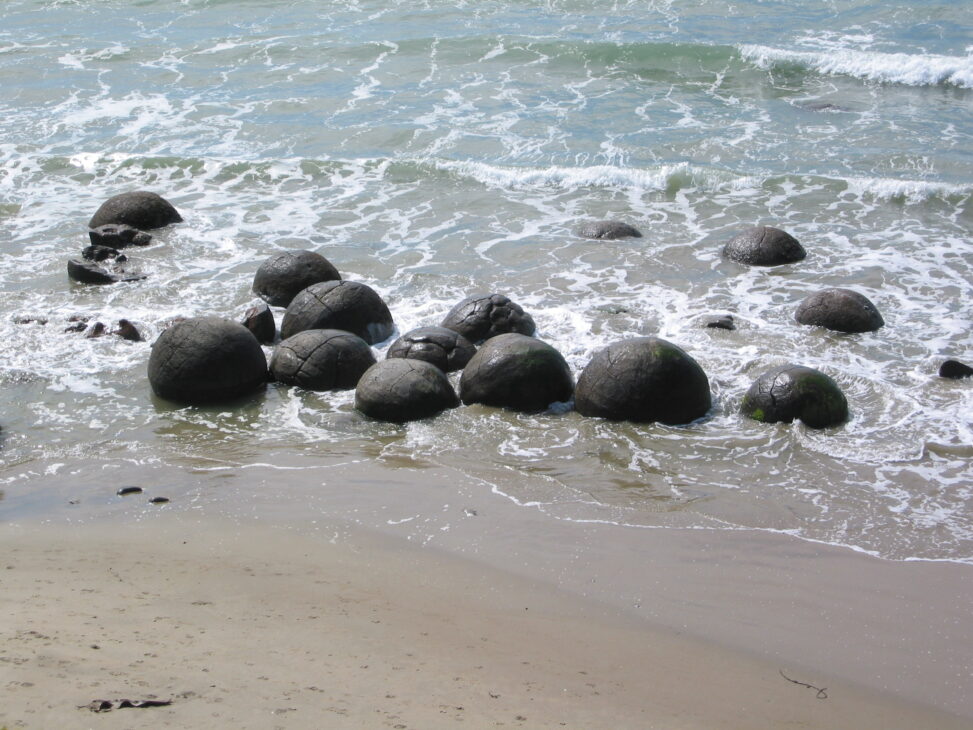
Over the years, the spheres have been mistaken for a variety of things. People sometimes take the Moeraki Boulders for dinosaur eggs, alien remnants, or evidence of the existence of giants. Although their enormous size and strange surface patterns are unique, round stones in nature are actually quite common — they are known as concretions, masses cemented by minerals that often form within layers of sediment.
The Maori culture, which has inhabited the Otago coast region for centuries, also has its own explanation for the spheres. Maori legends offer an explanation for the creation of the boulders, while science proposes others — and both coexist, adding layers of meaning to these formations that have long intrigued passersby. The question of their origin, therefore, is not new: it has accompanied these stones for generations.
Born at the bottom of the sea, 60 million years ago
To understand how something so perfect can arise naturally, it is necessary to go back tens of millions of years in time — to a time when present-day New Zealand was submerged under an ancient sea. About 60 million years ago, sediments accumulated at the bottom of the sea, containing small fragments like shells and plant remains. It was around these organic nuclei that it all began. Calcite — a calcium carbonate-based mineral — was slowly deposited around these small centers, forming spherical nodules with increasingly harder outer layers.
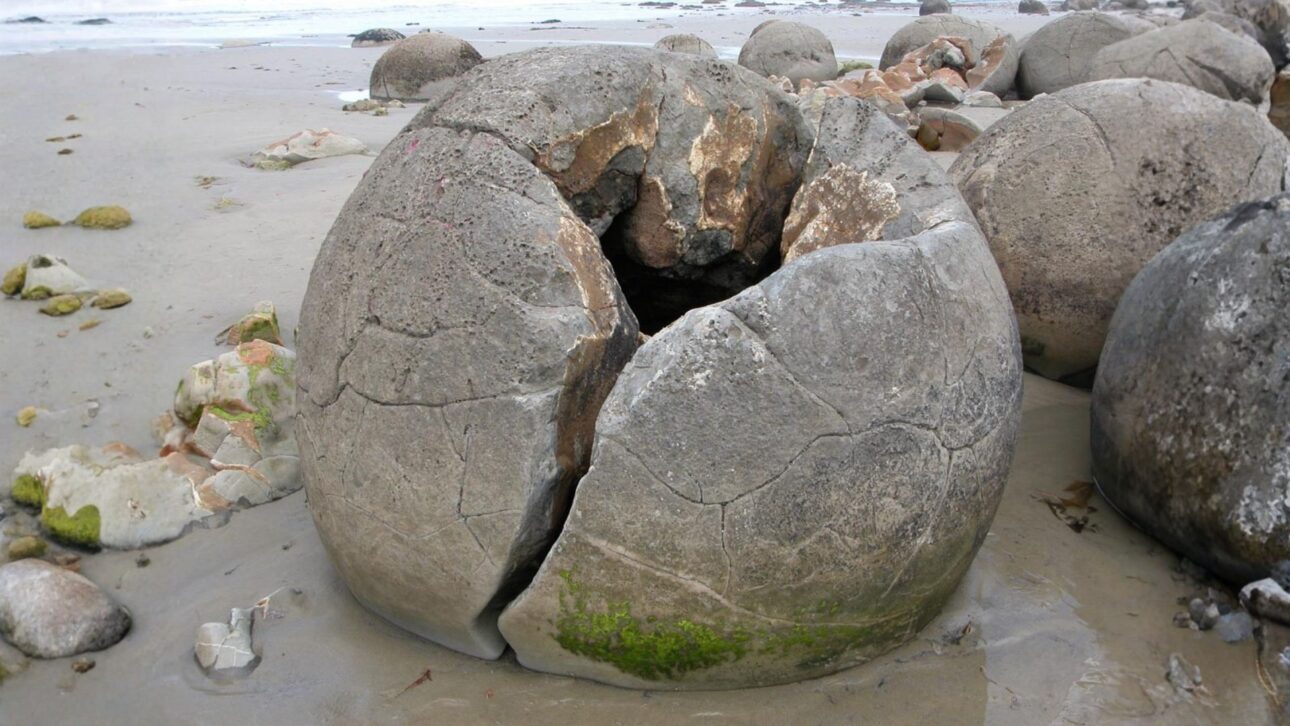
The process, interestingly, is very similar to that of a pearl. Each concretion began with an organic core — like a leaf, a pine cone, a shell, a fish spine, or another remnant of plant or animal —, and sedimentary and mineral particles, like calcite, aggregated around this organic matter in concentric layers.
The process is similar to how a natural pearl forms around a foreign particle inside an oyster: a complex chemical process, the minerals cemented the particles to each other, and the concretions grew slowly over millions of years. The perfectly spherical shape is not by chance: it indicates that the calcium diffused uniformly in all directions from the center, making the stone grow equally on all sides, like a ball.
Four million years to grow
If the origin of the spheres is already impressive, the time they took to reach their current size is what truly puts nature’s patience into perspective — a time scale that rivals human evolution itself. According to the New Zealand Geographic, in 1985, a study conducted by geologist Chuck Landis from the University of Otago and an American colleague concluded that the largest of the Moeraki concretions took an astonishing 4 million years to grow — a time period comparable to the entire evolutionary history of the human species. In other words, while these stones were silently forming at the bottom of the sea, the ancestors of human beings were just beginning to tread their evolutionary path.
According to data gathered by GeoTrips, the spheres are made of calcite that formed over several million years, after the sea floor mud had already been deposited and buried about 500 meters deep by overlying sediments. Formation temperatures of 25 to 35 degrees Celsius were calculated for the Moeraki Boulders. This detail is revealing: the spheres did not form on the surface, but in the Earth’s depths, under enormous pressure and at specific temperatures, over an almost inconceivable time for the human scale.
Concretions are relatively common in the mud rocks of New Zealand, but as GeoTrips notes, the perfect shape of the Moeraki ones is what sets them apart from all others. It is the sum of all these factors — the right core, uniform diffusion, pressure, time — that produced these rare geological masterpieces.
The golden secret hidden inside
The most surprising aspect of the Moeraki Boulders is only revealed when one of them breaks — and that’s when the seemingly ordinary stone shows why it is called a treasure. The Moeraki Boulders are what geologists call “septarian concretions” — stones whose internal cracks have been filled with mineral deposits. In some specimens, this internal pattern is exposed when the sphere splits.
The term “septarian” comes from the curious process that occurred inside these stones. According to the same source, calcite accumulated around the organic cores forming spherical nodules with harder outer layers, while the internal material dehydrated, generating cracks that spread radially towards the edge. It was these internal cracks that later filled with golden-yellow calcite, creating the honeycomb effect.
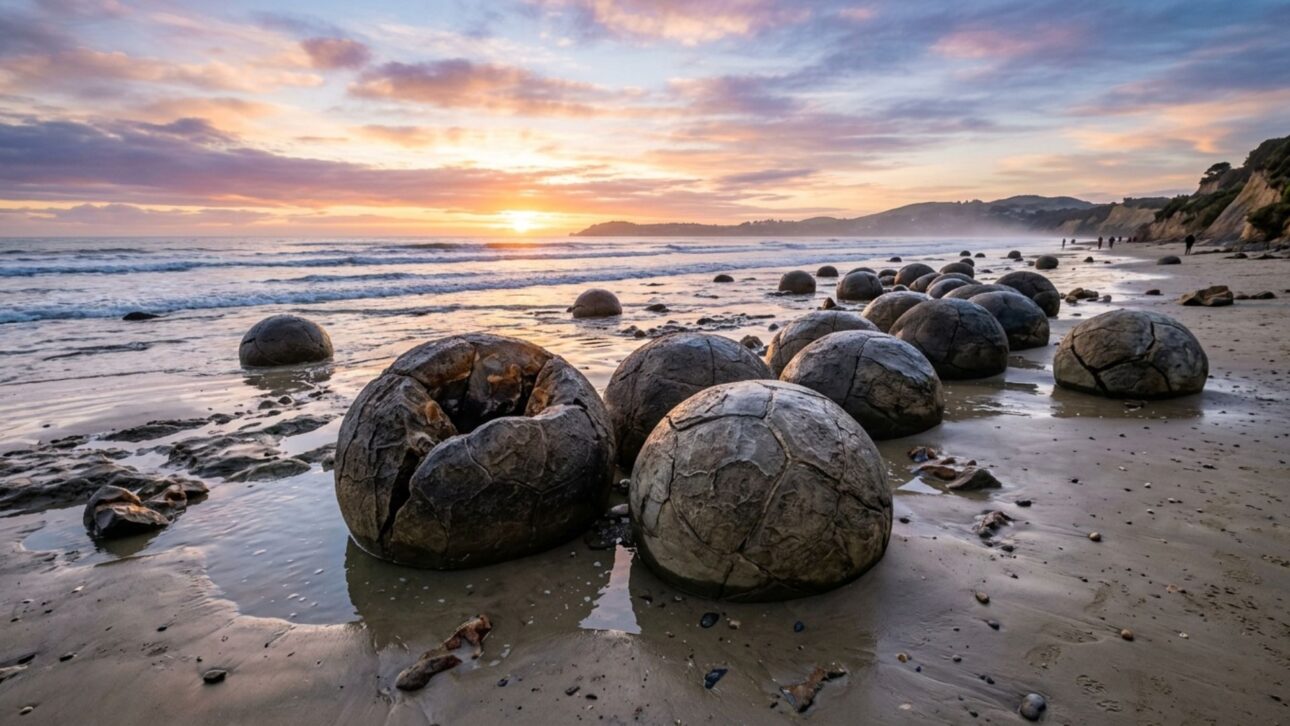
According to historical accounts gathered by Historic Mysteries, a 19th-century observer already described the stones like this: some were subglobular, others spherical; many were whole, while others were broken and shimmering with yellow and brown crystals of calcite spar. This contrast is what makes the spheres so magical: on the outside, a gray and sober stone; on the inside, a gleaming mosaic of golden veins dividing the surface into polygonal segments — a pattern so elaborate that, in other countries, it was mistaken for fossilized turtle shells. It is nature hiding jewels inside what seems to be just another rock on the beach.
A rare phenomenon, but not unique
As extraordinary as they are, the Moeraki Boulders are not completely alone in the world — and knowing their “cousins” helps to understand why they continue to be protected as a national treasure. Large and similar spherical concretions have been found in many other countries. New Zealand itself is home to close relatives of the Moeraki: the so-called Koutu Boulders, which also reach up to 3 meters in diameter and are almost spherical, and the Katiki Boulders, found about 19 kilometers to the south.
Interestingly, some of these neighboring concretions hold even greater surprises: unlike the Moeraki, some of them contain within them the bones of mosasaurs and plesiosaurs — giant marine reptiles from the dinosaur era. Similar concretions have also been discovered in Russia, Costa Rica, and Bosnia. But what keeps the Moeraki Boulders on a special level is the combination of enormous size and almost geometrically perfect shape — a rarity even among the world’s concretions.
Today, they are protected within a scientific reserve, and the coastal erosion continues, slowly, to do its work: every so often, the sea carves a new boulder from the mud cliff, and the newly exposed sphere rolls to the beach to join the others. The story of the Moeraki Boulders is, in the end, a powerful reminder that some of the planet’s greatest wonders were not made by human hands nor in the blink of an eye, but sculpted by chemistry, pressure, and above all, time — that invisible and infinitely patient artist.