Portuguese
  Spanish


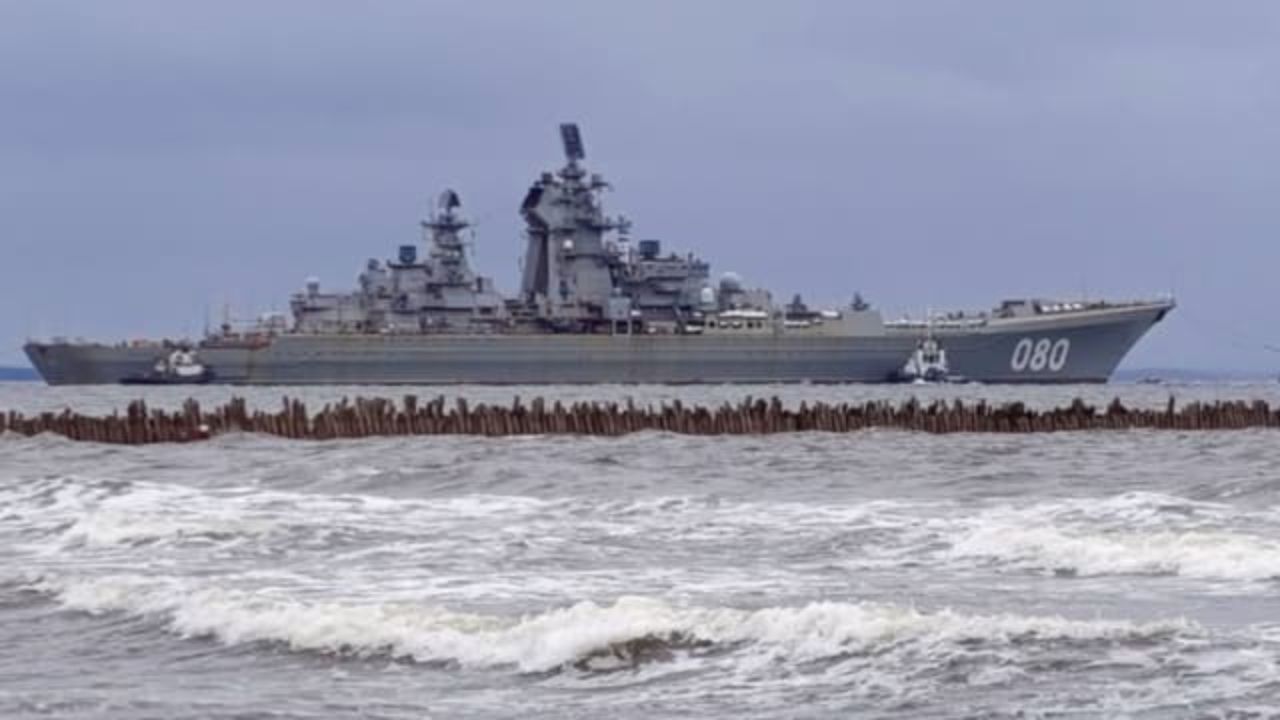

With Firepower Superior to American and Chinese Ships, Admiral Nakhimov Begins Sea Trials Aiming to Become the New Flagship of the Russian Fleet.
The Russian nuclear battlecruiser Admiral Nakhimov, a colossus of 28,000 tons from the Soviet era, has returned to sea trials for the first time since 1997. This milestone represents a breakthrough in one of Russia’s longest and most ambitious warship modernization projects, positioning the vessel as a centerpiece for the future of the country’s navy.
Admiral Nakhimov Back at Sea After 28 Years
The nuclear battlecruiser from the Cold War, Admiral Nakhimov, has started its factory trials in the White Sea. Launched in 1986 as Kalinin, the ship was renamed in 1992 in honor of Russian Admiral Pavel Nakhimov. It joined the Northern Fleet in 1988, but its last voyage occurred in 1997, remaining since then at the Sevmash shipyard for extensive modernization that started in 2014.
Shipbuilding authorities, cited by the TASS agency, have confirmed that the two nuclear reactors of the ship were restarted this year. The vessel can now move under its own power, a development reported directly to President Vladimir Putin.
-
U.S. Military Intervention Risk in Brazil Raises Alarm, Highlights National Sovereignty Amid Tensions Over Washington’s Terrorist Designation of PCC and Comando Vermelho

-
Brazilian Air Force’s Sole KC-30 Aircraft Completes Strategic Mission to Spain for 105mm Anti-Tank Ammunition for Leopard 1A5 Tanks

-
Brazilian Air Force Seeks to Acquire More Gripen Fighter Jets
-
U.S. Air Force Launches Air-to-Air Missile Project with Range of Up to 1,850 km for Indo-Pacific Operations




A Floating Fortress of Missiles
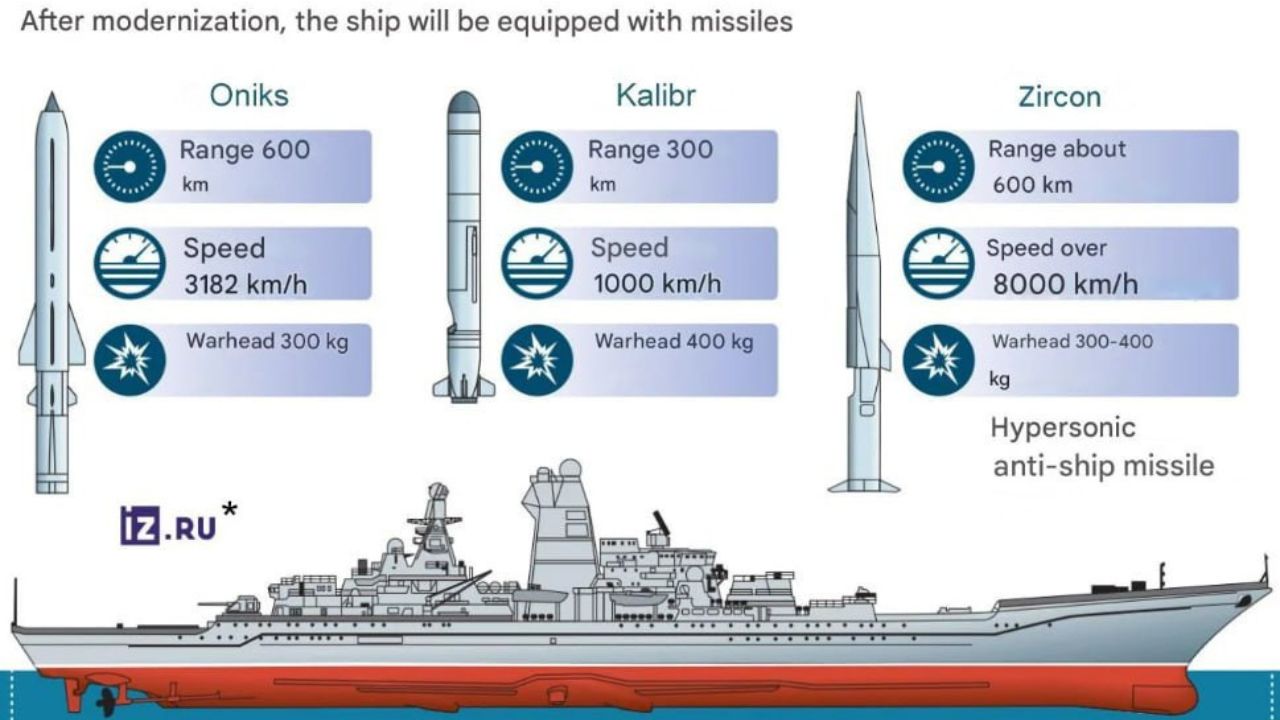
The refurbishment of Admiral Nakhimov is described as the most extensive ever conducted on a Russian surface combat vessel. The goal is to transform it into the future flagship of the Russian Navy.
At the heart of the modernization is the installation of 174 vertical launch tubes. This number gives the ship a missile capacity superior to that of other surface combatants. In comparison, China’s Type 055 destroyers have 112 cells, while the U.S. Ticonderoga-class cruisers carry 122.
Hypersonic Missiles and Advanced Defense
Of the total new cells, 78 are designed for a combination of Kalibr cruise missiles, Oniks supersonic missiles, and advanced Zircon hypersonic weapons. The remaining cells will be allocated for S-300FM Fort surface-to-air missiles, with the possibility of integrating new interceptors based on the S-400 system.
For short-range defense, combined cannon and missile systems Pantsir-M will be utilized. The refurbishment also includes new radars, command systems, and the replacement of the main gun with the modern AK-192M 130 mm system.
A Long-Term Project
The modernization project has faced numerous delays. The initial completion estimate was 2018, but the deadline was postponed to 2020, 2021, and subsequently to 2024. Analysts warn that it is still unclear how many of the new weapon systems and sensors have actually been installed. The true combat effectiveness of the modernized ship remains an open question.
The Future Flagship of the Russian Navy
The Kirov class is the only class of nuclear-powered surface combat ships in the world, since the U.S. Navy retired its nuclear cruisers in the 1990s. Admiral Nakhimov is the first of the class to undergo such comprehensive modernization.
Her sister ship, Pyotr Velikiy, the current flagship of the Northern Fleet, is expected to be decommissioned as soon as Admiral Nakhimov returns to service. With the future of Russia’s only aircraft carrier, Admiral Kuznetsov, being uncertain, the modernized Admiral Nakhimov is expected to become the centerpiece of Russia’s future surface fleet.