Portuguese
  Spanish


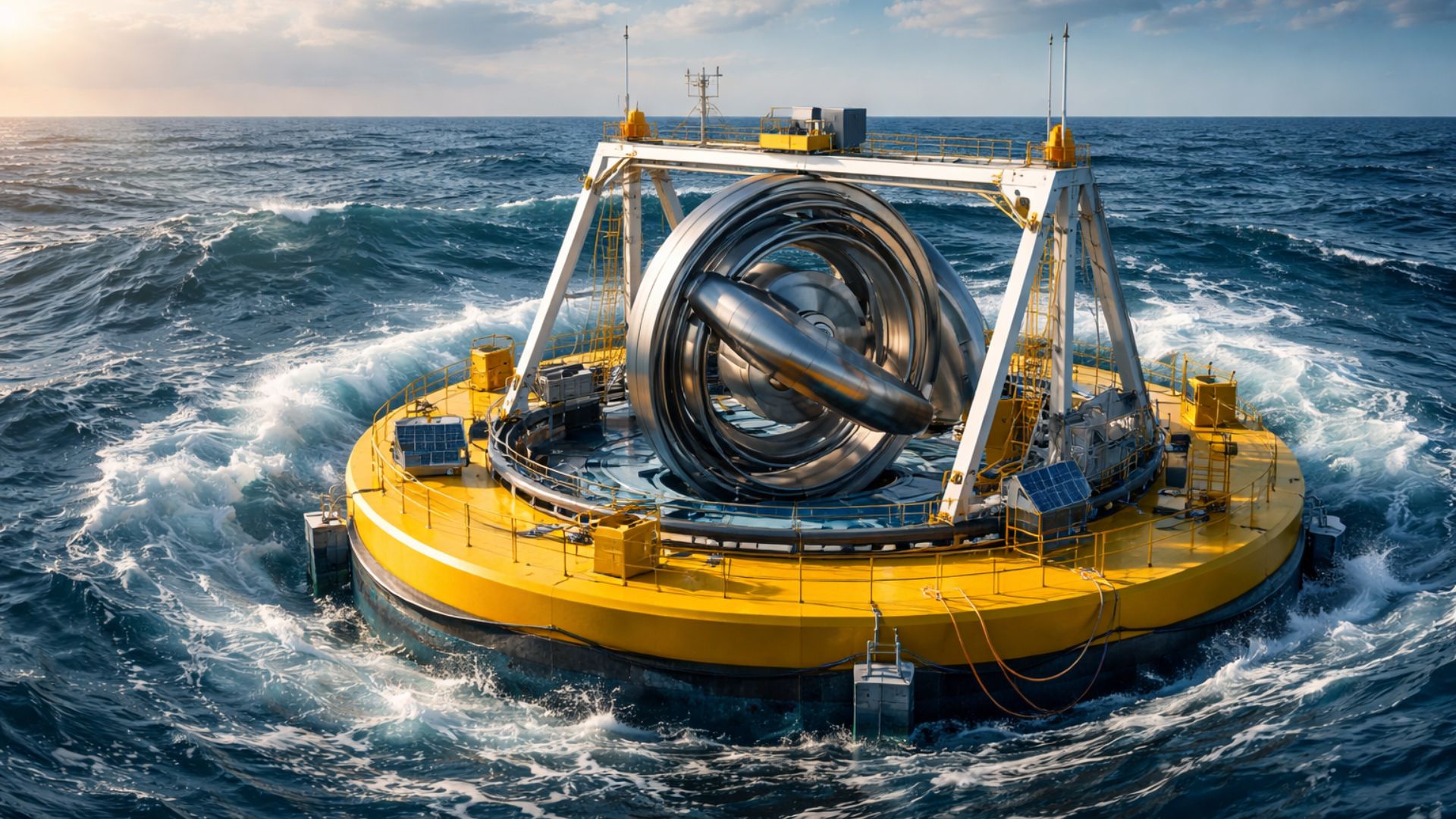


Study Published by Japanese Scientists Reveals How a Gyroscope-Based System Can Enhance Ocean Energy Efficiency, Overcoming Technical Limitations of Renewable Sources and Paving the Way for More Stable and Predictable Electricity Generation.
The ocean waves represent one of the largest natural reserves of clean energy available on the planet. Yet, transforming the irregular motion of the sea into reliable, large-scale electricity remains a technological challenge. According to an article published by the website Segunda Base on Wednesday (18), a study conducted by Japanese scientists from Osaka University analyzes a promising solution: a gyroscope-based system capable of enhancing ocean energy efficiency even in the face of constant wave variation.
Understand Why This Advancement by Japanese Scientists with Ocean Energy Is So Significant
The research was published in the scientific journal Journal of Fluid Mechanics and examines the so-called gyroscopic wave energy converter. The work evaluates whether this model can realistically sustain large-scale electricity generation and compete with other renewable sources.
The results indicate that with proper adjustments, the device can achieve the theoretical maximum efficiency of absorbing half of the energy available in the incident wave, a fundamental limit already known in wave energy theory.
-
What is a red flashlight used for, after all? See why it is so commonly used at night.

-
He has never read a line of code, but he already knows how to work: the French company UMA presented in Paris the Northstar, its first AI-powered humanoid robot designed for factories and warehouses, capable of copying tasks just by observing an employee in action.

-
A young Kenyan engineer collects plastic waste from the streets and transforms it into robots that translate physics lessons into sign language in real-time, a machine made with old bottles that teaches what was missing to deaf children left out of science.
-
What is the dark substance found in the sand of Ipanema Beach? Civil Police conduct an examination, collect samples of the material, and initiate an investigation to identify the composition, clarify the origin, and verify if there was an environmental crime.




The advancement is not only in maximum performance but in the ability to maintain high energy absorption across a wide range of ocean frequencies. This could redefine the role of ocean energy in the global electricity matrix.
Why Ocean Energy Still Faces Technical Barriers in the Modern Ocean
Ocean energy is considered one of the most stable renewable sources on the planet. Unlike solar energy, which depends on sunlight, or wind energy, which depends on wind intensity, ocean waves result from broad atmospheric systems and can be predicted further in advance.
Still, most current devices exhibit significant limitations. Many systems operate efficiently only within a specific range of wave frequencies. As the ocean is constantly changing, this restriction reduces the average annual efficiency of the equipment.
This technical difficulty has delayed the commercial consolidation of ocean energy. Despite the large potential estimated by international energy agencies, the share of ocean technologies in the global electricity matrix remains small compared to other established renewable sources. It is precisely in this scenario that the study by Japanese scientists gains strategic relevance.

Gyroscope Applied to Ocean Energy: The Logic Behind Precession in the Ocean
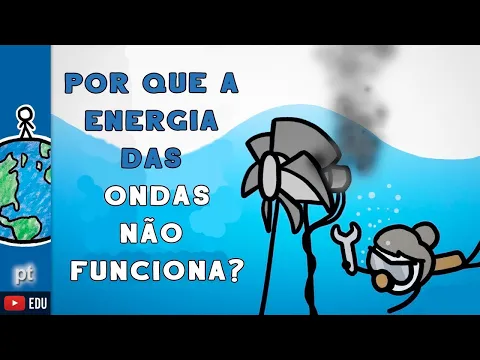
The concept analyzed by the Japanese scientists is based on a rotating flywheel installed within a floating platform in the ocean. This flywheel acts like a gyroscope, a fundamental element for the system’s operation.
When the waves cause the structure to oscillate, the rotating flywheel reacts to external forces through a physical phenomenon known as gyroscopic precession. In simple terms, when a rotating object is influenced by an external force, its axis of rotation changes its orientation.
In the case of the gyroscopic wave energy converter, this precession movement is connected to an electric generator. Thus, the tilt caused by the ocean waves is not wasted. It transforms into useful motion and, consequently, into electricity.
According to Takahito Iida, the study’s author, wave energy devices are challenging because ocean conditions continuously change. However, the gyroscope-based system can be controlled to maintain high energy absorption even when wave frequencies vary.
This adjustable control differentiates the technology from many traditional models of renewable maritime sources.
Mathematical Modeling Reveals Theoretical Limit of Half the Energy of the Sea
To understand the system’s performance, the Japanese scientists utilized linear wave theory. The modeling analyzed the interaction between the ocean waves, the floating platform, and the internal gyroscope.
The study confirmed that there is a fundamental limit in wave energy theory: the maximum that a device can absorb corresponds to half of the energy of the incident wave. This half value was already known in the scientific literature as a theoretical constraint.
What makes the result relevant is that the gyroscopic converter can achieve this maximum efficiency not only at a specific frequency but across a wide range of wave frequencies. This means that ocean energy can be captured more consistently, even when the state of the ocean changes.
Instead of relying on a single resonance point, the system can be adjusted for different maritime scenarios. This factor increases the technical viability and brings technology closer to the practical requirements of modern renewable sources.
Simulations in the Frequency and Time Domain Reinforce Performance in the Real Ocean
In addition to analytical modeling, the Japanese scientists conducted numerical simulations in both the frequency and time domains. These tests allowed for the evaluation of the gyroscope’s behavior in situations closer to operational reality.
The additional simulations included nonlinear gyroscopic behavior, important for understanding possible limitations of the system. The results showed that the device maintains high efficiency close to its resonance frequency, meaning when the motion of the structure matches the natural rhythm of the ocean waves.
Even with the inclusion of nonlinear effects, performance remained consistent. This indicates that the theoretical model has solid foundations and potential for practical applications in ocean energy generation.
The validation through simulations enhances the scientific credibility of the study and provides concrete guidelines for future full-scale prototypes.
Japanese Scientists and the Strategic Impact on Global Renewable Sources
The energy transition requires diversification. Solar and wind energy lead the expansion of renewable sources, but experts point out the need for complementarity between technologies to ensure grid stability.
Ocean energy can play this complementary role. The ocean offers an abundant, predictable, and still largely underexplored resource. The introduction of gyroscope-based systems can enhance average efficiency and reduce one of the main barriers to the technology.
Although the study is still in the theoretical and simulation stage, it provides clear parameters for the construction of more flexible devices. The dynamic adjustment capability of the gyroscope allows it to respond to different wave patterns without significant loss of performance.
If the results are confirmed in maritime tests, the impact could be significant for countries with extensive coastal areas. Diversifying renewable sources strengthens energy security and reduces dependence on fossil fuels.
What This Advancement Represents for the Future of Ocean Energy
The work of the Japanese scientists demonstrates that historical challenges of ocean energy can be addressed with solutions based on well-established physical principles. The application of the gyroscope to energy conversion broadens the operational range of the device and brings the technology closer to the theoretical limit of half the energy available in the wave.
In a global context seeking to reduce emissions and increase the use of renewable sources, the ocean emerges as a strategic frontier. The combination of predictability, abundance, and technical potential makes ocean energy a relevant candidate in the energy transition.
There are still important steps ahead, such as real-scale testing and evaluation of operational costs. However, the study published in the Journal of Fluid Mechanics provides consistent scientific evidence that gyroscopic precession can transform how ocean energy is captured.
By integrating gyroscopes, advanced modeling, and detailed simulations, the Japanese scientists present an approach that challenges traditional technical limits and broadens the horizon of renewable sources. If confirmed in practice, this innovation could position the ocean as one of the energy pillars of a sustainable future.