Portuguese
  Spanish


Proposal under review in the Senate provides for income tax exemption for military personnel, military police, and firefighters, including salaries, pensions, and paid reserves, while the legislative process continues without a finalized calculation of the fiscal waiver associated with the measure.
The Federal Senate is analyzing the Bill 2557/2026, which proposes to exempt from Personal Income Tax the income received by Armed Forces military personnel, military police, and military firefighters.
According to the presented draft, the proposal covers salaries, pensions, paid reserves, and reform, without distinguishing by rank, grade, or functional status of the members of the covered categories.
The matter was presented by the Senate’s Human Rights and Participatory Legislation Committee on May 21, 2026, and in the available legislative update, it appears to be under consideration in the House Plenary.
-
Tesla injected an additional $250 million into the German factory, doubled the battery cell target, and opened its own production line for startups.

-
A 180-meter ship with a deck the size of a football field was christened to carry 25,000 tons of giant energy modules around the world.
-
To erect the “Baleia” building on the richest avenue in Brazil, he bought 35 houses, paying with trips to Disney, a truck, and even an apartment, waited over 20 years, and today the complex is valued at R$ 2.5 billion.
-
The land belonged to her great-great-grandfather and was worth R$ 25 per square meter during the pandemic; the couple sold 250,000 m² for the nearly R$ 30 billion project that is transforming the “neighbor of Jericoacoara,” and today a house in the region goes for R$ 4.2 million.


Since May 29, 2026, the project has been awaiting dispatch, a stage that precedes the definition of the referral for analysis by the committees responsible for evaluating the merit and legal adequacy.
The deadline for submitting amendments ended on May 28, one week after the formal presentation of the proposal by the Human Rights and Participatory Legislation Committee.
According to the text under review, the exemption would apply to military personnel of the Navy, Army, and Air Force, as well as members of the Military Police and Military Fire Departments of the states, the Federal District, and the territories.
With this wording, the benefit would not be restricted to active military personnel and would also reach individuals in paid inactivity, provided that the income is directly linked to the military career.
Income Tax Exemption for Military Personnel
The proposal addresses income directly linked to the exercise of the military position and payments arising from this functional relationship with the Armed Forces, Military Police, and Military Fire Departments.
This group includes amounts received as work remuneration, retirement benefits, paid reserves, and reform, provided that the source of payment is linked to the military career.
The wording also delineates which revenues would be outside the scope of the exemption, preventing the benefit from being applied to income without a direct relation to military activity.
Remain outside the measure rentals, capital gains, alimony, benefits not directly linked to military activity, and income from spouse, partner, or dependent.
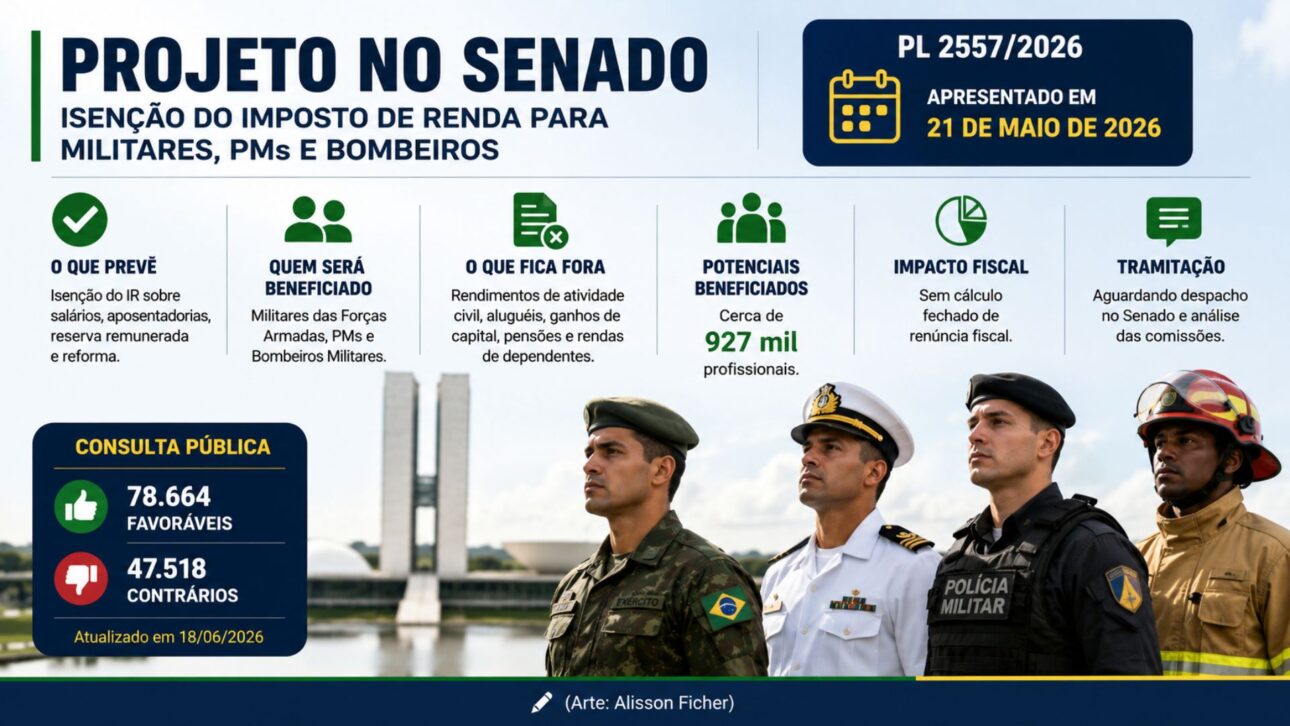
Income obtained from civil activities carried out in parallel, even if occasionally, would also not be covered by the exemption provided for in Bill 2557/2026.
Even with the proposed exemption, the project maintains the obligation for beneficiaries to submit the Annual Income Tax Adjustment Declaration according to the general rules of the Federal Revenue.
If the proposal is approved, the exempt amounts must be reported in a specific field to allow fiscal control and assessment of contributory capacity.
Military personnel, PMs, and firefighters among the beneficiaries
The estimated reach of the proposal exceeds 900,000 people when adding up military personnel from the Armed Forces, military police, military firefighters, and, by the amendment presented, civil police from the Federal District.
A survey cited by Money Times points to 927,000 professionals potentially reached, considering the groups provided for in the original project and the category included by amendment during the legislative period.
According to the publication, this calculation includes about 450,000 military personnel from the Armed Forces, 405,000 military police, 67,000 firefighters, and 5,000 civil police from the Federal District.
The Civil Police of the Federal District does not appear in the original text of the PL but was included in an amendment presented by Senator Izalci Lucas, from the PL of the Federal District.
On the Senate’s page of the matter, there is a record of only one amendment presented until the deadline for changes to the initial text expired.
The document was filed on May 28 and received the next day, aiming to extend the exemption to members of the Civil Police of the Federal District.
Fiscal impact of the exemption has not yet been calculated
The initial text of Bill 2557/2026 does not present a calculation of the fiscal impact of the exemption nor defines, in the main wording, the estimated value of the revenue waiver.
The proposal’s justification states that merit adjustments, including income ceilings and possible fiscal compensation measures, may be discussed during the proceedings in the National Congress.
With this, the matter reached the Senate without a finalized estimate of the exemption’s effect on federal revenue and without a compensation rule incorporated into the presented text.
The legislative analysis may indicate whether there will be an income limit, changes in the scope of the measure, or the inclusion of budgetary adjustment mechanisms during the proceedings.
Money Times reported that the project awaits dispatch for legal and budgetary analysis in the Senate committees, citing the Constitution and Justice Committee and the Economic Affairs Committee as expected evaluation stages.
According to the portal, the absence of a tax waiver estimate is one of the points mentioned in the discussion about the proposal’s budgetary effects.
Legislative Idea on e-Cidadania


The bill originated from Legislative Idea No. 213.133, registered on the e-Cidadania portal, a Senate tool that allows the submission of suggestions for creating or amending laws.
The official justification states that the suggestion received 25,703 popular supports before being accepted by the Human Rights and Participative Legislation Committee.
In the document, the committee states that the measure seeks to recognize specific characteristics of the military career, such as full dedication, hierarchy, discipline, and continuous availability to the State.
The justification also mentions restrictions on political and labor rights, exposure to risks, and subjection to specific norms as grounds used to advocate for differentiated tax treatment.
The exemption is described in the proposal as a measure of “compensatory nature” and “functional appreciation policy,” expressions used by the committee in defense of the initiative.
The document also states that the proposal would not be confused with privilege, but with recognition of the peculiarities of the military regime, according to the justification presented by the Human Rights and Participative Legislation Committee.
Public Consultation on PL 2557/2026
The public consultation linked to the matter on the Senate portal remains open for popular expression during the proceedings of Bill 2557/2026.
In the update recorded on June 18, 2026, at 1:41 PM, the bill’s page indicated 78,664 favorable votes and 47,518 opposed.
Although it has already been formally presented and received an amendment, the proposal still does not produce an immediate change in the income tax collection for military personnel, military police, and firefighters.
To become law, the project needs to go through the stages of analysis in the Senate, pass through the House of Representatives if approved by the senators, and proceed to presidential sanction or veto.