Portuguese
  Spanish


Between August 2001 and April 2010, the New York transportation authority (the MTA) removed from service, cleaned, and sank more than 2,500 retired subway cars into the bottom of the Atlantic Ocean, off the east coast of the United States. The plan seemed crazy, to throw tons of old steel into the sea, but each shell became the seed of an artificial reef that today teems with fish and attracts divers from all over the country.
According to the New York Transit Museum, the official museum of the system, between August 2001 and April 2010 the MTA deposited more than 2,500 decommissioned subway cars at points in the Atlantic off states like New Jersey, Delaware, Virginia, South Carolina, and Georgia, thus transforming sections of the seabed that were “barren deserts” into a habitat rich in life. And according to information from the DNREC portal, Delaware’s natural resources agency, the most famous of these points earned the nickname Redbird Reef, the artificial reef named after the red paint scheme of those trains that began descending there in 2001.
The red trains that New York wanted to retire
For decades, the Redbird series cars (models R26 to R36) ran through the city’s lines carrying millions of passengers. They were steel trains painted bright red, as much a part of the landscape as the skyscrapers. At the end of their useful life, however, the fleet was too old, and the MTA needed to decide what to do with a mountain of cars no longer useful on the tracks.
The traditional solution would be to send everything to the scrapyard, cut each car into pieces, and sell it as scrap. But someone had a different, even bold idea. What if, instead of becoming trash, those subway cars descended to the bottom of the sea to serve as a home for schools of fish and other creatures? It was the gamble behind what would become one of the largest artificial reef projects ever attempted in the United States.
-
From matches sold by bicycle at age 5 to a global furniture empire: the lumberjack’s son founded IKEA at 17 in his uncle’s kitchen and transformed a small company into the largest furniture retailer on the planet.

-
The mansion in Flamengo, built in 1865 for the Baron of São Clemente and closed for 20 years, has become a spa, event hall, and gym for “Symphony,” a luxury condominium that sold 70% of its gross development value in the first month on the R$ 60 million land of the former Bennett College.

-
The Ipiranga convent, a 1924 building adjacent to the Museum that remained vacant for a decade and became home to dozens of cats, is reborn as “Alma Mater,” a luxury development worth R$ 130 million with a pool in the courtyard and a clubhouse in the former nuns’ chapel.

-
An empty pool of almost 3 meters turned into tilapia farming in the backyard after a family transformed the dangerous space for children into an urban greenhouse with eggs and organic food.




The idea was not new in theory. Purposefully sunk structures often become reefs because they offer a hard surface where marine life can cling amidst a soft bed. But doing this with more than 2,500 subway cars from an entire city was another scale. New York would transform its retired transportation into bricks of a new kind of city, submerged and silent, in the dark of the Atlantic.
The cleaning before becoming an artificial reef
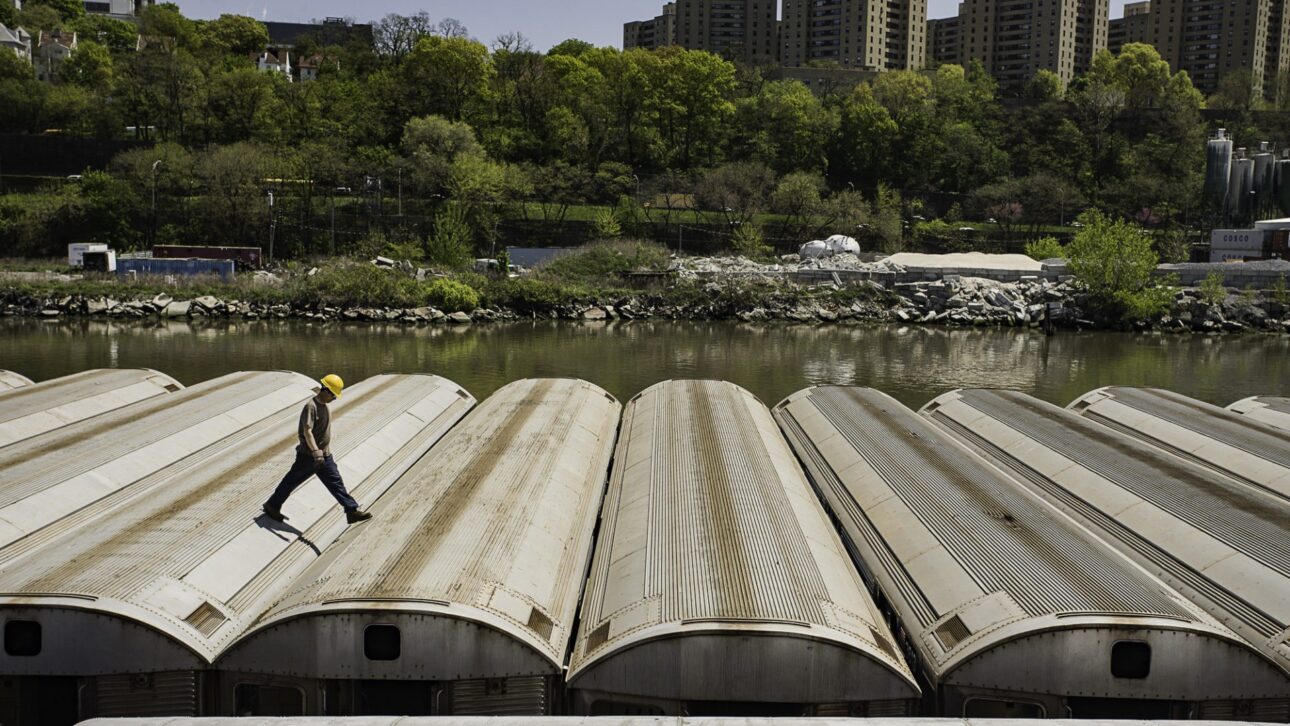
Before any car touched the water, the less glamorous and most important part of the project came. Each unit needed to be emptied of anything that could pollute the sea. Teams removed the asbestos used in the old insulation, stripped the wheels and steel axles, took out doors, windows, seats, and wiring, leaving only the clean metal shell that would serve as the skeleton for the artificial reef.
This care was what separated a serious project from a simple irresponsible disposal. A car full of oil, plastic, and toxic material would poison the water instead of housing the fauna. Therefore, each carcass left the workshops reduced to the bone, only steel and aluminum, ready to become a permanent structure without releasing contaminants into the surrounding marine life.
The work was repetitive and time-consuming, multiplied more than 2,500 times. One by one, the subway cars were inspected, cleaned, and certified. Only then did they receive the stamp that allowed the final journey. What entered as the city’s retired transportation left as a building block for the future reef, ready to start a second life far from the tracks.
The day the cars were thrown into the sea
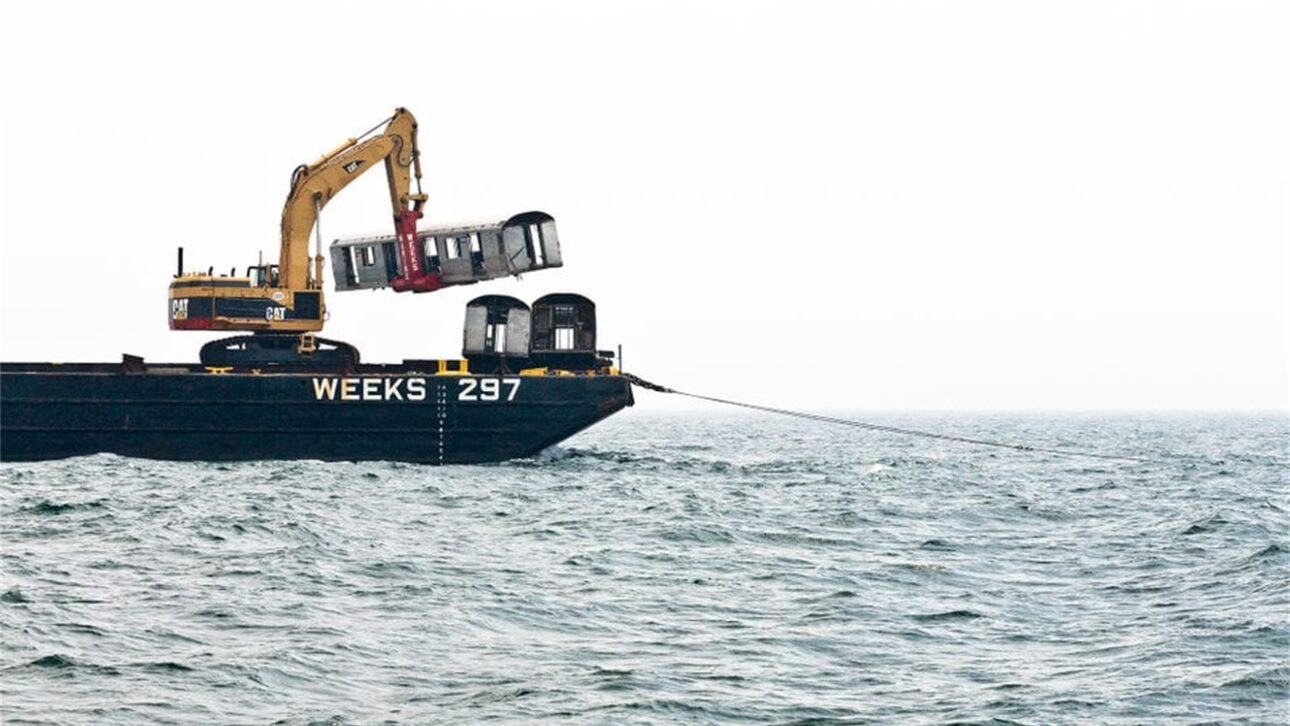
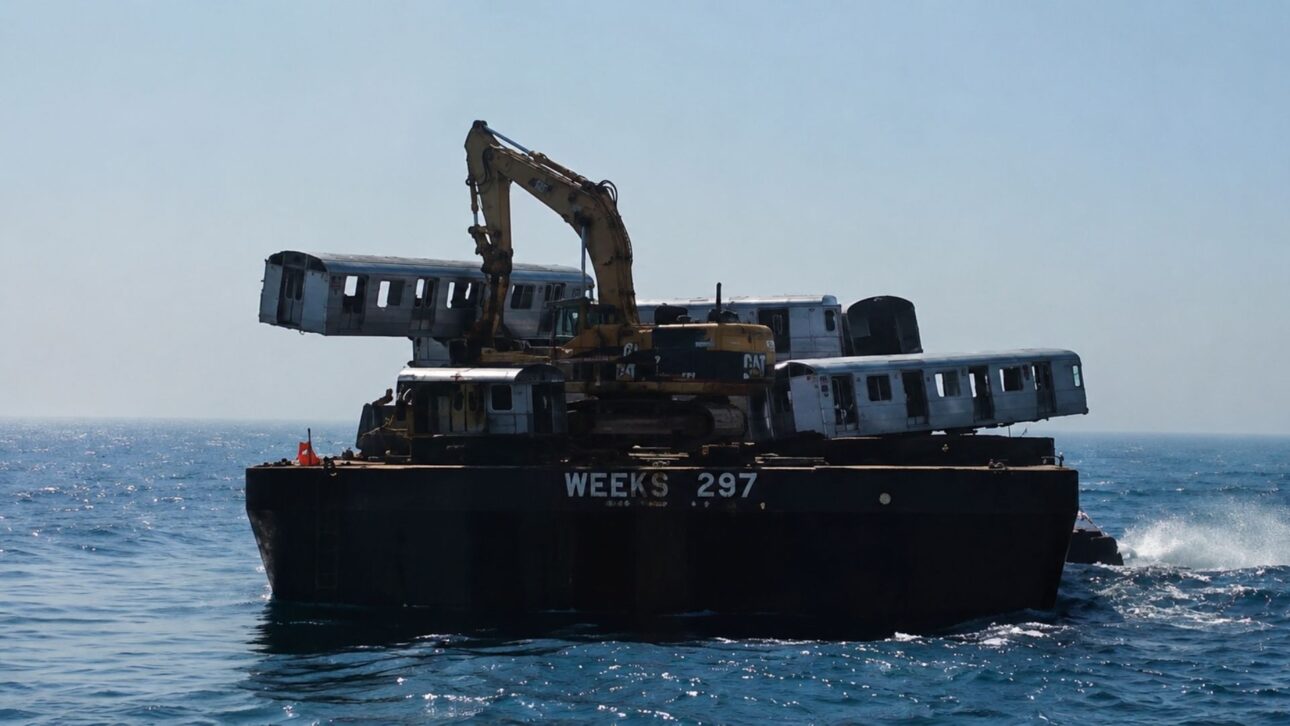
The most impressive scene of the project happened far from the mainland. Huge barges were loaded with dozens of subway cars stacked like giant toys and towed to marked points in the Atlantic. There, off the east coast, cranes and tractors pushed the cars one by one off the platform until they plunged into the sea.
Each wagon hit the water with a crash, raised a wall of white foam, and sank slowly spinning towards the seabed. In a few seconds, the red steel that once crossed New York disappeared under the Atlantic waves. At the bottom, a few meters deep, the car settled in the sand and instantly became the raw material for a new artificial reef.
The images of these dives spread worldwide. Seeing an entire wagon falling into the sea has something surreal, almost dreamlike, and it was precisely this strangeness that drew attention to the project. But beneath the surface, there was nothing poetic yet. There was only silence, cold water, and a piece of the city newly arrived at the bottom, waiting for marine life to decide to appear.
A desert at the bottom of the ocean
To understand why this artificial reef made such a difference, you need to imagine what the scenario was like before. Much of the ocean floor near the coast is not a colorful garden but a monotonous plain of sand and mud, without relief, without hiding places, without food. It is what Delaware’s own environmental agency describes as a virtually shapeless bed, where few species have reason to stay.
In this type of submerged desert, marine life passes by. There are no walls where mussels can attach, nor crevices where small creatures can hide from predators. The energy of the sea exists, but there is no structure to hold it. It’s like a vacant lot in the middle of the city, full of space and empty of people, waiting for someone to build something that gives life a reason to arrive.
It was exactly this void that New York’s subway cars came to fill. Each steel carcass left on the sand functioned like a newly inaugurated building in a deserted neighborhood. Suddenly, there was a roof, wall, column, and shade at the bottom of the ocean. And where there was once only sterile sand, an artificial reef began to emerge capable of sustaining fish, mollusks, and an entire chain of life.
The artificial reef that no one expected
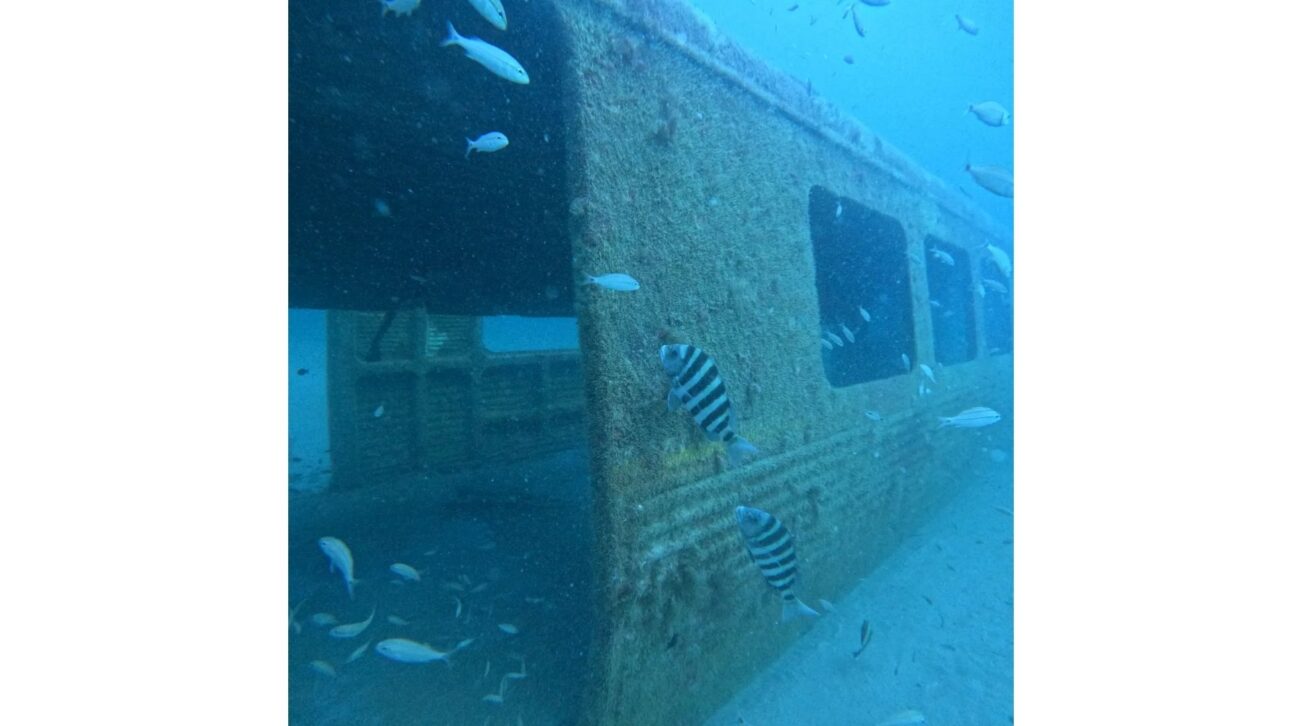
The most famous point of all is off the coast of Delaware and was nicknamed Redbird Reef, a direct tribute to the color of the trains that formed it. According to the state environmental agency’s record, the MTA donated more than 600 of those cars, about fifteen meters long, to build this artificial reef, which became the best-known along the entire local coast.
Scattered across the seabed, the cars created a steel labyrinth that nature quickly took over. Each unit became a piece of a much larger steel mosaic, with corridors, hideouts, and surfaces in all directions. What was once urban transportation for the metropolis became underwater architecture, an entire neighborhood built with subway scrap.
The name Redbird Reef caught on because it told the whole story in two words. On one side, the red of the iconic trains. On the other, the word reef, which promises life where there was once desert. And it was this promise that was fulfilled, transforming a heap of discarded wagons into the most visited artificial reef in that part of the Atlantic.
The explosion of fish and marine life
What happened next surprised even those who bet on the project. In no time, the steel structure was covered by a carpet of blue mussels, barnacles, and algae, which clung to the walls of the subway cars like a living skin. These organisms became abundant food, and the food attracted fish, and they attracted larger predators, in a chain reaction that filled the structure with life.
Today, Redbird Reef teems with species that hardly appeared there before. According to Delaware’s agency survey, fish like tautog, black sea bass, scup, spadefish, and triggerfish swim through the artificial reef, along with heavyweight hunters like bluefish and striped bass. Where there was once empty sand, now there are schools swirling among the cars each season of the year.
The explanation is simple and powerful. The soft seabed offered little food and no shelter, while the new structure offers both in abundance. Each subway car became both a dining hall and a fortress, a place where small fish hide and large ones come to hunt. The density of marine life around these structures is many times greater than on the smooth sand that existed before in the ocean.
The most beautiful thing is that this abundance has not stopped growing. Each season adds new layers of mussels and new generations of fish to the artificial reef, which becomes richer each year. A project that started as a way to get rid of old trains turned into a living factory, sustaining an entire food chain that did not exist in that part of the Atlantic.
Divers and fishermen discover the submerged treasure
Where there are fish, people come. Redbird Reef has become a destination for thousands of fishermen and divers who descend every year to see up close what became of that pile of subway cars. For fishermen, the artificial reef is a guarantee of a taut line, a fertile fishing ground where black sea bass and tautog bite all year round.
For divers, the experience is even stranger and more fascinating. Descending to the ocean floor and finding cars covered in marine life, with fish entering and exiting through the empty windows, is like visiting a ghost town that nature has reclaimed. Each unit is a small submerged museum, half New York machine, half artificial reef pulsating with life.
This attraction transformed the local economy. The submerged reef became a reason for travel, boat rental, diving courses, and fishing trips. A transport that the city was going to discard ended up generating income at sea, proving that a well-planned artificial reef can be worth much more sunk than it would be as scrap on land.
Trash that became a legacy at the bottom of the ocean
Twenty-some years after the first dive, the outcome is hard to dispute. More than 2,500 subway cars that New York didn’t know where to place now support fish, mussels, and divers at various points in the Atlantic. What would have been a disposal cost turned into economy and life, all at once, in the form of a submerged reef.


Of course, the project did not go without criticism. Some turned up their noses at the idea of dumping steel in the ocean, fearing it was just a cover-up for an underwater landfill. That’s why the rigorous cleaning of each car mattered so much, and that’s why the result, an artificial reef full of fish, silenced many of the doubts over time.
In the end, the story of the Redbird Reef changed the way many people view the very concept of trash. A retired subway car, seemingly doomed to the junkyard, became a home, refuge, and dining hall for marine life at the bottom of the sea. Few objects sink so low and rise so high in value as these red trains from New York that became an artificial reef.
And perhaps this is the question that the artificial reef returns to each diver who descends there: how many other things that we call trash today are just waiting for the right chance to become life at the bottom of the ocean?