Portuguese
  Spanish


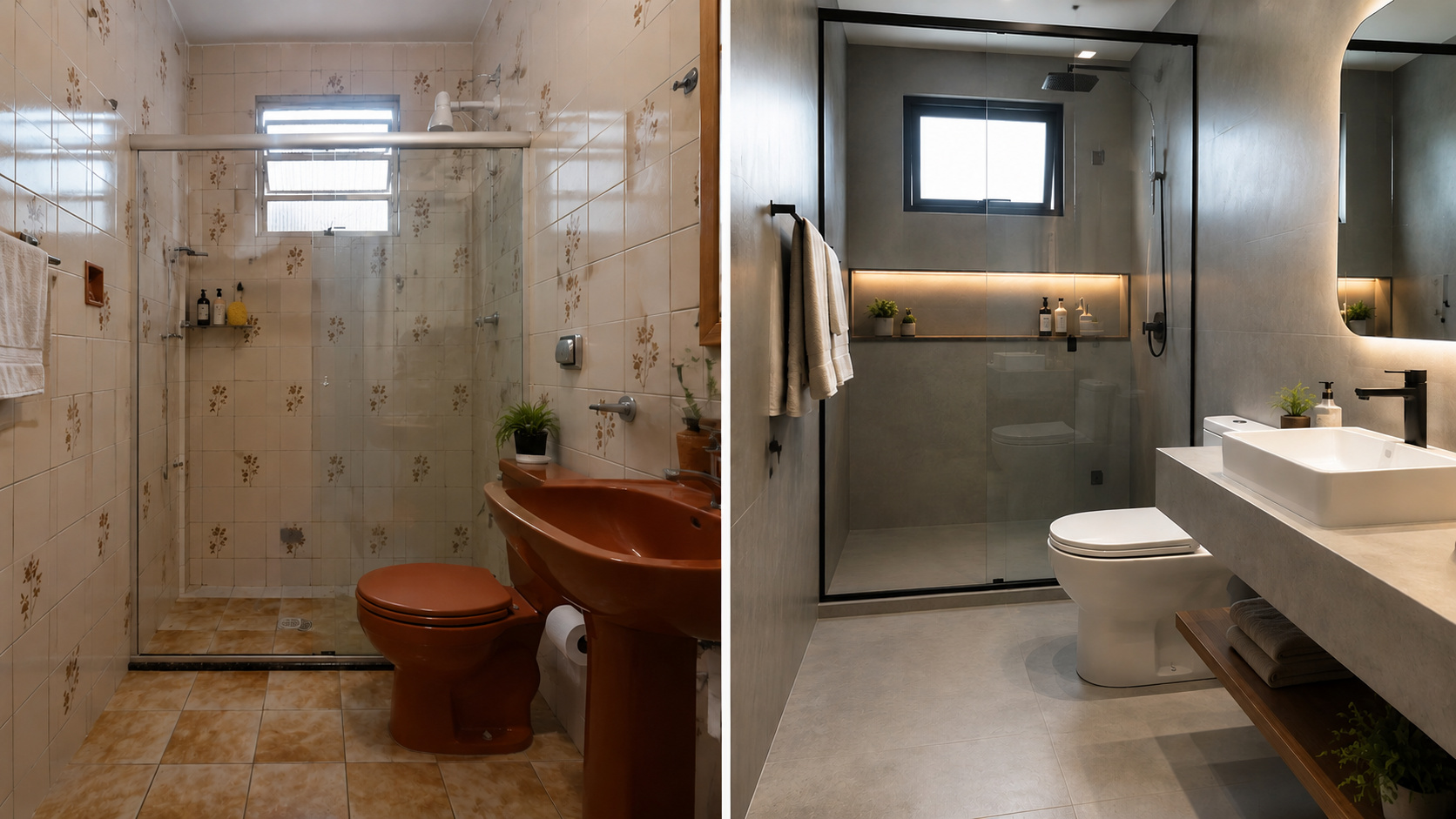

Discover how to renovate the bathroom without construction using adhesive tiles, special paints, and bathroom coatings, reducing costs and avoiding debris.
Replacing bathroom coverings always meant facing days of noise, dust spread throughout the house, and a dumpster parked at the door. However, this scenario has changed drastically. The application of modern materials — such as microcement, vinyl adhesives, and epoxy paints — allows creating a new covering over old tiles without the need to remove them.
According to information from Super Rádio Tupi on July 8, 2026, the trend of creating a bathroom without construction has established itself as a practical, quick, and highly accessible alternative for those who wish to update the look of the space with minimal disruption and maximum efficiency, reducing costs by up to 70%.
Why cover the walls instead of generating debris?
The choice not to break walls and floors goes beyond direct financial savings. It preserves the property’s structure and avoids the wear and tear associated with residential construction sites. While a conventional bathroom renovation can cost between R$ 15,000 and R$ 30,000, according to surveys from the civil construction sector, overlaying emerges as the main alternative for those seeking a cheap renovation.
-
Goodbye to the traditional clay brick: Indian startup transforms burnt straw into a carbon-negative brick that costs half, insulates better, and even removes CO2 from the air.

-
A Japanese governor single-handedly stalled the construction of the world’s fastest train for nine years, and only now has he agreed to allow a tunnel excavated at a depth of 1,400 meters.

-
A 180-meter ship with a deck the size of a football field was christened to carry 25,000 tons of giant energy modules around the world.
-
While modern cities rely on pumps and electricity, in Iran, ancient tunnels carried water through the desert using only slope and gravity.


The schedule is also drastically optimized. Traditional ceramic replacement usually takes weeks of dust and noise. Meanwhile, the revitalization process by overlaying is completed in a period ranging from two to five days. To adopt this strategy, the original pieces only need to be well-fixed, without deep cracks, detachments, or signs of infiltration. A firm, clean, and dry base is sufficient to receive the new layers of material.


Four practical bathroom coating solutions without breaking anything
Currently, the market has consolidated four main solutions for those looking to apply a new bathroom coating directly over the old ceramic. Each alternative caters to different profiles of budget, durability, and aesthetics:
- Microcement: Ultrafine cementitious coating, with a thickness between 2 mm and 3 mm, applied in layers to create a continuous and grout-free finish.
- Epoxy paint: Special paint highly resistant to moisture, ideal for quick color changes at a lower cost.
- Adhesive tile (vinyl): Waterproof films glued directly onto the surface, with prints that mimic marble, stone, and wood.
- Vinyl or mineral composite panels: Large format panels fixed over the old structure, with a finish similar to porcelain.

How microcement helps to renovate the bathroom with sophistication
Microcement is the fastest-growing material in current renovation projects. According to information published by Correio Braziliense, its high adhesion capacity allows it to effectively cover ceramic surfaces, tiles, and even marble without any demolition. As it has a reduced thickness (from 2 mm to 3 mm), its application occurs without altering the floor levels and without interfering with doors or frames.
The total absence of grout eliminates the traditional points of dirt and mold accumulation, making cleaning routines easier. After drying, a waterproof sealant protects the surface against water and stains. In terms of costs in major capitals, the average value of specialized labor varies between R$ 180 and R$ 350 per square meter, excluding the cost of material.
Epoxy paint and adhesive tile: options for a cheap and quick renovation
For those prioritizing the budget, epoxy paint and vinyl films represent the fastest options. Epoxy painting allows you to completely change the color of the environment for an approximate cost of R$ 800 for a 3 m² bathroom, including material and tools, making it feasible in a do-it-yourself style. Its average durability ranges from 3 to 7 years, varying according to the intensity of use and cleaning routine.
On the other hand, the use of vinyl adhesive tile is the fastest alternative to cover old surfaces in a few hours, with prices starting at R$ 30 per square meter. They are available in hundreds of patterns and can be individually stuck over each ceramic piece. For those living in rented properties, future removal is clean and preserves the original wall intact. The planned use of these materials enables a true cheap renovation in any residence.
Technical Comparison of Materials for Bathroom Without Construction
To facilitate the choice of the best path for your project, check out the direct comparison of the three main market solutions, with data based on publications from Correio Braziliense:
- Microcement: Cost from R$ 180 to R$ 350/m² (labor) + material. High durability of more than 10 years with periodic sealing. Requires application by a specialized professional.
- Epoxy paint: Cost of approximately R$ 800 for a 3 m² bathroom (material and tools). Medium durability of 3 to 7 years. Allows autonomous application.
- Vinyl adhesive: Cost starting at R$ 30/m². Medium durability of 2 to 5 years, with lower resistance in areas of constant steam. Simple and quick application.

Essential Care When Applying Adhesive Tile and Panels
The application of a new finish requires attention to practical details to ensure maximum lifespan. According to information from Estado de Minas, investing in continuous coverings and large-format panels eliminates the recurring effort of scrubbing darkened grouts, which reduces one of the biggest nuisances in bathroom maintenance. Some basic care makes all the difference in durability:
- Thoroughly clean the entire surface with a degreaser before application.
- Avoid using common adhesives inside the shower, where steam is constant.
- Prefer versions with a waterproof seal for wet areas.
- Use a spatula to smooth the material and avoid bubbles during sticking.
Constructive Intelligence in Favor of Your Budget and Routine
Covering the old tiles in the bathroom has ceased to be a decorative improvisation and has become a definitive project solution. Technologies such as microcement, epoxy paint, rigid panels, and adhesives offer different paths for those looking to renovate the bathroom with lower costs, short deadlines, and no debris.
By assessing the condition of your walls and choosing the ideal method for your budget, you ensure a profound transformation in record time. An intelligent design choice proves that modernizing a home doesn’t need to start with the hammer’s demolition.