Portuguese
  Spanish


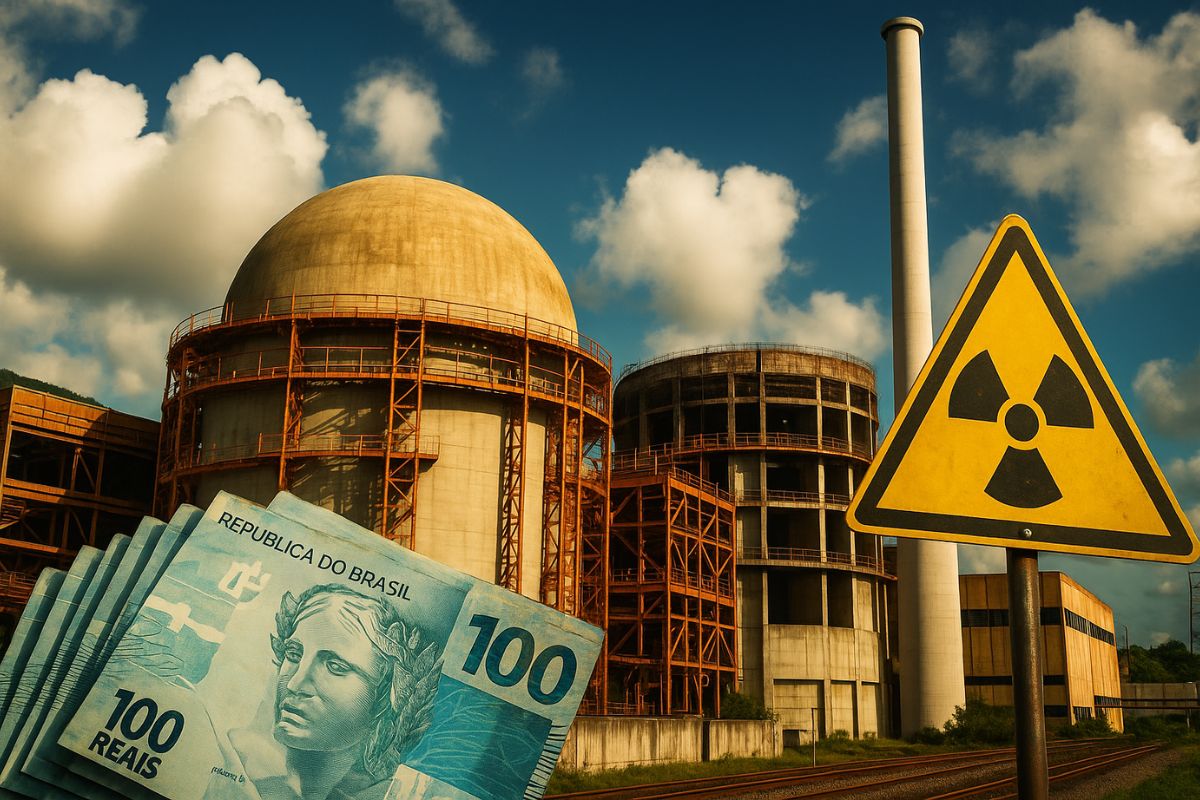

Studies Commissioned by the National Energy Policy Council Will Determine Whether Angra 3 Should Be Completed, Maintained with Private Capital, or Terminated, After R$ 12 Billion Already Invested and Ten Years of Paralysis, According to O Globo
The future of Angra 3 has returned to the center of the national energy debate. The government has decided to commission new studies to evaluate three scenarios: complete the nuclear plant with private sector support, finish the project solely with public funds, or completely abandon the venture, assuming the billion-dollar loss.
The decision reflects the impasse over a project that has already consumed around R$ 12 billion, has been halted since 2015, and would require an additional R$ 23 billion to be completed. Amid economic pressures, legal risks, and the promise of clean and reliable energy, Angra 3 symbolizes Brazil’s difficulty in balancing energy security and the management of large projects.
Three Scenarios Under Analysis
The National Energy Policy Council (CNPE) has determined that Eletronuclear and BNDES update the technical and financial projections.
-
Former Marketing Agency Owner Thrives on Foraging for 250 Days, Sampling Over 170 Plants, and Says He No Longer Remembers Supermarkets

-
IKEA’s AI Handles Nearly Half of Customer Calls, Company Reassigns 8,500 Staff as Design Consultants, Boosting Revenue by €1.3 Billion
-
Owner of Havan Visits Paraguay to Discuss Lower Taxes, Local Suppliers, and International Expansion with President

-
Brazilian Construction Retail Chain Closes After 60 Years, Begins Liquidation Sale Across Five Cities




The teams must deliver three clear alternatives: finish the construction with private investors, complete it solely with public money, or calculate the costs of shutting down the project.
According to already disclosed estimates, abandoning Angra 3 could result in losses of up to R$ 21 billion, a value close to that necessary to complete the plant.
Thus, the choice will not only be technical but also political and strategic.
Strategic Importance for the Country
The Minister of Mines and Energy, Alexandre Silveira, argues that completing the project is essential.
For him, Angra 3 would strengthen Brazil’s energy security by providing clean, stable, and baseload power, which is especially relevant given the intermittency of renewable sources like solar and wind.
Currently, the country only has Angra 1 and Angra 2, which together represent 0.8% of the installed electricity capacity.
If completed, the third plant would have the capacity to supply around 4.5 million people, equivalent to 70% of the residential consumption of the state of Rio de Janeiro.
A Project Marked by Delays and Scandals
The construction of Angra 3 began in the 1980s but has been interrupted several times.
The most recent pause occurred in 2015, following corruption allegations revealed by Operation Lava Jato.
Since then, the construction site remains idle, with two-thirds of the building already completed.
This history makes the decision even more complex.
Resuming the project would mean dealing with old contracts, technical revisions, and potential legal challenges, in addition to the challenge of attracting investors in a highly regulated high-risk sector.
The Economic and Political Weight of the Decision
The choice regarding Angra 3 does not involve just numbers.
There are regional interests in Rio de Janeiro, international pressures regarding the energy matrix, and a global agenda for transitioning to clean sources.
While some experts advocate for the plant as a strategic alternative, others argue that the cost is excessive compared to cheaper and faster renewable options.
CNPE will have to weigh whether the country should insist on completing a project marked by scandals or redirect resources to other energy sources.
The outcome could determine not only the fate of Angra 3 but also the role of nuclear energy in Brazil’s energy matrix over the coming decades.
The impasse surrounding Angra 3 exposes the dilemma between preserving investments already made and betting on alternative energy sources. Completing the project will require an additional R$ 23 billion, but abandoning it could cost almost the same in losses.
In your view, should Brazil insist on completing the nuclear plant or turn the page and invest in cheaper and faster alternatives? Leave your opinion in the comments – we want to hear from those closely following the impacts of the energy matrix in the country.