Portuguese
  Spanish


A Great Treasure of Roman Coins Has Been Discovered, and Experts Believe Its Historical and Financial Value Could Make It One of the Most Valuable Archaeological Discoveries
An unprecedented destroyed find surprised construction workers in England. It is a treasure containing 1,368 Iron Age and Roman coins, valued at over 130 thousand dollars, discovered at a construction site near Worcester. Experts classify the find as one of the most significant in a century.
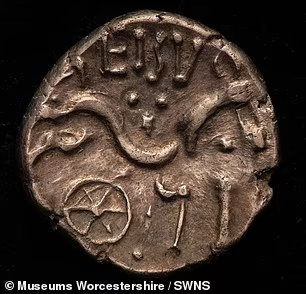
The coins, primarily silver denarii minted in Rome, date from the Roman Republic in 157 BC to the reign of Emperor Nero, between AD 54 and 68. Among them is a standout gold coin, identified as a stater from the Iron Age, minted by the British tribe Dobunni, who inhabited the area between AD 20 and 45. This find is considered one of the largest secret treasures from the Roman Conquest period ever found in the United Kingdom.

A Window into the Past
The treasure, named the Worcestershire Conquest Hoard, is believed to have belonged to a wealthy local farmer. This individual, likely a supplier of grain and livestock to the Roman army, would have buried the coins in a ceramic pot manufactured in local kilns.
-
Scientists Find Regular Activity Can Mitigate Alzheimer’s Impact, Even in Genetically High-Risk Individuals, Offering Strong Evidence for Cognitive Protection and Healthy Aging

-
Exploring Nazareth: Uncovering the Historical Setting of the Annunciation, Not Proving a Biblical Miracle

-
Former Student Returns to Teach Over 100 Children in São Paulo How PET Bottles Can Help Protect the Oceans
-
Man Buys Metal Detector for Recovery Walks, Discovers 27.2 kg Gold Nugget in Brazil


Murray Andrews, a British archaeology expert from University College London, described the discovery as “miraculous.” “It helps us understand what was happening here 2,000 years ago, when the Malvern Hills were one of the frontiers of the Roman Empire,” he stated.
The treasure was found in the area of Leigh and Bransford, near the Malvern Hills. This region, rich in history, continues to surprise archaeologists and historians with its buried secrets.
Preservation and Exhibition
After the official declaration of the treasure in June of this year, Worcestershire Heritage, Art & Museums launched a campaign to raise £6,000. The goal is to ensure that the find is preserved and exhibited to the public. Karen May, chair of the joint museums committee of Worcestershire County Council, highlighted the cultural importance of the discovery: “This is a true treasure of Worcestershire and needs to be seen and appreciated by future generations.”
The find joins other treasures discovered in the region over the last few decades. In 1999, 434 silver coins and ceramic fragments were unearthed near Chaddesley Corbett. In 2011, a pot containing 3,784 coins was found at Bredon Hill. These events reaffirmed Worcestershire’s central role in the British landscape.
The Roman Rule in Great Britain
Great Britain was the stage for transformative events during the Roman period. Julius Caesar began the invasions in AD 55, but it was not until AD 43, under the command of Aulus Plautius and with the approval of Emperor Claudius, that the Romans consolidated their presence on the island. Londinium (modern London) was founded in AD 47, becoming the administrative center of the new territory.
Over nearly 500 years, the Romans shaped the British landscape. Roads, cities, and governance systems left a profound legacy. However, in AD 410, facing barbarian invasions and the need to defend Rome, the Roman Empire withdrew its forces, ending its dominion over Great Britain.