






 Portuguese
  Spanish
  5 min of reading
  0 comments


Invisible crack on the surface reveals how the ocean floor can feed fish, birds, whales, and sponges in one of the coldest regions on the planet
In the middle of the Bering Sea, between Alaska and Siberia, there is a formation that does not appear to those looking at the surface water. The Zhemchug Canyon cuts through the ocean floor for about 160 kilometers and reaches approximately 2,600 meters of vertical relief.
The dimension draws attention because this underwater abyss is deeper than the Grand Canyon in the United States. But the most important point is not just the size; the crack helps move cold, nutrient-rich waters, creating a favorable environment for the development of the marine ecosystem.
The canyon functions as a kind of natural corridor in the Bering Sea. The formation concentrates nutrients, influences currents, and helps sustain organisms ranging from small marine creatures to mammals and birds.
-
A hospital janitor who also washed cars to make a living has just impressed Brazil by achieving the impossible dream of becoming a doctor at 26 years old and shouting to the world that the janitor has won.

-
Two billionaires spend $67 million just to avoid having a neighbor and block a $285 million mega mansion, with 4,645 m², bowling alley, car museum, and waterfront area in Florida.

-
David Camacho, the 10-year-old Mexican child prodigy with an IQ of 162, higher than Einstein’s, underwent astronaut training at NASA, speaks four languages, and created an app to help children deal with emotions after the bullying he experienced.
-
London waited more than 360 years for this scene: four pelican chicks are born in St James’s Park, surprising experts, resembling little dinosaurs, and turning an isolation caused by avian flu into a historic chapter for the birds that have lived alongside British royalty since 1664.





It is a landscape invisible to the human eye but crucial to understanding why seemingly cold and hostile areas can transform into zones of high productivity in the ocean.
The hidden submarine canyon in the Bering Sea
The Zhemchug Canyon is located in the central region of the Bering Sea, an area marked by icy waters, strong fishing activity, and great ecological importance. The formation was named after a Russian research vessel called Zhemchug, a word associated with “pearl.”
According to Marine Regions, an international database linked to the nomenclature of submarine features, the Zhemchug was discovered and explored by a Russian vessel in 1959. The record also places the canyon as a feature of the Bering Sea, with coordinates recognized in bathymetric databases.
Most people will never see this relief. From the surface, the sea appears to be just a vast mass of cold water. The real design only appears through sonars, bathymetric surveys, and ocean floor maps.
This invisibility helps explain why giant submarine formations still surprise the public. While mountains, deserts, and terrestrial canyons attract attention for their open landscapes, structures like the Zhemchug remain hidden under kilometers of water.
Why this crack surpasses the Grand Canyon in depth
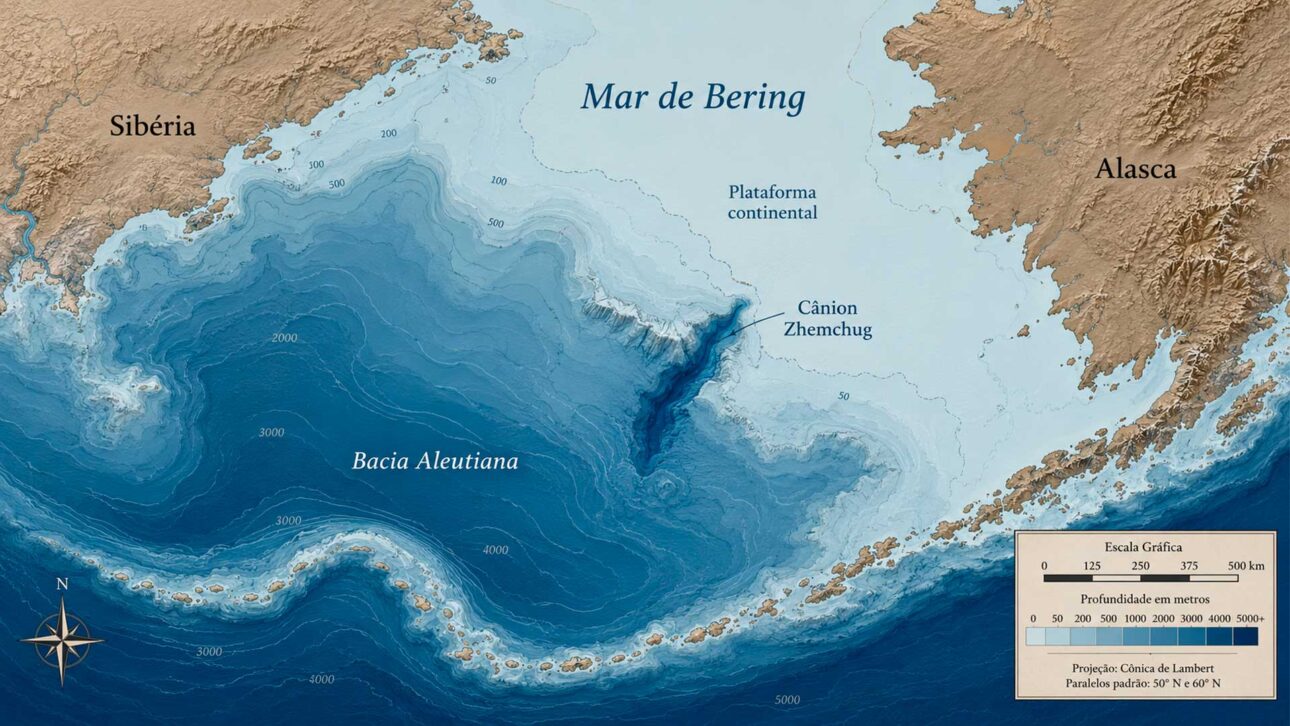
The Grand Canyon in Arizona is one of the most famous canyons on the planet and reaches about 1,857 meters in depth. The Zhemchug, on the other hand, reaches approximately 2,600 meters of vertical relief, placing it on an impressive scale within submarine geology.
According to the United States Geological Survey, the USGS, the Bering, Pribilof, and Zhemchug canyons cut through the continental margin of the southeastern Bering Sea. The agency also highlights that the Zhemchug may be among the largest known submarine valleys, with an estimated volume of 8,500 km³ in a classic study published in 1970.
This data reinforces the importance of handling the topic with care. Some publications mention different volume estimates, but the consensus is that the Zhemchug is among the largest submarine formations of its kind and surpasses the Grand Canyon in vertical depth.
More than a geographical curiosity, the size of the chasm shows how the seafloor holds landscapes as grand as those on dry land.
How the icy relief turns into food for marine life
The main ecological function of the Zhemchug Canyon lies in how it interferes with water circulation. In such regions, the submarine relief can alter currents, direct water masses, and favor the rise of nutrients from deeper parts to shallower layers.
This process is known as upwelling. When deep waters rise, they carry nutrients that feed microscopic organisms. These organisms form the base of a food chain involving fish, squids, birds, and marine mammals.
In a study published in the scientific journal PLOS One, researchers described Zhemchug and Pribilof as two of the largest canyons in the world, located in a productive area called the Green Belt. The region combines currents and upwelling, supporting fish, squids, birds, and marine mammals.
This helps explain why the Bering Sea, despite the cold, is one of the biologically important areas of the North Pacific. What seems like an empty environment on the surface may hide an active system, fueled by the meeting of geology and oceanography.
The logic is simple: when the seafloor creates corridors for water circulation, life finds concentration points. The canyon acts as a physical structure that helps distribute food over a wide region.
Cold corals, sponges, and protected animals appear in this corridor
Life in the Zhemchug does not depend on colorful landscapes like tropical reefs. There, the environment is cold, dark, and deep, yet it still hosts organisms adapted to extreme conditions.
According to NOAA Fisheries, research in the Bering Sea analyzed corals, sponges, crabs, and fish in canyons like Zhemchug and Pribilof. The survey showed that these environments are relevant for understanding sensitive habitats and possible impacts of human activity, especially bottom fishing.
Among the organisms associated with these areas are sponges, cold-water corals, fish, crustaceans, and animals that use the canyon edges as a feeding zone. In some areas, sponges appear with greater density, creating structures that can serve as shelter for other species.
The Geophysical Institute of the University of Alaska also recorded reports of manned exploration in Zhemchug, with observations of fish, corals, crabs, sponges, and zooplankton aggregations at depth. These records help show that the water column can be biologically active far below the surface.
Additionally, studies on seabirds indicate that the short-tailed albatross, an endangered species, has been associated with canyon edge areas in the Bering Sea. This does not mean that Zhemchug is the only vital point for these animals, but it reinforces the importance of the region as part of a larger ecological corridor.
The origin of the abyss is linked to ancient rivers, ice, and sediments
The formation of Zhemchug did not happen all at once. The origin is linked to the geological history of the Bering Sea continental shelf and glacial periods when sea levels were lower.
During these periods, rivers like the Yukon would have transported a large volume of sediments to the edge of the shelf. Over time, part of this material became unstable and descended the continental slope, carving the relief towards the Aleutian Basin.
These descents of mud, sand, and dense water are called turbidity currents. They function like underwater avalanches, capable of reshaping the ocean floor over thousands or millions of years.
The result is a deep, cut, and elongated landscape that today influences water circulation and nutrient distribution. In other words, an ancient geological process still affects current marine life.
What do you think of this dispute: should deep areas like the Zhemchug Canyon have stricter protection, even if it affects part of the fishing, or should the economic use of the Bering Sea continue with current rules? Leave your opinion in the comments.




Be the first to react!