Portuguese
  Spanish




On an Open Lot, a Man Built a Wooden House on Stilts with 1 Raised Base to Organize Work, Speed Up Assembly, and Attract Attention from Those Following the Project.
At first, there is grass, visible dirt, and an imaginary rectangle on the ground. Then everything changes suddenly: instead of starting “on the ground,” the house is born elevated, supported by stilts, and this changes everything, from movement on the construction site to the order of tasks.
First, the holes in the ground, then the pillars, followed by the beams securing the perimeter. From there, joists and boards close off the floor, and the place becomes a solid platform. It is at this point that everything else starts to happen “on top” of the structure, and no longer on the lot.
The striking aspect is the contrast between before and after. Before, there was only marking and loose dirt. Afterward, a wooden house with an elevated floor, raised walls with braces, defined openings, and external closure with rows of boards appears.
-
Elevated Flooring System May Replace Traditional Concrete Slabs by 2026, Offering Improved Drainage and Easier Maintenance Access

-
Giant Vessel Svanen Prepares to Install Foundations for Poland’s First Offshore Wind Farm in the Baltic Sea
-
Bulk Carrier Docks at Brazil’s Coast, Marking First-Ever Cargo Unloading at Porto Piauí and Opening New Iron Ore Route to China After Over a Century of Logistical Challenges
-
Labor Shortage: Despite More Doctors Graduating in Brazil, Lack of Anesthesiologists Leads to Surgery Cancellations and Exposes Hidden Bottleneck in Hospitals


Low-Cost Wooden House on Stilts Became a Highlight on the Construction Site
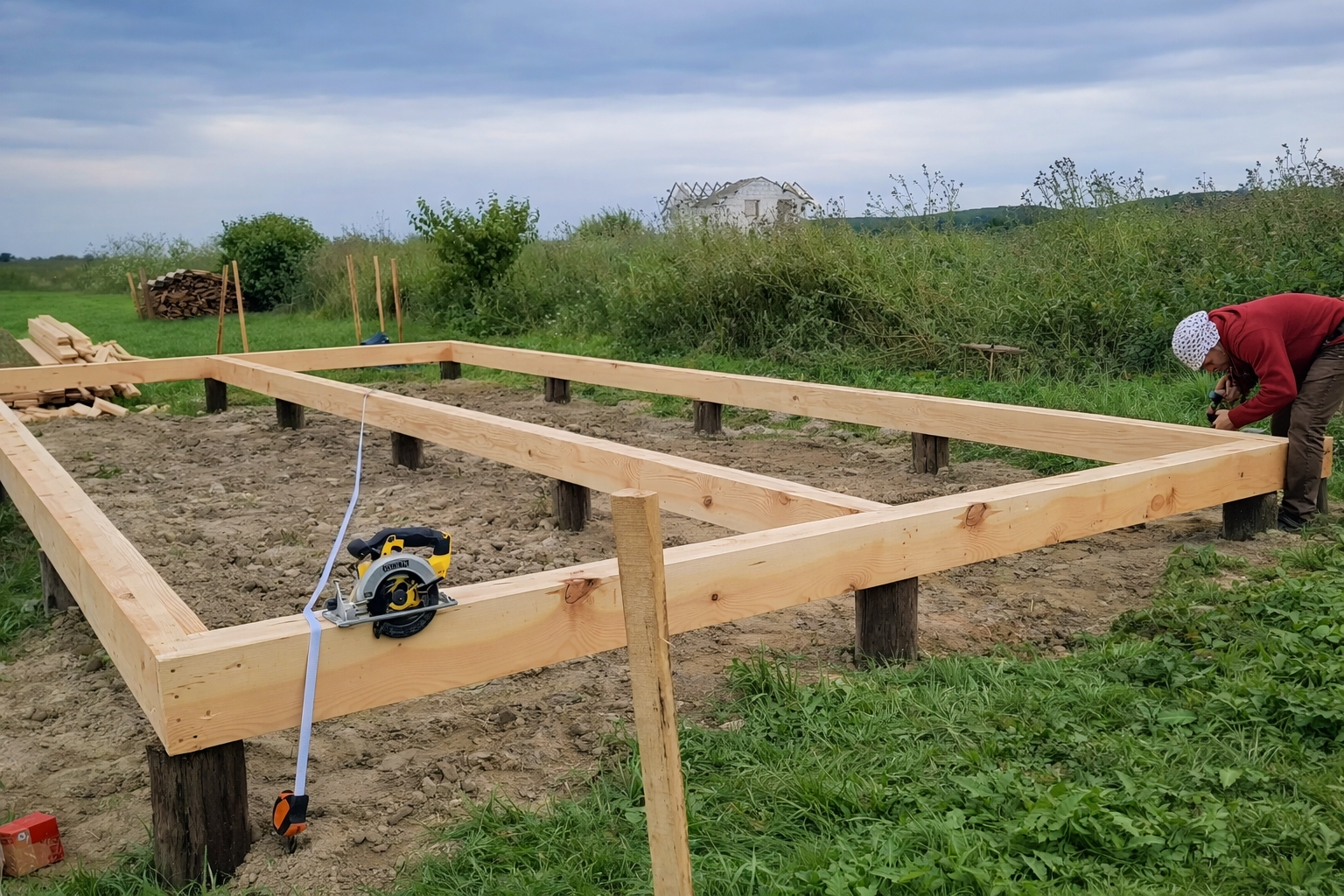
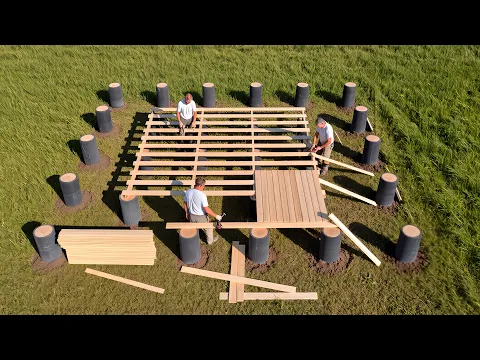
What is initially seen is the ground being “punctuated” by holes distributed in a rectangle. Then, the pillars come in, and the base already rises from the ground level, leaving a visible free space underneath. For an observer, the message is clear: it is not a house resting on the ground, it is a house that is supported by stilts.
The work is always done by the two young men, alternating roles and repeating gestures. One holds, aligns, and checks. The other secures, adjusts, and repositions. This back and forth creates a rhythm of assembly that prevents the structure from becoming “loose” at any stage.
When the perimeter is secured, the construction site shifts phases. The structure starts to guide what comes next, and tasks no longer rely on the ground to “correct” misalignment. The detail that stands out is that each piece is added only when there is already real support for it.
From Ground Hole to Elevated Floor with Beams, Joists, and Boards
The ground is perforated using a spiral drill. It enters, pulls out dirt, and leaves loose material around, in short cycles. The operator controls the verticality with his hands, repositions, and repeats until the hole is ready to receive the support.
Next come dark wooden pillars and long light-colored beams forming the rectangle. The corners are joined and secured, with fastening done using screws and an electric tightening tool. Before the final tightening, the pieces are leaned against, pulled, and aligned, without haste.
Then internal joists are added parallel to create regular openings. The floor is closed off with boards placed one by one. A manual applicator with a hose and nozzle then spreads liquid over the already-installed floor in long and continuous passes.
The visual effect is a coverage by areas, as if the floor is receiving a layer applied in a controlled manner.
2 Men, One Raised Base, and Many Repetitions of Cutting and Securing

The team consists of a couple who follows the entire assembly from start to finish. The process gains scale through the method, not through large machines. At each stage, what appears is a repetition of actions and pieces, always in the same pattern.
The raised base is also a simple yet decisive numerical landmark: it is 1 platform that becomes “work floor.” Before it, the work is scattered across the lot. After it, everything happens on the floor, with more organized movement and less interference from the ground.
The order of the stages is clear: holes, pillars, beams, joists, boards, walls, internal layers, and external cladding. The mini hook that remains is always the same: when one phase closes, the next is already ready to begin.
Walls Rise with Studs and Braces, and Openings Already Mark Where Doors and Windows Will Be
When the floor is solid, the house starts to gain height. Wall panels with vertical studs are added, and the volume appears even without finishing. The change is clear: horizontal construction gives way to vertical construction.
The frames are raised and held in place by diagonal braces. The connections between base and studs become evident, especially at the corners, where alignment requires more adjustment before tightening. The work involves positioning, holding, checking, and securing, repeatedly.
The practical consequence is that the assembly starts to behave as a stable volume. The rectangular openings already define where the doors and windows will go, and the braces visibly show their function: to keep plumb until the opposing walls are raised and connected.
Internal Layers Are Added with Fiber Mats and Metallic Sheets, and the External Cladding Covers the Facades with Boards

When the structure is standing, the interior changes scenery. Compact bales appear on the floor, and between the studs, fiber mats are placed in the openings. What stands out is the care taken to fill in without leaving visible gaps, as crevices can be easily seen.
In addition to the mats, sheets with a metallic surface are extended and adjusted, covering planes and contours, including around openings. It cannot be definitively stated what the purpose is beyond what is visible, but the presence of added layers to the whole is clear, and the cutting must follow the form of the structure.
Outside, the closure progresses with horizontal boards arranged in rows, aligned and fixed until covering the walls.
In the higher sections, there is temporary support to work above the ground, with one of the men at height and the routine of positioning and securing being repeated. The result is surprising when the volume “closes,” and the house comes to have a complete appearance, with a base on stilts, a defined body, and edges.
In the end, what dictates everything is the assembly discipline: pillars, beams, joists, boards, studs, braces, mats, and exterior boards enter in an order that reduces rework and keeps the structure always supported by something already secured.
It is this continuity that transforms the low-cost wooden house on stilts from a skeleton into an entire volume, with visible changes at each stage.

What Surprised the Most: The Elevated Floor Already Changing the Construction Site Early On, the Series of Securing Actions Making Everything Firm Stage by Stage, or the External Cladding with Boards in Rows Until the House Gained a Finished Look?