






 Portuguese
  Spanish
  5 min of reading
  1 comment


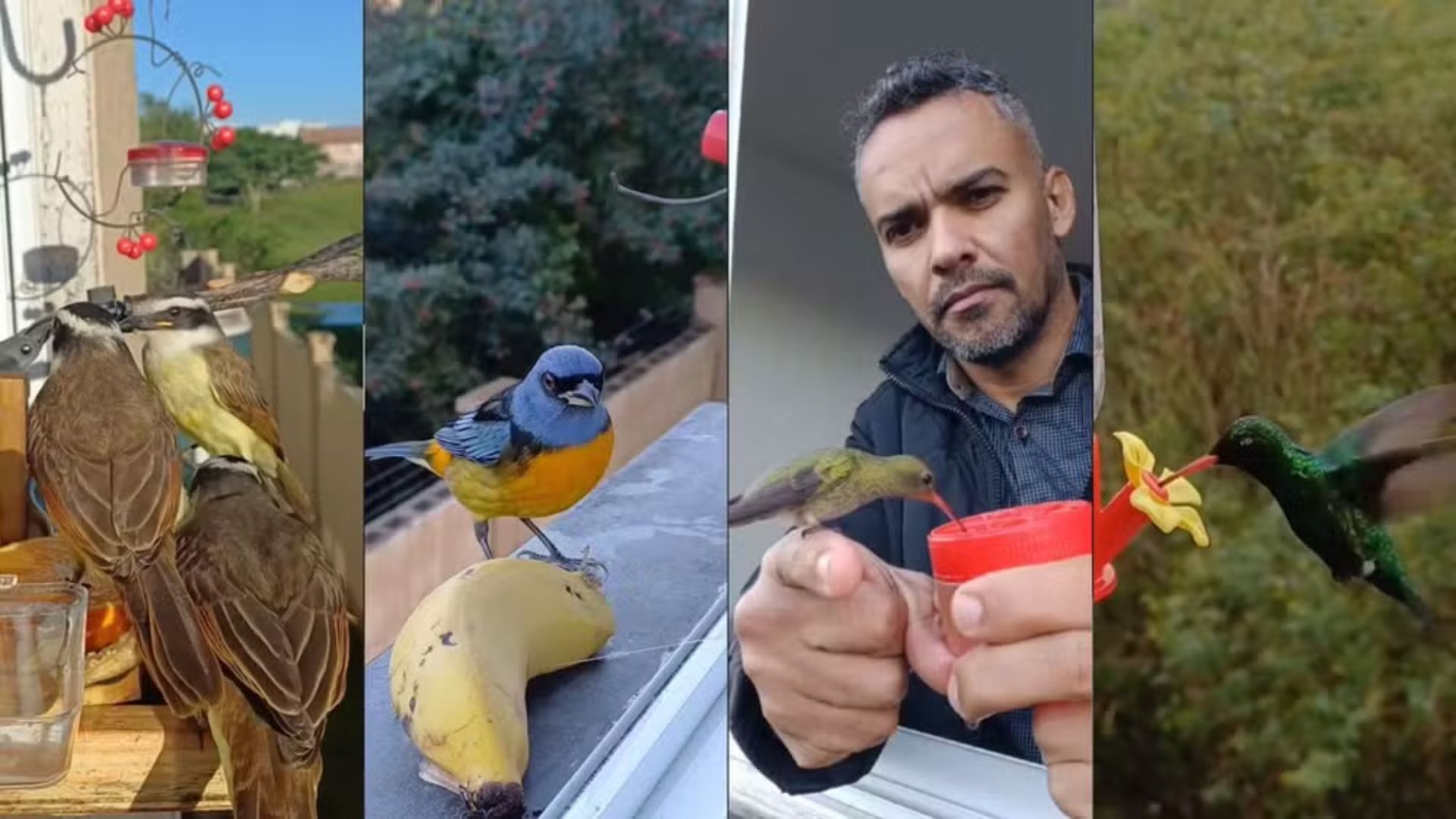


Routine Created in Canoas Attracts Various Bird Species to a Window, Generates Viral Content, and Sparks Debate on Care When Offering Food to Wild Animals.
A simple habit, started in an apartment in Canoas, in the Metropolitan Region of Porto Alegre, transformed the routine of Joélcio Oliveira and brought visibility to a piece of urban wildlife.
By setting up a daily “afternoon coffee” at the window, he began to receive visits from more than ten species of birds and saw images of the encounters with the animals garner millions of views on social media.
Birds Transform Window into Meeting Spot in Canoas
The idea emerged in 2023, after Joélcio noticed the intense movement of birds in his neighbor’s trees.
-
Light blue, black, red, or green-yellow wire? Understand what each color indicates in electrical installation and why confusing phase, neutral, and ground can become a risk inside the house.

-
Brown scar tearing through the blue of the ocean seen from space stretches over 8,000 km in the Atlantic, reaches the route of Northern Brazil, and raises an alert about sargassum on the beaches.
-
The woman who heard a silent alert in the villages of Kenya and transformed the lack of firewood, water, and food into a movement that began with simple seedlings and grew to over 51 million trees planted.

-
Brazil launches the new national identity in Paraguay, where more than 250,000 Brazilians live, and the document eliminates the need for a passport in 8 South American countries and provides access to 5,000 digital government services.



A bird enthusiast since childhood, he decided to install imported feeders on the windowsill, specifically aimed at this species.
According to him, the response was immediate.
“I started putting it on the window, and I realized it was very easy to catch their attention”, recalls the resident, who works as an automotive technician.
Over time, the space prepared for hummingbirds began to attract other winged visitors.
Today, great kiskadees, thrushes, and the orange-headed tanager frequent the spot at different times of the day.
According to Joélcio, the diversity of birds surprised even those who were already observing the movement in the neighborhood closely. “More than 10 species have passed by”, he reports.
Organized Routine and Fruit Menu for the Birds

To maintain the routine, Joélcio organizes the offering of food in a controlled manner.
He does not leave the fruit exposed all day to avoid waste and the accumulation of residues.
The pieces of banana, papaya, and orange are placed at specific times, whenever he returns from work.
As months went by, the birds began to associate the time with the arrival of food.
“They already know the time I get home from work. It’s almost an afternoon coffee”, he says humorously.
The regularity helped consolidate the window as a fixed feeding and resting spot for the animals.
To record the visits without scaring the birds, the resident also adjusted his own presence.
He invested in camouflage clothing, followed followers’ advice, and set up a small setting for the birds to feel more secure.
Experts Advise on Risks and Care When Feeding Birds
The practice of offering food to wild birds in urban areas is viewed cautiously by biologists and ecologists.
Experts point out that the strategy can be positive, provided that some basic criteria are respected to avoid environmental imbalances or health problems for the animals.
One of the main recommendations is to prioritize, whenever possible, the planting of native fruit trees, a measure that promotes natural feeding and seed dispersal.
According to the coordinator of the Graduate Program in Ecology and Evolution of Biodiversity at PUCRS, Eduardo Eizirik, when this planting is not feasible, offering fruits can be an alternative as long as it is done responsibly.
The guidance is to offer pieces of banana, papaya, or orange without seeds, to prevent exotic plants from germinating and spreading as invasive species.
Another essential point is hygiene.
Before handling fruits or refilling feeders, one should wash hands well and keep the area clean.
This recommendation is emphasized in homes with domestic birds, as food scraps or contaminated surfaces can facilitate the transmission of diseases to wild fauna.
Eizirik emphasizes that leftovers of fruits provided to domestic birds should not be reused in areas designated for native birds.
Hummingbird Feeders Require Specific Care
In the case of hummingbirds, the care must be even stricter.
Many of these animals rely on natural nectar and can get sick if the sugary solution has an inappropriate concentration or stays in the containers too long.
The professor from the School of Health and Life Sciences at PUCRS, Júlio César Bicca-Marques, emphasizes that it is necessary to study the correct preparation of the solution so that it is nutritious and safe.
Frequent replacement of the liquid and rigorous cleaning of the feeders are fundamental.
Containers with accumulated crystallized sugar, fungi, or residues can become sources of contamination and drive away the animals.
Viralization of Videos and Growth on Social Media
Joélcio’s routine went beyond the apartment window when he decided to share the records on social media.
The first videos showed the approach of hummingbirds and, later, the arrival of great kiskadees, thrushes, and tanagers.
With the frequency of postings, the content began to attract a loyal audience.
One of the recordings, which shows a family of great kiskadees feeding on the tray attached to the glass, surpassed 12 million views.
The growth was also reflected in the number of followers.
According to Joélcio, the profile had about 300 people at the beginning of the year, advanced to 10,000, and today exceeds 60,000 interested in following the birds’ “afternoon coffee.”
‘Birdwatching’ and the Impact of Bird Observation in Urban Life
More than the success on social media, the experience altered the way the resident perceives the pace of the city.
He notes that he learned the term “birdwatching”, used by observers to define the act of contemplating birds in natural environments.
According to Joélcio, this daily moment has become a space for pause and tranquility.
“The act of contemplating nature brings peace to a person. It’s incredible. It has greatly improved my quality of life”, he asserts.
The observation of species, behavior differences, and the adaptation of animals to the urban setting have become an important part of his daily routine.
By sharing images, he began to receive reports from people who have started to pay closer attention to trees, wires, and windowsills of their own homes, identifying species that previously went unnoticed.
The experience reignites the debate about how careful observation initiatives can bring residents closer to local wildlife without causing negative impacts.
In a bustling city, to what extent can simple gestures like this change people’s relationship with the surrounding nature?


A ta , os pássaros por acaso não vivem indo nos lixos pegarem comidas, principalmente em portas de restaurantes, pegam tudo que veem pelo chao , e cadê o cuidado para que eles não se contaminem? Agora o rapaz está dando frutas e tem que ter cuidado em o que oferecer. Afff cada uma