






 Portuguese
  Spanish


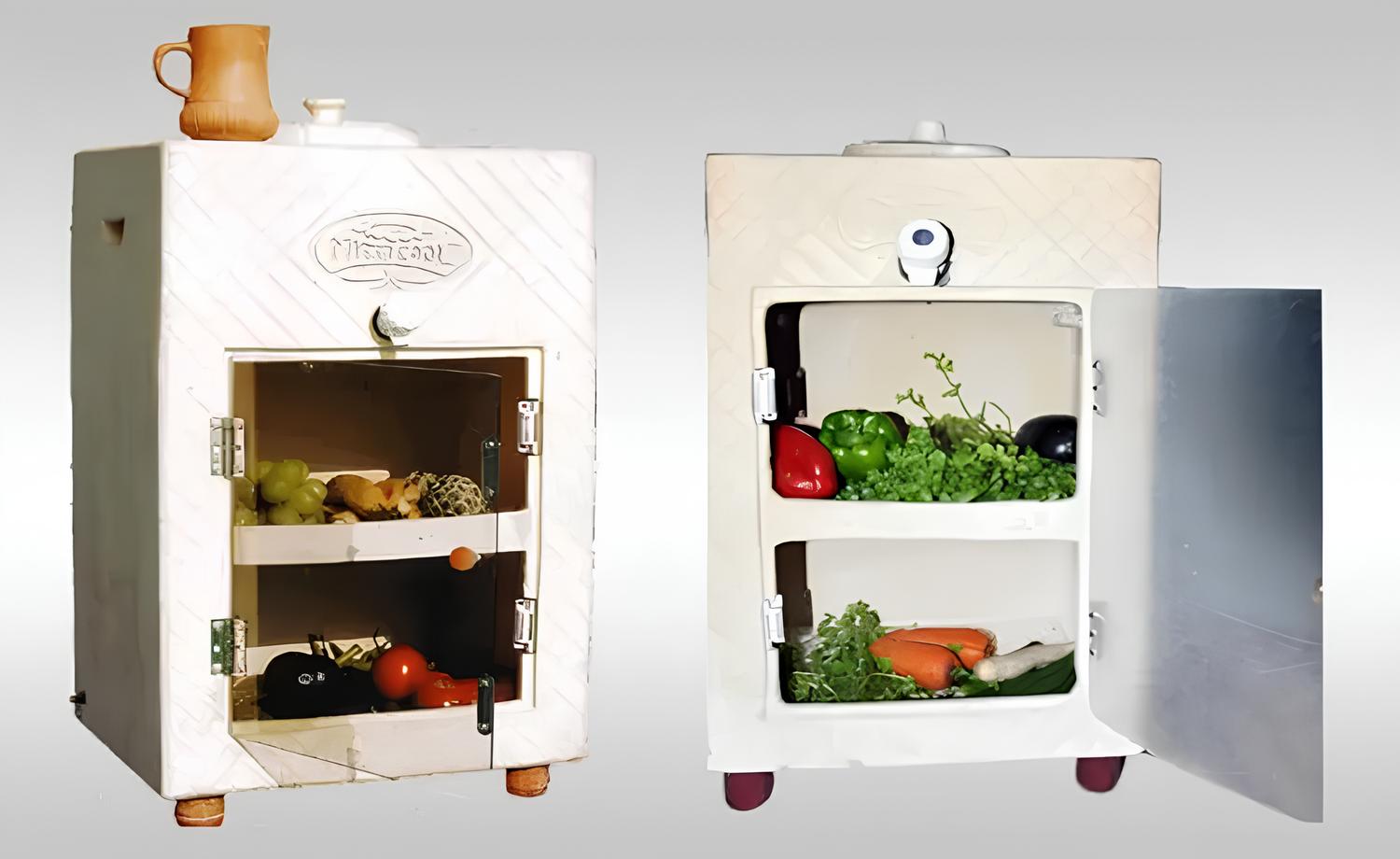
Clay Refrigerator Created in India Works Without Electricity, Preserves Foods by Evaporation and Costs About R$ 135, Becoming an Affordable Alternative to Traditional Refrigeration.
In an increasingly electricity-dependent world for absolutely everything, from communication to food preservation, a simple invention made of clay and water continues to challenge the logic of modern technology. Created in India by Mansukh Prajapati, the so-called clay refrigerator, commercially known as Mitticool, works without using electricity, without motors, without gas, and without any electronic components. And the most impressive part: the average cost of the equipment is around the equivalent of R$ 135, a price that places it light-years ahead of any conventional refrigerator in terms of affordability.
This is not an assistive or experimental project. Mitticool is a real commercial product, manufactured, sold, exported, and used by thousands of families. It exists, works, generates income, stimulates the market, and solves one of the biggest bottlenecks of life outside major urban centers: how to preserve food without continuous access to electricity.
How the Clay Refrigerator That Dispenses Energy Works
The principle behind the operation of Mitticool is as old as ceramics themselves: natural thermal evaporation. Clay is a porous material.
-
Chile’s Plan for a 20,000 km Undersea Cable to Hong Kong Halted by U.S. Pressure, Highlighting the Silent Data Control Battle in Latin America

-
In Somaliland’s Desert, Greenhouse Uses Sun and Seawater to Grow Lettuce, Cucumbers, and Tomatoes Without Rain: 1-Hectare Project Cools Crops, Desalinates Water, and Converts Brine into Commercial Salt
-
Trump Unveils $400 Million Boeing 747 Donated by Qatar as Temporary Air Force One Amid Boeing Delays, Sparking Debate on National Security, Costs, and Foreign Influence
-
Chinese Company Unveils Robotic Toilet That Comes to You, Featuring Lidar Sensors, Voice Command, Bidet, Hot Air Drying, UV Light, and Self-Cleaning Waste Disposal



When water slowly passes through these pores and evaporates on the outer surface, heat is drawn from the interior of the structure. The result is a drop in internal temperature.

In practice, this allows the temperature of stored foods to be reduced by up to 8 to 10 °C below the ambient temperature, without any energy expenditure. It is not refrigeration comparable to a common electric refrigerator, but it is sufficient to:
- keep fruits fresh for several days
- slow down the spoilage of vegetables
- preserve milk for longer periods
- keep water naturally cool
All of this is achieved with just clay, water, and natural air circulation.
From a Personal Tragedy to a Product Sold Around the World
The idea emerged after the Gujarat earthquake in 2001, which left thousands of people without electricity and basic infrastructure. In that scenario, Mansukh realized something simple: electric refrigerators had become instantly useless, while the traditionally used clay pots still managed to keep water cool.
From this observation, he began testing ceramic refrigeration models until arriving at the functional format of Mitticool. The design includes:
- upper compartment for water
- internal space for food
- thick walls of porous ceramic
- natural air circulation system
The project started artisanally, but quickly gained national and international visibility.
How Much the Clay Refrigerator Costs in Practice
The major differential that made Mitticool a popular success was its price. While electric refrigerators usually cost between R$ 1,200 and R$ 2,500 in Brazil, the equivalent of Mitticool varies between US$ 25 and US$ 30, which today corresponds to something between R$ 125 and R$ 150, depending on exchange rates.
In other words, it costs up to 15 times less than a basic electric refrigerator.
This price allows the product to be purchased:
- in rural areas
- by low-income families
- by small merchants
- by street vendors
- by producers of artisanal foods
Without relying on the electrical grid, outlets, or complex infrastructure.
Why Mitticool Became an International Phenomenon
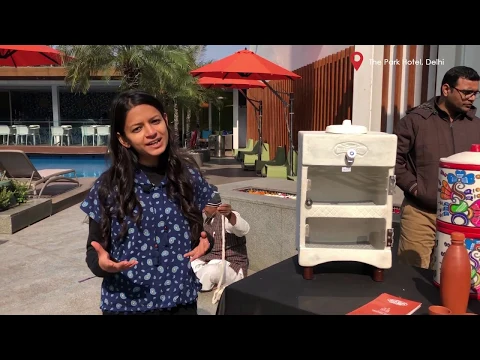
The clay refrigerator gained international prominence after reports from BBC, National Geographic, and other major science and technology publications. What caught the attention of the global media was not just the simplicity of the project but its practical impact.
In many countries in Asia, Africa, and Latin America, instability in energy supply remains a daily obstacle. In these regions, Mitticool is being used as:
- an alternative to traditional refrigeration
- a solution for small businesses
- support equipment in open markets
- means of preservation for artisanal production
It does not completely replace an electric refrigerator in urban environments, but solves a real problem where conventional technology does not reach or is not financially viable.
Scale Production and Active Market
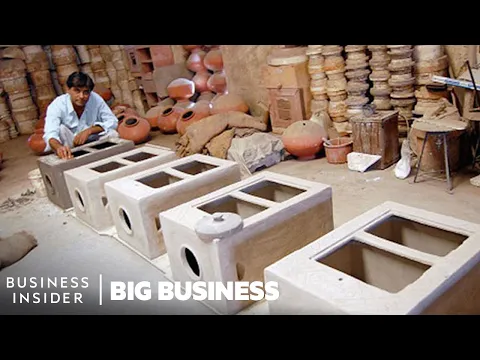
Unlike many homemade creations that remain restricted to prototypes, Mitticool has truly entered the production chain. The product is now being manufactured on an artisanal-industrial scale, with nationwide distribution in India and exports to other countries.
The production involves:
- extraction of selected clay
- manual and molded shaping
- natural drying
- firing in a ceramic oven
- proper sealing of internal surfaces
Each unit requires days of production but maintains an extremely low cost due to the absence of expensive industrial components.
The Silent Economic Impact of the Refrigerator Without Energy
Although it is seen as a technological curiosity, Mitticool generates real economic impact in three areas:
Direct Income Generation
The production employs artisans, potters, distributors, and sellers.
Reduction of Food Waste
Families and merchants manage to prolong the durability of perishable products.
Substitution of Energy Expenditure
It completely eliminates the cost of electricity for refrigeration, which over the years represents significant savings.
This set transforms the clay refrigerator into a financially strategic product for low-income markets.
Technical Limitations That Prevent Total Replacement
Despite its advantages, Mitticool has clear limitations:
- does not reach temperatures below 10 °C
- does not freeze food
- does not preserve meat for long periods
- depends on frequent water replenishment
- its performance declines in high humidity regions
Therefore, it does not replace an electric refrigerator in all contexts. Its role is complementary and regionally strategic, not universal.
Simple Technology, But Based on Solid Physical Principles
The operation of the refrigerator is explained by a classic concept of thermodynamics: latent heat of vaporization. When water evaporates, it absorbs thermal energy from the surrounding environment. This same principle is used:
- in industrial cooling towers
- in evaporative air conditioning systems
- in low-energy air coolers
The big insight was to apply this same principle to a household object made entirely of clay.
Why It Costs So Little
The low price of Mitticool does not come from massive subsidies or imported technology. It exists because:
- the raw material is local
- the production process is artisanal
- there are no motors, compressors, or gas
- there is no energy cost in use
- the logistics are simplified
In practice, the consumer only pays for the material, artisan labor, and firing of the clay.
The Frontier Where Innovation Does Not Mean High Technology
The story of Mitticool dismantles a common idea: that innovation must necessarily be linked to artificial intelligence, chips, or digital systems. Here, innovation is about simplifying to the extreme, using basic science, ancestral material, and real need.
While the global industry competes for energy efficiency in increasingly expensive refrigerators, the clay refrigerator delivers the essentials for a fraction of the price.
The clay refrigerator that works without electricity is not just an exotic curiosity. It is concrete proof that the combination of observation, basic physics, and simple materials can create a functional, low-cost, and economically viable product.
Costing the equivalent of only R$ 135, Mitticool remains one of the most accessible food preservation solutions ever created without relying on energy.
In a world where half the population still faces electrical instability or high energy costs, the simplicity of the clay refrigerator continues to show that sometimes the most powerful solution is not the most technological — it is the most intelligent within the reality of those who need to use it.


-

-

-

-

9 people reacted to this.