






 Portuguese
  Spanish


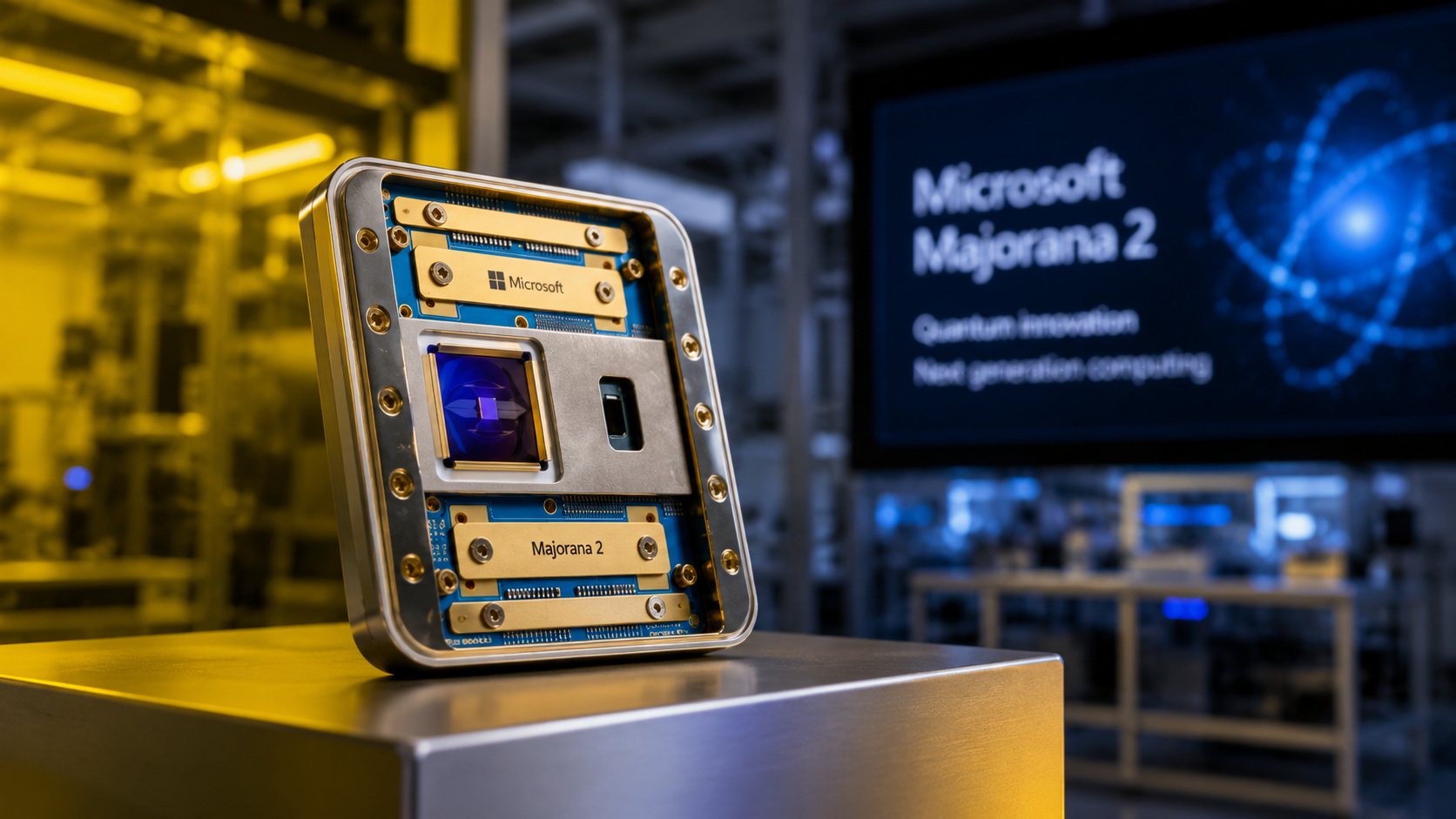
Microsoft presents the Majorana 2 quantum chip with advances in stability and AI, accelerating advanced computing towards the market.
Microsoft announced during the Build 2026 conference, held in San Francisco, the new Majorana 2 quantum chip. The launch represents one of the most significant advances in quantum computing in recent years and reinforces the company’s commitment to an architecture considered more fault-tolerant.
The new processor operates with 12 qubits, compared to the 8 qubits of the previous generation, and showed a significant leap in stability. According to the company in a publication on June 2nd, the qubits can now remain operational for more than 20 seconds, a significant advancement compared to the less than 12 milliseconds recorded previously.
In addition to hardware evolution, Microsoft highlighted the use of artificial intelligence to accelerate research, materials development, and scientific processes. The company believes these advances could enable the creation of a commercially viable quantum computer by 2029, halving the previously estimated timeline.
-
Smart Glass Revolutionizes Privacy: Touch-Activated Opacity Transforms Windows into Connected Home Features with App and Voice Control

-
Young Innovators from Brazil Turn Discarded Plastic into Eco-Friendly Bricks Using Coconut Fiber, Offering a Sustainable Alternative for Construction
-
Brazilian Scientists Among Team Proposing to Turn Ocean Depths into Giant Gravity Battery Using Cargo Ships and Subsea Cranes

-
Chile’s Plan for a 20,000 km Undersea Cable to Hong Kong Halted by U.S. Pressure, Highlighting the Silent Data Control Battle in Latin America




Microsoft reveals the Majorana 2 quantum chip with greater stability and changes its timeline to 2029
The announcement of Majorana 2 not only brought technical improvements. Microsoft also surprised the market by revising its forecast for the arrival of commercially useful quantum systems.
According to Chetan Nayak, head of the company’s quantum hardware program, the progress made in recent months allowed the originally estimated timeline to be halved. Now, the expectation is to achieve a functional quantum computer by 2029.
The change demonstrates the company’s confidence in its approach based on topological qubits, a strategy different from that adopted by competitors like Google and IBM.

The leap from 8 to 12 qubits was accompanied by an even more important evolution
Although the increase from 8 to 12 qubits is relevant, Microsoft claims that the main advancement is related to the system’s reliability.
The Majorana 2 qubits remained stable for more than 20 seconds during tests released by the company. In the previous model, this time was below 12 milliseconds.
For industry experts, stability is one of the most important factors to transform quantum computing into a truly usable technology outside laboratories.
Among the implemented changes are:
- Use of a lead superconductor;
- Changes in the physical architecture of the chip;
- Better control of quantum states;
- Improvement of semiconductor materials.
Microsoft reveals the Majorana 2 quantum chip based on topological qubits
Microsoft’s strategy remains focused on the so-called topological qubits, considered one of the most promising approaches in quantum computing.
These qubits are theoretically inspired by the works of Italian physicist Ettore Majorana, who gave his name to the quasiparticles explored by the company.
The main advantage of this architecture is the possibility of naturally reducing the incidence of errors. This problem is one of the biggest obstacles currently faced by the quantum industry.
While conventional qubits can easily lose information due to small external interferences, topological qubits are designed to offer additional protection against this type of failure.

How artificial intelligence participated in the development of the new processor
Another aspect that drew attention during the announcement was the role played by artificial intelligence.
According to Microsoft, AI agent technologies have become integrated into virtually all stages of the development of Majorana 2, from scientific research to material analysis.
According to Nayak, AI has become a natural tool within the processes of the team responsible for the project.
The applications include:
- Advanced simulations;
- Analysis of large volumes of data;
- Identification of patterns in experiments;
- Optimization of manufacturing processes;
- Acceleration of scientific discoveries.
This integration between quantum computing and artificial intelligence is seen by many experts as one of the most important technological trends of the decade.
Supervision by DARPA seeks to reinforce the project’s credibility
Microsoft also highlighted the oversight conducted by DARPA, an advanced research agency linked to the United States Department of Defense.
According to Zulfi Alam, a researcher at the company, the project’s technical data has been shared with the agency for continuous evaluation.
The strategy gained importance after the launch of the first generation of Majorana, which faced questions from the scientific community.
In recent years, some studies related to the quantum research supported by the company have been subject to reviews and criticisms, increasing the need for external validation.
The participation of DARPA aims precisely to increase confidence in the results obtained.
What differentiates Majorana 2 from Google and IBM projects
The race for leadership in quantum computing is becoming increasingly intense.
Google, IBM, Amazon, and other industry giants are investing billions of dollars in research to overcome the current limitations of the technology.
The difference is that Microsoft follows its own path based on topological qubits.
The company believes that this approach could offer:
- Lower error rate;
- Greater operational stability;
- More efficient scalability;
- Less need for complex corrections;
- More robust systems in the long term.
If the strategy works as expected, it could represent a significant competitive advantage in the coming years.
Majorana 2 expands expectations for various sectors
Quantum computing is considered a strategic technology because it can solve extremely complex problems that are beyond the capacity of traditional computers.
Among the sectors that may be impacted are:
- Medicine and drug discovery;
- Finance and risk modeling;
- Development of new materials;
- Energy research;
- Logistics and transportation;
- Digital security;
- Advanced cryptography.
For this reason, each relevant advancement is closely monitored by governments, universities, research centers, and technology companies.
The step that could bring quantum computing closer to the market
The Majorana 2 emerges as one of Microsoft’s most ambitious initiatives in the field of quantum computing. The increase to 12 qubits, stability over 20 seconds, the use of artificial intelligence, and DARPA’s supervision indicate that the company seeks to accelerate the transition of this technology to real applications.
There are still significant technical challenges ahead, but the announcement reinforces that the global race for quantum computing has entered a new phase. If the goal set for 2029 is achieved, the Majorana 2 could become one of the most important milestones in the evolution of computing in the coming decades.
With information from Microsoft






Be the first to react!