






 Portuguese
  Spanish


Farmer from Burkina Faso Recovers Arid Land with Enhanced Traditional Technique and Increases Agricultural Production by 100% to 150% Amid Climate Crisis

In the dry soil of northern Burkina Faso, where desertification advances year after year, one man decided to act when many preferred to leave. For four decades, Yakuba Sawadogo dedicated his life to transforming a 100-acre arid area into a productive forest in the heart of the Sahel. Today, he is known as “the man who stopped the desert.”
The information was reported by “BBC”, which reported how the farmer faced climate change and reversed a scenario that, in the 1980s, seemed irreversible. At that time, residents of the semi-rural town of Ouahigouya began to feel the effects of increasingly unpredictable weather.
Living in one of the driest regions of the Sahel, farmers relied solely on rain. However, when precipitation decreased and became irregular, crops failed. Consequently, animals died, trees disappeared, and the land turned to dust.
-
Warm water hidden deep in the ocean has been moving towards Antarctica for 20 years, potentially accelerating glacier melting from below.

-
U.S. Offers Nearly $200,000 to Combat Invasive Mussels Threatening Waterways and Hydroelectric Plants
-
Cigarette Butts Pollute Brazilian Beaches, Sparking Debate on Coastal Environmental Protection Measures
-
App Drivers Unite in Major Solidarity Effort to Aid Venezuela Earthquake Victims, Mobilizing the Brazilian Amazon with Donation Campaign


“This forest that you see today was once a true desert,” says Sawadogo. “There was not a single tree’s shade here.”
Zai Technique Drives Soil Recovery and Increases Agricultural Production by Up to 150%
While many abandoned the region, Sawadogo made a different decision. Instead of fleeing, he perfected a traditional technique called Zai, historically used by local farmers. However, unlike the conventional method—started only in the rainy season—he decided to prepare the soil in advance.
First, Sawadogo and his sons dug deep holes in the dry soil. Then, they filled each one with organic compost, creating natural reservoirs capable of capturing moisture before the rains even began. Additionally, they built small stone walls to direct rainwater to the seeds.
Over the years, he continually refined the method. At the same time, he shared knowledge with other farmers in the region. According to the United Nations Environment Program, although the Zai technique requires a lot of manual labor, it increased agricultural production by 100% to 150% in areas where it was applied.
Thus, what was once barren land began to produce food again.
Forest Houses Over 60 Species and Earns International Recognition
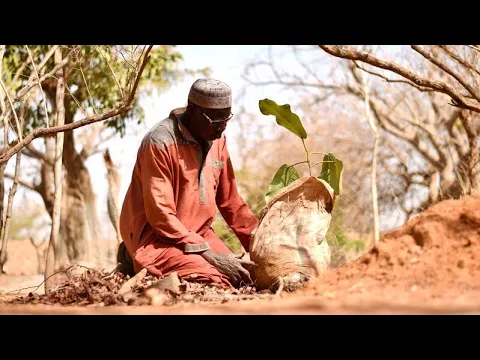

In addition to recovering agriculture, Sawadogo decided to use the same technique to plant trees. Over the years, he cultivated a forest that now houses over 60 species of shrubs and trees, as well as medicinal herbs that he distributes to the local community.
To him, the commitment goes beyond production. “It’s my love for trees that led me to invest in this forest,” he says. “Trees strengthen the beauty of life.”
Recently, the United Nations Environment Program recognized his efforts by naming him one of the six Champions of the Earth 2020, the highest environmental honor awarded by the UN. However, even after the award, Sawadogo warns that he cannot save the environment alone.
Currently, farmers in the region still face rising temperatures and increasingly severe weather conditions. Still, his story demonstrates that environmental recovery is possible when traditional knowledge, persistence, and innovation work together.
Therefore, amidst a planet suffering from the advance of desertification, Yakuba Sawadogo’s example proves that planting trees can, indeed, change destinies.
Do you believe that tree planting can be one of the most powerful solutions against desertification and global warming?


I had the privilege to visit Yacuba in his forest in 2013 and i was very impressed. I saw many animals like squirrels and birds. We encourage people across the different regions of Africa to plant trees, especially high value trees (fruits, medicinal and timber species. I think a monument should be built in his honour in Burkina Faso.
Siii claro , el Sr c sus conocimientos ancestrales + lo actuales lo esta D E M O S T R A N D O!!!! espero q se imite!!!
Excelente!
Totalmente de acuerdo!