Portuguese
  Spanish


New Electric Engine From Honda Comes to Displace Yamaha, Shineray, and Bajaj. New V3 Engine Promises to Revolutionize the Market and Will Arrive in a Few Years.
One of the main launches from Japanese Honda during this year’s Milan Motorcycle Show (Eicma), the largest global event for motorcycle manufacturers, was not a new vehicle. It is a new V3 turbo electric engine from Honda, which promises to extend the lifespan of combustion engines and, in addition, adopt unprecedented technologies for the two-wheeler universe (at least concerning mass-produced models).
New Engine From The Japanese Will Be A V3 Turbo Electric Engine
The new engine from Honda in question features a V3 configuration with two pistons inclined forward and one backward, separated by an angle of 75°. The V3 engine is liquid-cooled and, according to Honda, has an extremely compact dimension.
However, beyond the unusual configuration of three cylinders in a V, what draws attention is the fact that it is supercharged by an electric supercharger. If Honda’s new engine were turbocharged, it would already be a highlight, but by opting for an electric solution, Honda adds an extra ingredient of uniqueness to the project.
-
Thinking of Installing LED Headlights? Why Replacing Halogen Bulbs is Still Banned, the Glare Risks Authorities Worry About, and How a New Proposal Could Allow Certified, Safe Installations

-
2027 Toyota Corolla Cross Unveiled: New Design, Enhanced Fuel Efficiency, Reduced Maintenance Costs, Advanced Technology, Connected Services, and Up to 10-Year Warranty

-
Fiat Cronos Precision 2018: Affordable Sedan with Spacious Trunk and Reliable Maintenance
-
Volkswagen to Cut Production by 1 Million Cars by 2030, Reducing Jobs and Platforms, Focusing on More Profitable Models




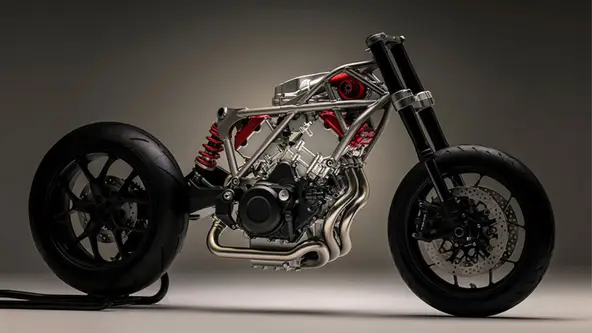
According to the Japanese brand, the electric supercharger allows for independent control of air intake compression from the engine’s revolutions, meaning that the torque from the V3 engine can be delivered even at low revs.
This happens because it is a new Honda engine, powered by a battery, that is responsible for spinning the supercharger rotors, not the gases expelled from the combustion chamber (as would be the case with a conventional turbo, which relies on engine speed to send more gases to the turbo). Additionally, there is no need for an intercooler, which is common in turbo engines.
Understand The Advantages Of The New Honda Engine
Though it sounds more complex and heavier due to the addition of extra components in the powertrain, Honda claims that this configuration of the V3 engine plus supercharger enables a more efficient mass centralization.
With the advancement of hybrid technologies and electrification in motorcycles, the brand emphasized that it will continue developing “advanced technologies while launching electric motorcycles and other products in its portfolio to meet the varied demands of today’s consumers.
The brand sees the development of this new V3 engine from Honda with an electric supercharger as a new challenge in the field of combustion engines, and its goal is to allow its consumers to continue experiencing the pleasure of riding a motorcycle.
There is still no expectation of the power and torque of this supercharged V3 engine, nor a forecast of when it will go into production, but it is already known that it will be aimed at larger displacement engines, possibly as an alternative to in-line four-cylinder engines.
The Future Of Technology In Honda Motorcycles
Despite the excitement generated by this new technology of Honda’s new engine, the brand indicates that there are still several stages before the engine becomes a commercial reality. The company is focused on development and mass production, prioritizing safety and efficiency.
The launch of the engine in motorcycles will initially be restricted to premium models, reflecting the complexity and cost of the new technology.
The technological advances in this V3 engine illustrate the direction in which the motorcycle industry is moving: combinations of power and efficiency through innovation. Honda, once again, demonstrates its commitment to innovation by offering solutions that not only enhance performance but also consider practical limitations such as available space and thermal management.