Portuguese
  Spanish


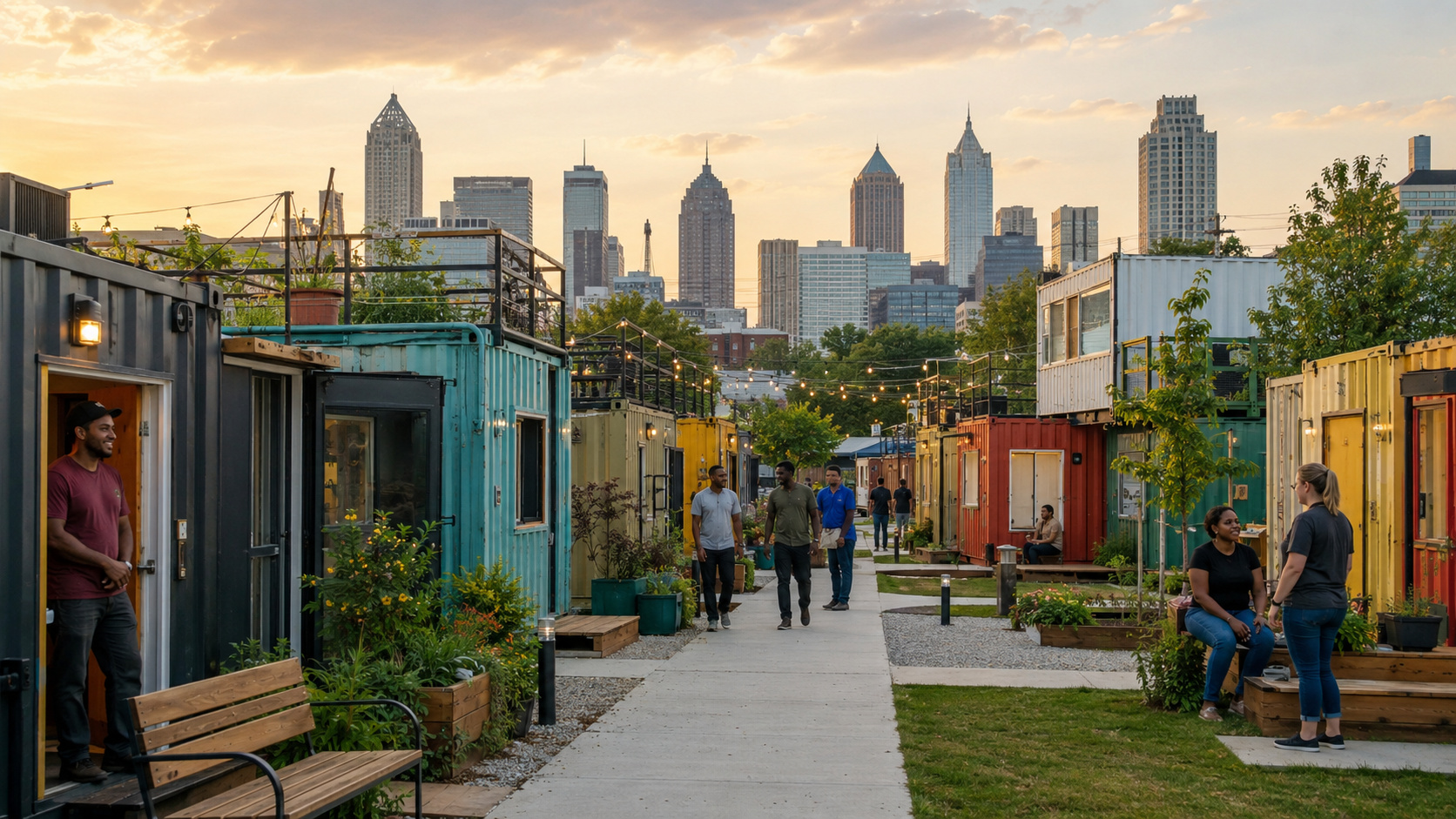

Atlanta transformed containers into housing for the homeless and reinforced the U.S. bet on quick, small, and cheaper micro-communities.
In Atlanta, in the United States, a former parking lot was converted into a closed micro-community called The Melody, a project that transformed shipping containers into 40 isolated studio apartments for people who previously lived on the streets. The report by Associated Press, published on June 14, 2024, describes a space with artificial grass, pots, red chairs, and even a dog park, in direct contrast to the gray landscape of the city center.
Among the residents is Cynthia Diamond, a former cook aged 61 and wheelchair user, who had lived for years in chronic homelessness. In the AP narrative, the central point is not the visual appeal of the containers, but the symbolic and practical weight of having a door, a lock, and a personal space to start over.
Housing with its own key became the center of transformation in Atlanta
The most powerful aspect of the project is not the size of the studio, but the autonomy it restores. For those who spent years between shelters, strict rules, and minimal privacy, having a key and deciding their own routine represents a concrete break from the logic of daily survival.
-
São Paulo Highway to Receive Over $260 Million in Upgrades, Including 90 Kilometers of Service Roads and New Infrastructure, by 2027

-
Couple Transforms Abandoned Seaside Public Restroom Bought for £33,000 into £295,000 Beach House After a Decade of Renovations

-
With 26 Million Brazilian Families in Substandard Housing, Churches to Launch 2026 Challenge: Each Parish to Build or Renovate a Home for a Local Family
-
Wood-Look Aluminum Emerges as a High-Tech Alternative for Facades and Gates, Offering Sophisticated Aesthetics and Low Maintenance



AP itself shows that this sense of control helps explain why these micro-communities are being treated as a more effective alternative than traditional collective shelters. In the case of Atlanta, services are concentrated in the same location and include case management, counseling, mental health support, addiction treatment, and housing guidance.
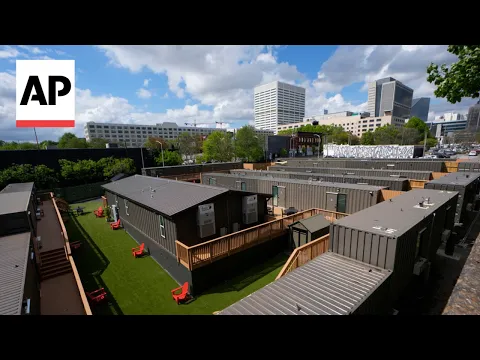

This combination of individual shelter and continuous support is what sustains the promise of the model. Clinician Peter Cumiskey, interviewed by the Associated Press, stated that the structure can meet needs ranging from security and shelter to a sense of community and personal fulfillment.
Micro-communities for the homeless advance in the United States with a focus on speed and low cost
The strength of this model is not restricted to Atlanta. The AP report shows that American cities have started adopting transitional housing solutions based on three central attributes: being small, fast, and cheaper than conventional housing developments.
In Denver, for example, the city built three micro-communities with almost 160 units in about six months, at an approximate cost of US$ 25,000 per unit. According to the AP, more than 1,500 people had already been brought indoors through the program, and more than 80% remained housed during the period mentioned in the report.
These numbers help explain why the format has gained traction in cities with expensive real estate markets and significant pressure on the shelter network. Instead of waiting years for traditional projects, public managers have started betting on smaller and faster units as an intermediate step towards permanent housing.
Housing containers accelerate the delivery of transitional housing
The container has become a key piece because it shortens the timeline and simplifies part of the construction. In Atlanta, Mayor Andre Dickens stated in his official city address that the containers were converted into 40 housing units in just four months, reinforcing the project’s quick delivery logic.
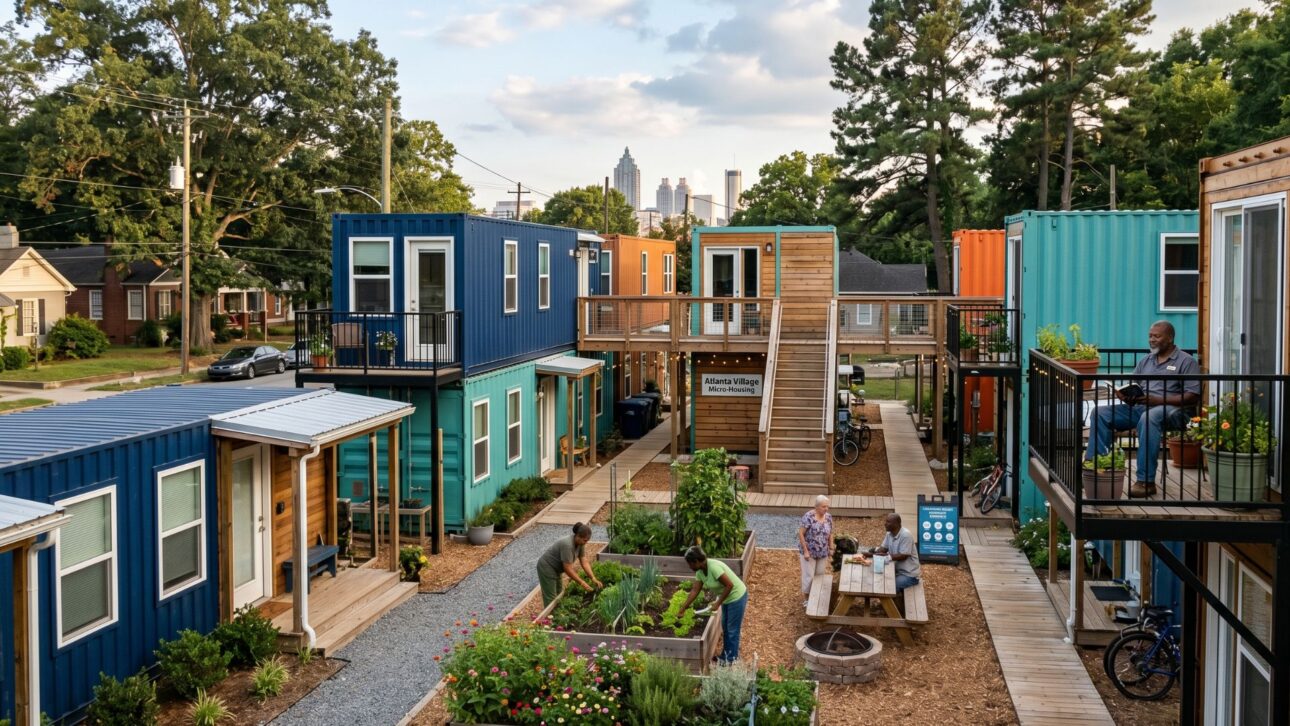
In practice, this allows for transforming a standardized industrial structure into housing more quickly than most conventional constructions.
At The Melody, the result was a set of studios with a bed, air conditioning, desk, microwave, small refrigerator, TV, sink, and bathroom, a combination that dispels the image of extreme improvisation usually associated with emergency shelters.
The bet on containers does not solve the housing crisis alone, but it reduces a decisive barrier: time. In scenarios with a high number of people on the streets, this factor weighs almost as much as cost, as it delays less the access to individual shelter and support services.
The Melody bets on community and not just on emergency shelter
The Atlanta micro-community was designed to look more than just a row of metal modules. The AP describes an environment with living areas, plants, chairs scattered throughout the courtyard, and a dog park, elements that help create a sense of permanence and belonging.
This design matters because the project was not conceived just to take someone off the street for a few days. The proposal combines privacy, stability, and social connection, three factors that tend to be fragile in temporary collective structures and in constant movements between shelters and camps.

In the report, residents appear talking in common areas, a sign that recovery also involves rebuilding routine and relationships. The physical space, in this context, serves as a foundation for something greater: reorganizing life with a minimum of security and predictability.
Transitional housing for the homeless population still doesn’t solve everything
Despite the progress, the very framing given by the report avoids selling the model as a total solution. Political scientist Michael Rich, from Emory University, told the AP that projects like The Melody are a very promising, viable, and cost-effective way to tackle the crisis, but he emphasized that transitional housing remains just the first step towards permanent housing.
This point is crucial because the homeless population does not face just the absence of a roof. The problem also involves health, employment, income, documentation, substance dependency, clinical follow-up, and access to lasting housing, which requires articulated public policies beyond the physical delivery of units.
Even so, the Atlanta experience gained prominence precisely for showing that dignity can begin with objective and immediate measures.
In many cases, the reconstruction of life does not start with a grand urban solution, but with something much more elemental: a door, a key, and the real chance to be at peace within one’s own space.