






 Portuguese
  Spanish


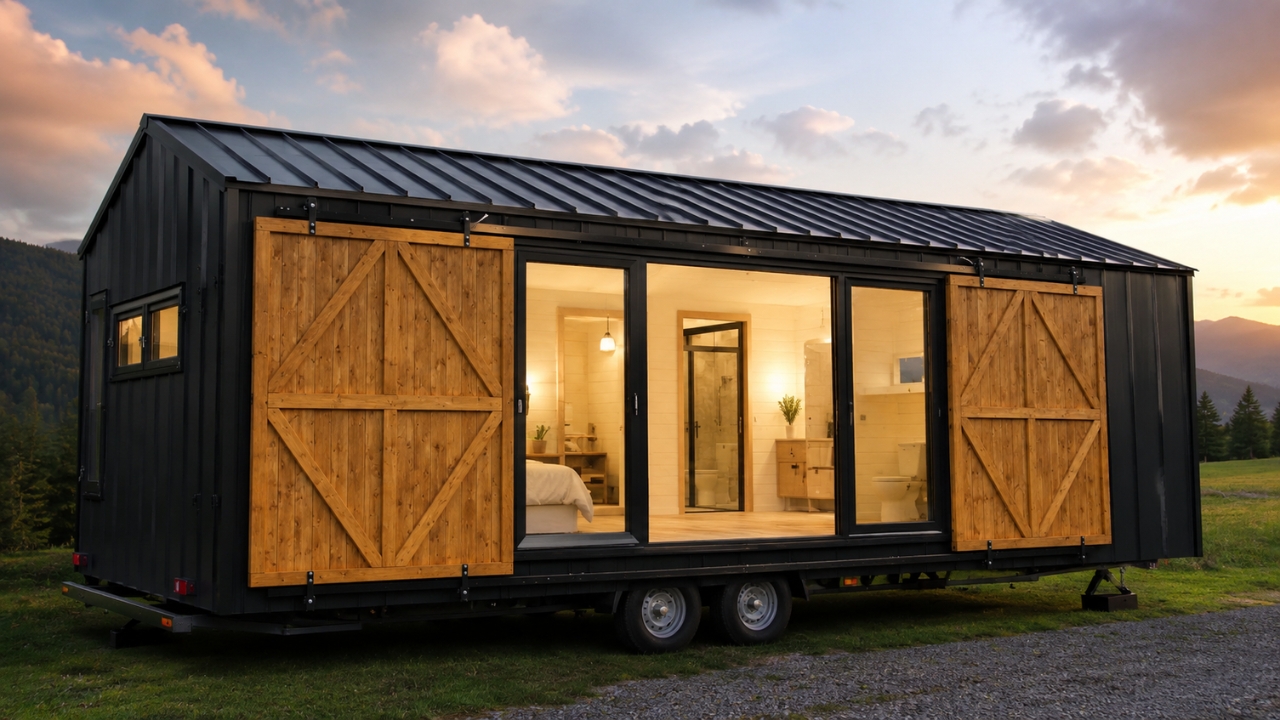

The Mini Domek 350 x 1000 model shows how modular homes can gain space amidst rising construction costs, offering a compact, transportable, and functional alternative with defined rooms and an appearance closer to a conventional house.
A modular house on wheels is attracting attention for attempting to break one of the biggest criticisms made of tiny houses: the feeling of living squeezed into a few square meters. The Mini Domek 350 x 1000 model, created by the Polish company Mini Domy, appears as a kind of mobile compact apartment, with 35 m², two bedrooms, a spacious living room, a full bathroom, and a ground floor plan.
Unlike many traditional tiny houses, which rely on cramped lofts, steep stairs, and beds installed close to the ceiling, this house tries to take a different path. The proposal is to deliver a small dwelling, but with the look of a real house, designed for those who want mobility, comfort, and permanent use in a reduced space.
According to information published by New Atlas, the model stands out precisely because it looks less like an improvised cabin and more like a compact residence with an apartment layout. The house measures 10 meters in length, 3.50 meters in width, and 3.99 meters in height, dimensions that allow for a more comfortable internal distribution than the average micro houses on wheels.
-
Brazilian Engineer Revives Ancient Tool for Focus, Creates Supera Network with Over 100,000 Students and $37 Million Revenue

-
Father Turns Simple Idea into Digital Empire, Managing Contracts Worth Over $80 Million Annually

-
12-Year-Old Discovers 1,500-Year-Old Rare Gemstone in Biblical Village Linked to Jesus’ Ministry, Unveiling Ancient Galilean Wealth and Trade

-
Austrian City Revamps Public Parks to Attract Girls Aged 10-13 by Adding Lighting, Sports Facilities, and Inclusive Spaces



A tiny house that tries to escape the feeling of tightness
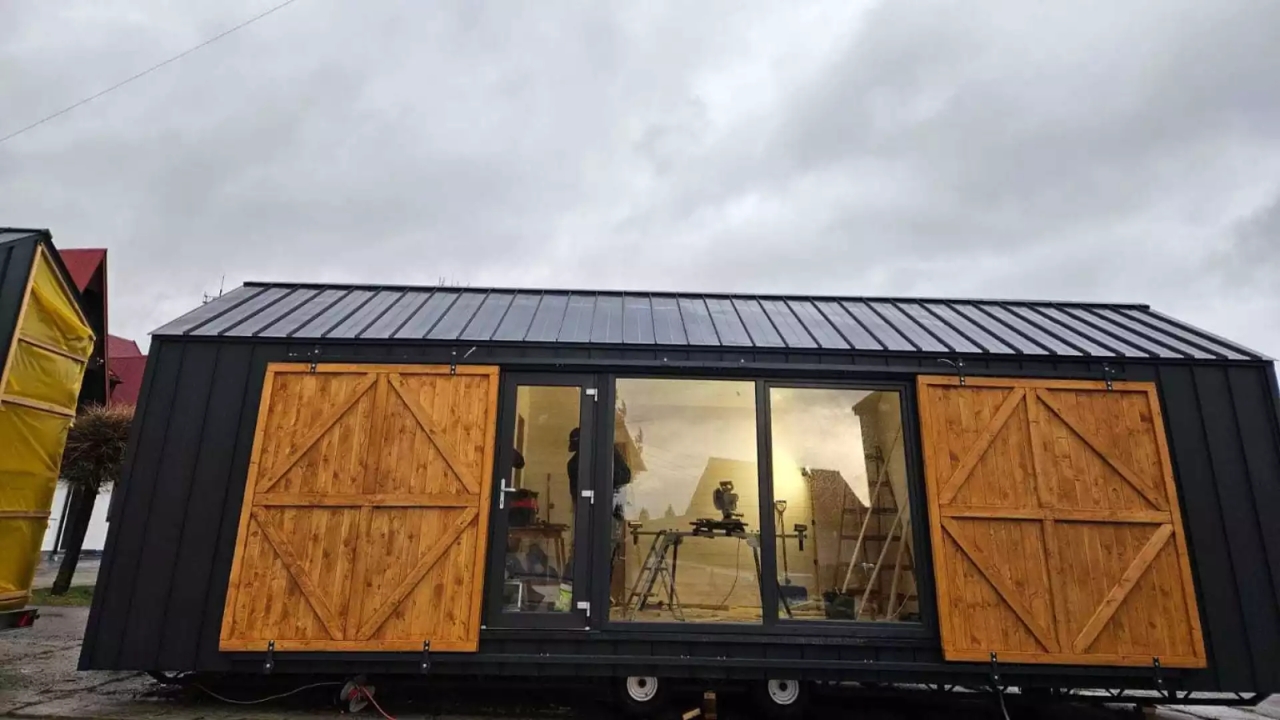
The great differential of the Mini Domek 350 x 1000 lies in the way the space was organized. Instead of stacking environments or relying on mezzanines, the house bets on a ground floor plan, with all rooms on the same level.
This significantly changes the user experience. In many tiny houses, the resident needs to climb stairs to sleep, use foldable furniture all the time, and adapt every corner for multiple functions. In this model, the idea is different: to create a small but functional dwelling, with simpler circulation and more defined environments.
The house is installed on a dual-axle trailer, reinforcing the concept of a transportable dwelling. Even so, the visual and structural focus does not seem to be that of a simple vacation home, but of a unit that could serve as a permanent residence, compact lodging, or auxiliary house on a plot.
Two bedrooms in just 35 m²
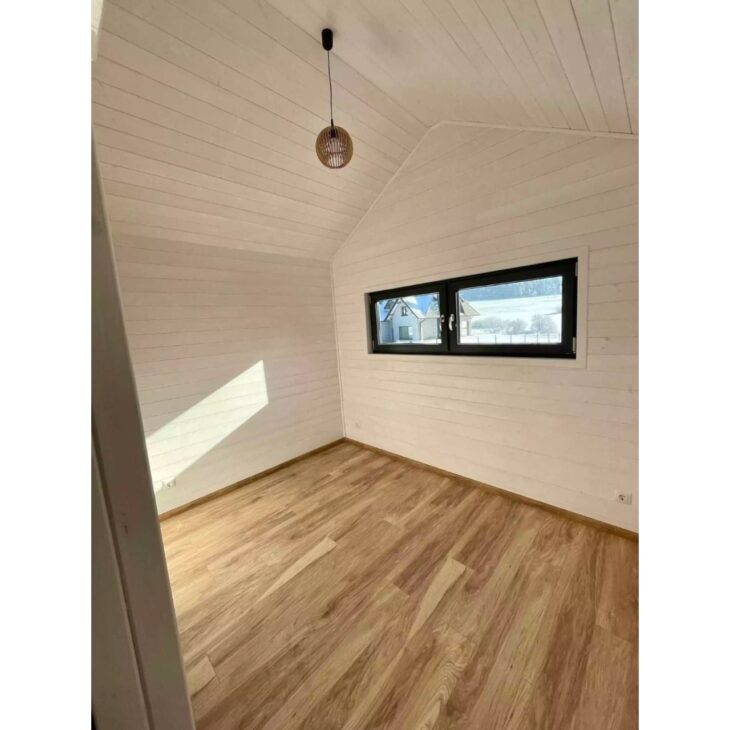
One of the most striking features is the presence of two bedrooms within a house of just 35 m². This is rare in tiny houses, especially those that keep all rooms on one floor.
The main bedroom is separated from the social area by a barn-style sliding door, a solution that saves space and helps maintain some privacy. Although the images show the room with few furnishings, the space was designed to accommodate a double bed and compact wardrobes.
On the other side of the living room, there is a second room, also separated by a sliding door. This space can function as a children’s room, guest bedroom, office, closet, or storage, depending on the resident’s profile.
Spacious living room becomes the heart of the modular house
The living room is the central point of the layout. It appears as the space that most closely resembles a traditional apartment, with room for a sofa, coffee table, and more comfortable circulation.
The presence of large glass openings also helps to enhance the internal feeling. The entrance features a glass door and sliding doors, allowing more natural light and creating a direct connection with the outdoor area.
This detail is important because, in small houses, lighting and visual integration with the exterior make a difference. A dark tiny house can seem even smaller. However, a unit with large windows, open living room, and comfortable ceiling height tends to convey a feeling closer to a conventional house.
Compact kitchen and complete bathroom
The kitchen is integrated into the living room and follows the logic of a compact dwelling: it is not huge, but offers the basics for daily use. The project includes a countertop with a sink, space for food preparation, and the possibility of installing additional equipment.
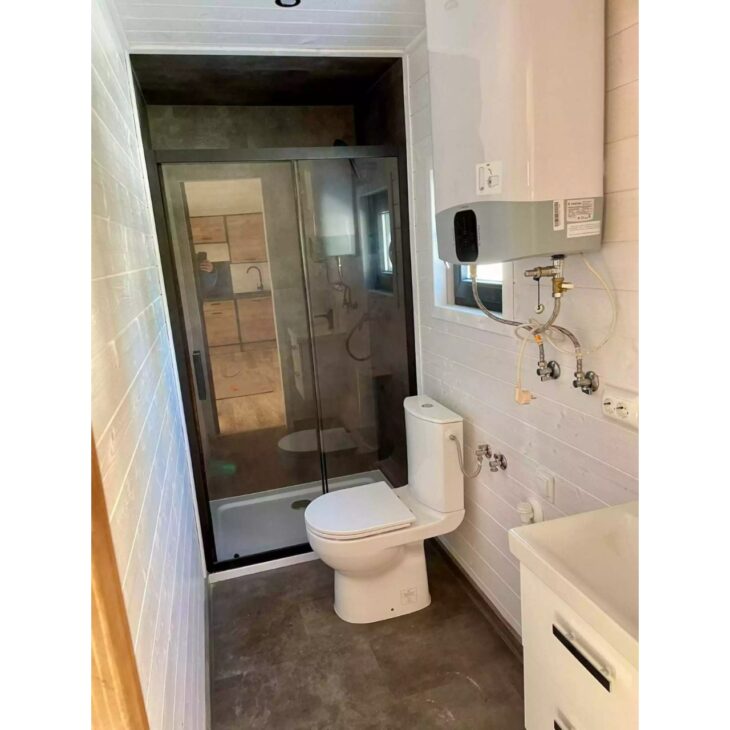
The bathroom was also not treated as an improvised detail. It features a shower enclosed by glass, a toilet with a flush, and a washbasin, forming a set closer to a residential bathroom than a temporary structure.
This point reinforces the project’s appeal: the Mini Domek does not try to sell just a “charming little house.” It tries to show that a small house on wheels can offer a more complete routine, with separation of spaces and sufficient structure to live for a longer time.
Manufacturer sells the idea of a mobile home for annual use
Mini Domy presents its mobile homes as solutions for private and commercial use. The company claims that this type of construction seeks to combine the functionality of a traditional house with the flexibility of a transportable structure.
In practice, this places the model within a market that has been growing in several countries: that of modular homes, tiny houses, units for seasonal rental, compact country houses, and alternative housing for smaller plots.
The manufacturer also highlights advantages such as faster construction, production in a controlled environment, and the possibility of repositioning the unit. These are arguments that usually attract those seeking alternatives to conventional construction, especially in a scenario of expensive properties, contested land, and high construction costs.
Price still requires caution
The specific price of the version shown by New Atlas was not publicly confirmed in the report. However, the manufacturer’s table indicates references for mobile homes of 35 m², with values starting from 122 thousand net zlotys in a closed state, potentially reaching higher values in more complete versions.
Therefore, the best way to approach the subject is with caution. The highlight should not only be the price but the proposal: an extra-wide tiny house, with greater width, two bedrooms, and a more comfortable layout.
Is a tiny house starting to become a real home?


The most striking point is symbolic. For years, tiny houses were associated with a radically minimalist lifestyle, with residents giving up space, privacy, and comfort in exchange for mobility and economy.
The Mini Domek 350 x 1000 seems to try to change this perception. With two bedrooms, a spacious living room, a full bathroom, and a ground floor plan, it resembles more a compact apartment than a micro cabin.
It is still not a solution for everyone. The space remains small, availability depends on the manufacturer, and the model does not have confirmed presence in Brazil. Even so, the house shows a clear trend: tiny houses are no longer just architectural curiosities and are beginning to compete as real compact dwellings.
In a world where many people are looking for alternatives to the traditional house, this modular house on wheels emerges as a strong example of how future housing can be smaller, mobile, and more flexible, but without necessarily seeming makeshift.


