Portuguese
  Spanish


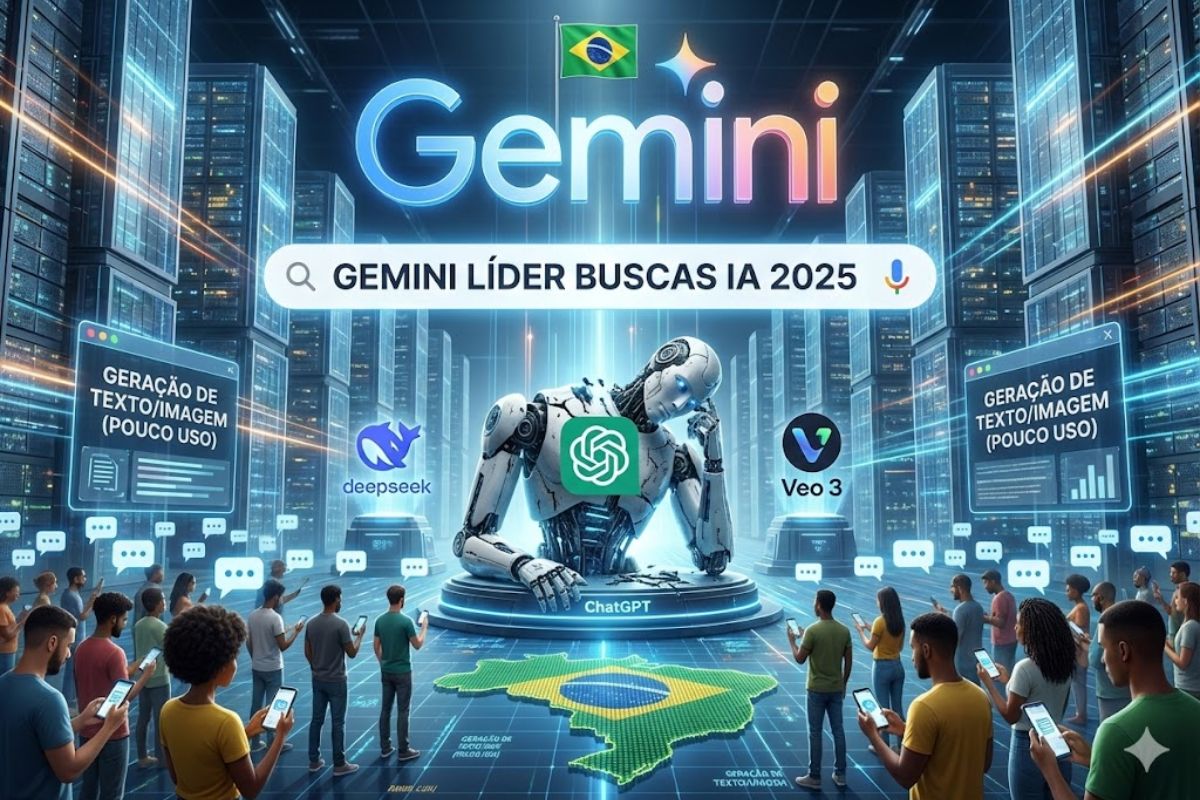


Google’s Review Reveals the AI Landscape in 2025: Gemini Leads Searches with DeepSeek and Veo 3, ChatGPT Disappears from the Top 10, Filter Trends Become a Craze, but Datafolha Research Shows Most People Don’t Use Text or Image Generators in Their Daily Digital Life Despite Massive Brazilian Usage
Google has released its search retrospective in Brazil and revealed a surprising portrait of AI in 2025. Gemini emerged as the most searched artificial intelligence tool of the year, surpassing heavyweight rivals and reshaping the landscape of digital curiosity among Brazilians.
At the same time, ChatGPT, which receives over 2 billion commands worldwide daily and over 140 million daily messages just from Brazilians, was absent from the list of the 10 most searched AIs on Google. The contrast is heightened by a Datafolha survey released in August 2025, which shows that the majority of the population still does not use text or image generators, even with AI already embedded in almost all digital services of daily life.
Gemini Leads Searches, ChatGPT Disappears from the Ranking
In searches for AI tools in 2025, Gemini took first place, consolidating Google’s effort to transform its chat assistant into the main hub of artificial intelligence for the average user.
-
15-Year-Old American Builds Ocean Generator with PVC Pipe and 3D-Printed Propeller for $12, Wins National Prize, Presents at White House, and Makes Forbes 30 Under 30 List

-
$12 Billion Invested in AI Data Centers in Semi-Desert Mexican State, But 17 of 18 Municipalities Now Face Water Shortages, Residents Receive Water Only 3 Days a Week
-
How Much Does Starlink Satellite Internet Cost for Cars, Trucks, and RVs? Prices for Antenna, Accessories, and Plans

-
Scientists Convert Food Waste into Aviation Fuel, Successfully Test 50% Blend with Conventional Kerosene to Cut Emissions and Promote Sustainable Flights



Second place goes to the Chinese DeepSeek, focused on agents capable of performing complex tasks, followed by Veo 3, the creator of realistic videos also from Google.
What stands out the most is that ChatGPT does not appear in any position in the top 10 most searched AIs. This occurs even after OpenAI reported that Brazil is already the third country with the highest number of users on the platform.
In other words, Brazilians use ChatGPT a lot, but do not necessarily search for it on Google, either because they already have the address saved or because they access it through apps or integrations.
It’s important to remember that Google’s data measures topics that gained relevance throughout 2025, not the size of the user base for each service. Still, the ranking indicates where public curiosity lies when it comes to AI in 2025.
The 10 Most Searched AIs on Google in 2025
The top 10 AI tools in 2025 on Google Brazil are as follows:
- Gemini
- DeepSeek
- Veo 3
- NotebookLM
- Grok
- Pixverse
- Flow
- Manus
- Blackbox
- Nano Banana
The ranking shows a mix of chat assistants, video tools, visual creation resources, and solutions aimed at programmers. Two Google products appear in the top 3 (Gemini and Veo 3), reinforcing the company’s strategy to integrate AI across all fronts, from text to video.
At the same time, the presence of lesser-known names to the general public, such as Manus and Nano Banana, reveals that curiosity about AI in 2025 is not limited to the most famous brands, but spreads across specific niches such as automation, development, and professional content creation.
Social Media Trends Transform AI into Filters, Fun, and Special Effects
It wasn’t just platforms that dominated searches. The biggest AI trends in 2025 also exploded on social media, almost always linked to filters, montages, and visual fun.
Among the 10 most searched trends, only three had no direct relation to AI, showing how artificial intelligence has become part of the visual language of the Brazilian internet. The main ones were:
- Anime Trend transforming a real photo into anime or drawing
- Gemini Trend creating photos with a professional studio look using Google’s AI
- Box Doll Trend placing people as dolls inside themed boxes
- Jesus Hugging Trend editing a photo to turn it into a video with Jesus embracing the central figure
- Miniature Car Trend assembling images with miniature cars and real versions in combining scenarios
- Polaroid Trend including celebrities hugging someone, in a montage with a polaroid photo frame
- Magic Dust Trend mixing kitchen ingredients to create a fun effect in front of the camera
- Love Strawberry Trend preparing a strawberry with a layer of brigadeiro and another of caramel
- Hair Tie Trend challenge to untangle hair ties stuck on fingers
- Mermaid Trend transforming images of people into mermaids underwater
These fads help explain why the AI experience in 2025 is, for many, synonymous with filters, effects, and montages in photo or video, rather than necessarily writing long texts, creating reports, or automating work tasks.
Datafolha Research Shows That the Majority Still Do Not Use Text and Image Generators
On one hand, AI in 2025 dominates searches and trends, but on the other hand, the active use of generative tools remains limited.
The Datafolha survey in partnership with the Itaú Foundation Observatory, released in August 2025, shows that 93 percent of respondents use some service with integrated AI, often without realizing it.
According to the study, 89 percent use social networks with AI in the background, 78 percent rely on movie and music recommendation systems, such as YouTube, and 63 percent use navigation apps, such as Waze and Google Maps, which also depend on intelligent algorithms.
When the question shifts to direct content creation, the scenario changes. About 57 percent have never used text generators and 69 percent have never resorted to image generation tools.
This means that the majority of Brazilians deal with AI in 2025 all the time but still do not see themselves as users of generative AI, such as ChatGPT, Midjourney, and other similar models.
Brazil is a Powerhouse in ChatGPT but Still a Beginner in AI Creation
On OpenAI’s side, the numbers are gigantic. Over 2 billion commands are sent daily to ChatGPT and, within that volume, over 140 million daily messages come from Brazil, which is already the third country in the world in terms of users of the tool.
Even so, these figures coexist with the reality shown by Datafolha. The average Brazilian is surrounded by AI in 2025 but still uses generative tools that require active creation sparingly, such as writing a text from scratch, creating a script, or drawing a complex image with prompts.
The set of numbers suggests a country in transition. AI is already the invisible infrastructure of daily digital life, present in recommendations, maps, feeds, and filters, while the conscious adoption of text and image generators grows more slowly, driven by curious individuals, technology professionals, content creators, and businesses.
And you, have you fully immersed yourself in AI in 2025 to create texts and images, or do you still prefer to stick with just the filters and automatic recommendations that appear on your screen?