






 Portuguese
  Spanish
  5 min of reading
  0 comments


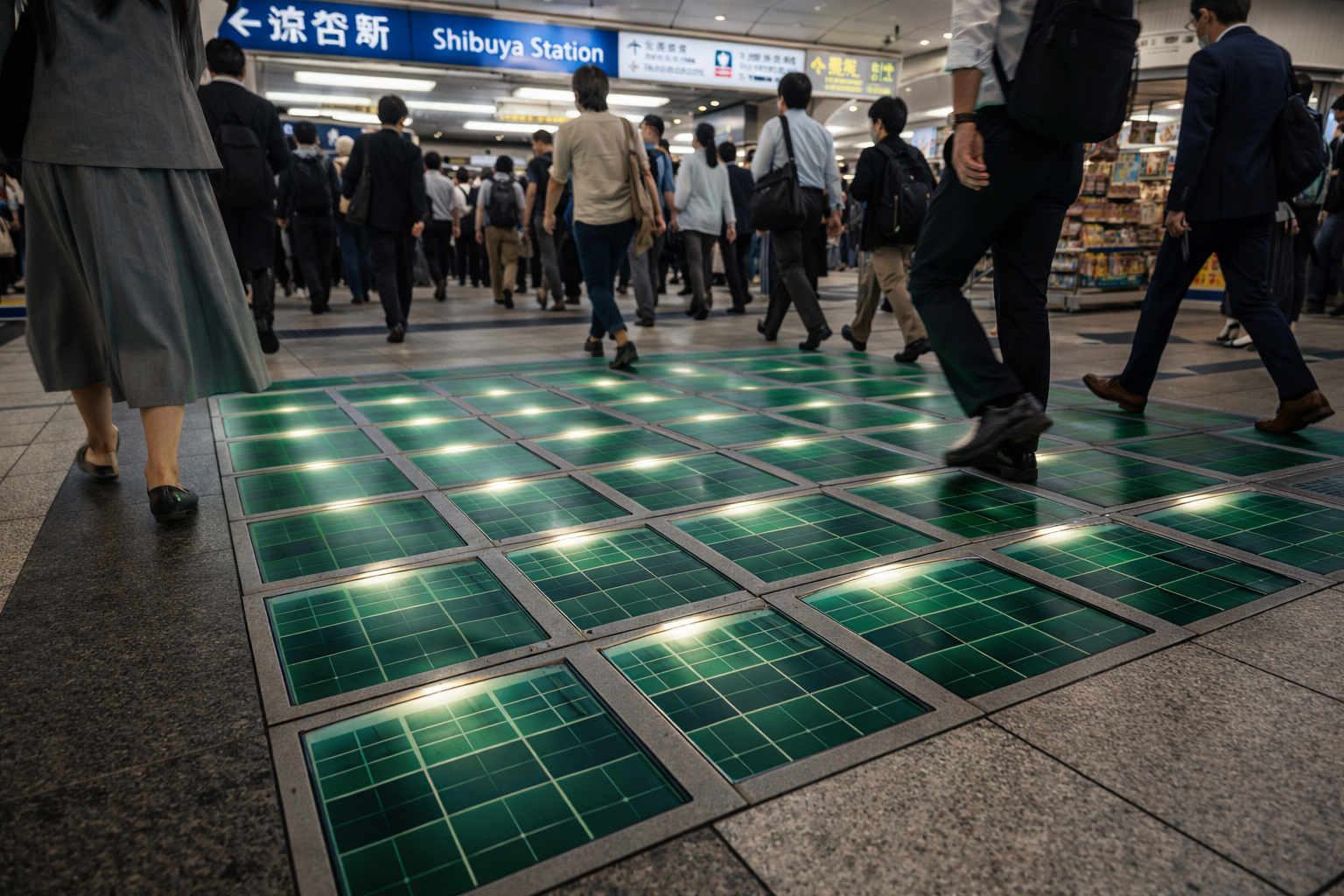
Piezoelectric floors in Shibuya transform steps into electricity and show how crowds can generate clean energy in cities.
In December 2008, the Shibuya Station in Tokyo became a showcase for an experiment that seemed straight out of science fiction: a floor capable of transforming pedestrian steps into electricity. The test used piezoelectric tiles that convert mechanical pressure into electrical energy, a technology that even powered a light installation and an LED panel with real-time generation in one of the city’s busiest areas.
Years later, the concept gained international scale with companies like Pavegen, which brought this type of solution to transport hubs, urban projects, and even dancing floors, accumulating installations in over 45 countries. The principle remains simple, but its application depends on a sophisticated combination of piezoelectric materials, power electronics, and integration with urban infrastructure.
How piezoelectric floors transform steps into electricity in urban areas
The operation of the floors installed in Shibuya is based on the piezoelectric effect, a physical phenomenon in which certain materials generate electric charge when subjected to mechanical pressure.
-
“Bee drone”: Researchers develop an autonomous drone that does not require GPS and can return home after flights of more than 600 meters — meet the Bee-Nav

-
Aluminum alloys created in the USA make truck engines 15% lighter and over 10% more efficient in GM test.
-
China transforms 7 billion tons of coal waste into sand, gravel, and bricks for construction and attempts to reduce the pressure on rivers, quarries, and former mining areas.

-
Stars display different colors in the sky and science explains why.




When a person steps on one of these tiles, a small deformation occurs in the internal material. This deformation generates a difference in electric potential, which is captured by internal circuits and converted into usable current.
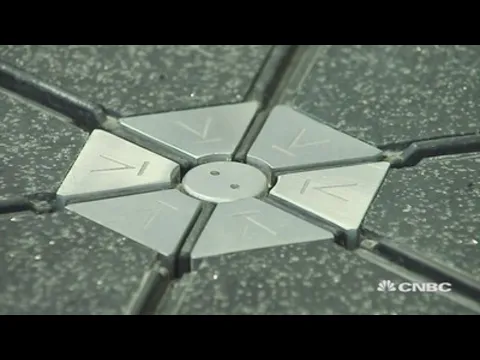

Each individual step produces a very small amount of energy, but the big difference lies in the scale. In places with intense and continuous flow, like Shibuya, millions of daily steps can generate a relevant accumulated energy output for specific applications.
Test in Shibuya showed the viability of the technology in high-traffic environments
The experiment conducted in 2008 was one of the first to test the technology in a real urban environment with extremely high foot traffic.
According to technical records cited in urban engineering and energy reports, the installed system was able to generate enough energy to power electronic devices in controlled demonstrations, including lighting and low-power equipment.
In one of the most widely reported data points at the time, the energy accumulated during about 20 days of operation was sufficient to power thousands of televisions for a limited period, which reinforced the potential of the technology as a complementary, although not substitutive, solution for urban energy generation.
It is important to highlight that these numbers are based on accumulated measurements and do not represent continuous generation on a power grid scale, but serve as proof of concept.
Shibuya Station offers ideal conditions for energy generation based on human movement
The choice of the station was not random. Shibuya Station is one of Japan’s main transportation hubs, connecting multiple railway lines, subways, and urban flows.
With millions of daily commutes, the location presents ideal characteristics for technologies based on repetitive movement:
- High pedestrian density
- Constant flow throughout the day
- Predictable circulation patterns
This predictability allows for optimizing the installation of tiles at strategic points, such as entrances, exits, and high-traffic corridors, increasing the efficiency of the system.
Technology has already been implemented in more than 30 countries with diverse applications
The company Pavegen has expanded the concept globally, bringing the technology to over 30 countries. The floors have already been installed in:
- public transport stations
- shopping centers
- sports events
- interactive installations
- corporate environments
In many cases, the energy generated is used locally to power LED lighting, sensors, information screens, or data collection systems.
In addition to energy generation, the systems are also capable of collecting information about foot traffic, creating an additional layer of value for urban planning and behavior analysis.
Energy production per step varies and still limits large-scale use
One of the most discussed points about the technology is the actual amount of energy generated. Frequently cited values indicate that each step can generate between 2 and 8 watts of instantaneous power, depending on the individual’s weight, walking speed, and system efficiency.
However, this power is not continuous and needs to be converted into accumulated energy over time.
In practice, this means that the technology is not yet viable for powering large infrastructures, but it can be extremely useful for decentralized and low-consumption applications.
Research advances to integrate piezoelectric generation in highways and urban infrastructure
In addition to use in sidewalks and public spaces, researchers have been exploring the application of piezoelectricity in other areas.
Projects funded by agencies such as the California Energy Commission investigate the possibility of installing piezoelectric systems on highways, harnessing the weight of vehicles to generate electricity.

Universities such as Rutgers and Purdue are also studying transducers integrated into asphalt, capable of capturing energy from automotive traffic.
These initiatives indicate that the concept can evolve beyond human movement, expanding its generation potential in urban environments.
Technology functions independently of weather conditions and operates 24 hours a day
One of the main differentiators of piezoelectric floors is their independence from environmental factors. Unlike solar panels, which depend on sunlight, or wind turbines, which depend on wind, human movement-based generation occurs continuously, as long as there is a flow of people.
This makes the technology particularly interesting for dense urban environments, where movement is constant and predictable.
In most current applications, the energy generated by the floors is used locally. This includes:
- lighting of public areas
- powering urban sensors
- signaling systems
- interactive installations
This decentralized model reduces transmission losses and allows the technology to be integrated into smart city projects.
Instead of powering the conventional electrical grid, the system functions as a distributed micro power source, connected directly to the consumption site.
Using human movement as an energy source raises new possibilities for smart cities
The experiment in Shibuya and its global expansion show that the concept of energy generation can go beyond traditional sources and incorporate everyday human activities.
Although there are still technical and economic limitations, technology opens up space for a new way of thinking about urban infrastructure.
Sidewalks, stations, airports, and public spaces cease to be merely passageways and begin to act as active surfaces, capable of generating energy and data simultaneously.
Do you believe that future cities will transform every step into useful energy
The idea of transforming the simple act of walking into electricity is still in the development phase, but it already shows practical applications in real urban environments.
If combined with other distributed generation technologies, this approach can help reduce the energy consumption of urban systems and enhance the efficiency of cities.
In light of this, a central question arises: to what extent can human movement be significantly incorporated into the energy matrix of future cities?








Be the first to react!