Portuguese
  Spanish


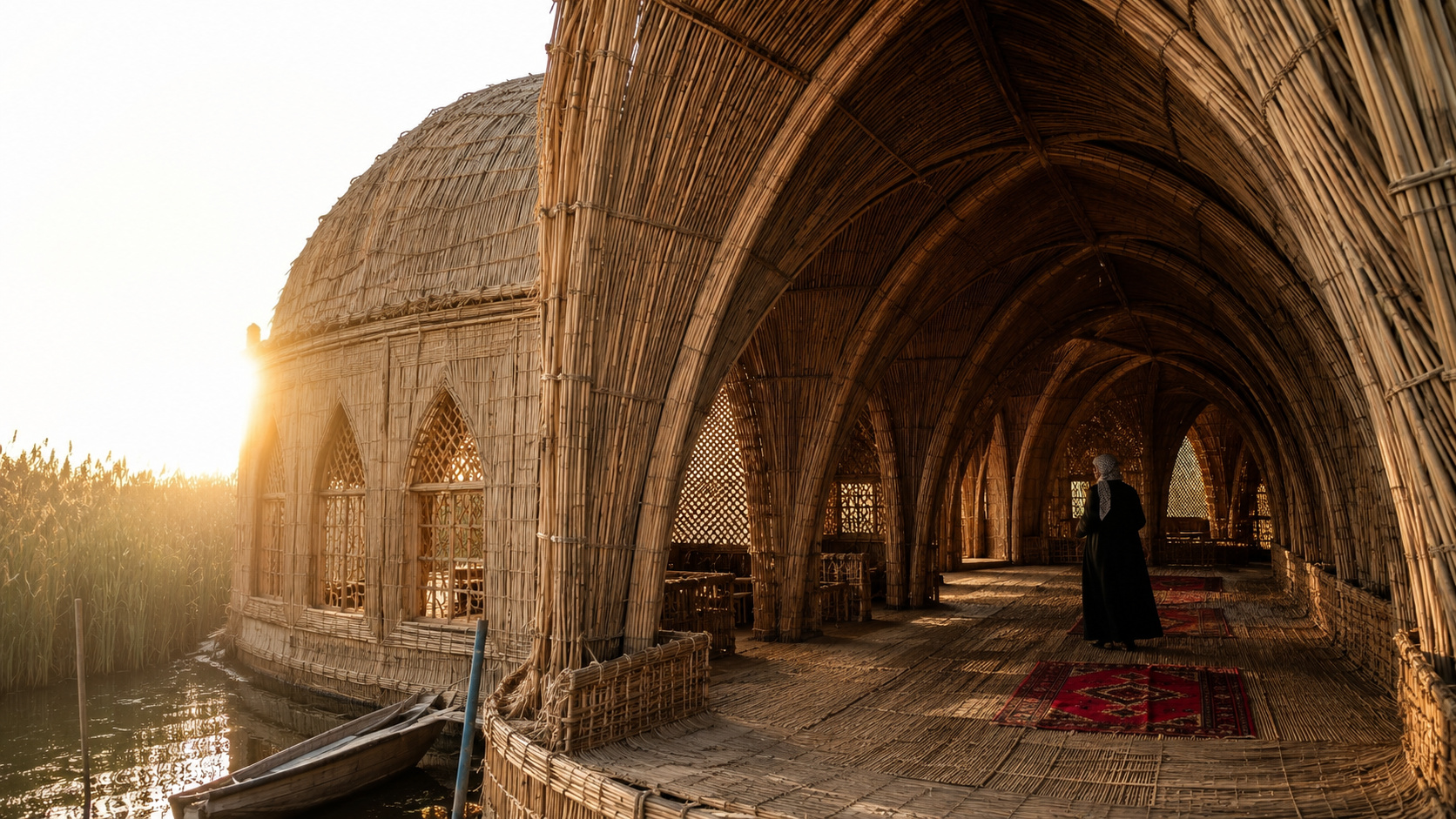

The mudhif of the Iraqi marshes show how building with reed can form spacious, ventilated, and resilient halls, using local plants, vegetal arches, and traditional knowledge recognized by UNESCO as living knowledge of communities in southern Iraq
In southern Iraq, a construction made solely with marsh plants creates arched halls that seem to defy the logic of modern works. The mudhif use reed and papyrus harvested from the marshes themselves to form structure, roofing, and community space.
The information was released by UNESCO, the UN agency for education, science, and culture. The entity records the traditional building skills of the mudhif as living knowledge linked to the marshes of southern Iraq.
The impact is in the contrast. While urban construction usually relies on wood, steel, and concrete, this traditional architecture uses flexible plants, bindings, and repetition of arches to create large living spaces.
-
Architect Converts 1955 Grain Silo into 31m² Home with Full Amenities, Including Kitchen, Bathroom, Curved Living Room, and Loft Bedroom

-
Egypt Partners with China to Build 2 GW Wind Turbine Factory and 2,000 MW Wind Farm in Gulf of Suez, Aiming to Export Across Africa

-
Family of Six Leaves Georgia to Live in a $300,000 Cold War-Era Underground Bunker Since 2020: Unlikely 557 m² Home with 60 cm Concrete Walls
-
Self-taught Brazilian Mechanic Builds 10-Ton Aluminum Sailboat in Backyard, Now Navigates the Brazilian Coast at 50



How a marsh plant becomes an arch and supports an entire hall
The mudhif originates from a simple material: the reed. This plant grows in the marshes and can be gathered in bundles. When these bundles are bent and tied, they form arches capable of creating the main body of the hall.


The logic is easy to understand. A single stalk seems fragile, but many stalks together gain strength. With the right curvature, the bundles cease to be just plants and start functioning as the structure of the building.
The repeated arches create a high and continuous internal space. This sequence forms the most striking image of the mudhif: a hall with a curved roof, made with the very material taken from the surrounding environment.
This technique shows an ancient engineering based on observation and practice. It does not rely on metal parts to create the main form. The secret lies in the combination of reed, binding, curve, and repetition.
Why the Iraqi marshes gave rise to such a different solution
The mudhif belong to the marshes of southern Iraq, a region marked by water and the presence of plants native to this environment. There, the reed and papyrus are not mere details of the landscape. They are part of local life.
The construction takes advantage of what the territory offers. Instead of seeking industrial materials as the basis of the work, the communities use resources from the swamp itself to create shelter, shade, and meeting space.
This point explains why the technique makes sense in that place. In a flooded area, a light construction can respond better to the environment. The mudhif does not try to erase the swamp. It is born from it.
Architecture, in this case, is not just a beautiful form. It reveals adaptation. The available material, the humid climate, and the community use help explain why this solution remained alive.
What UNESCO recognized in the mudhif of southern Iraq
UNESCO, the UN agency for education, science, and culture, detailed the central points of the theme by registering the traditional skills and arts linked to Al Mudhif construction.
The recognition involves more than the appearance of the halls. The practice includes knowing how to choose the material, prepare the bundles, tie the elements, and raise the space with knowledge passed down through generations.
The mudhif also function as meeting spaces. They serve to welcome visitors, gather people, and maintain social practices linked to the swamp communities.
Therefore, this reed construction cannot be considered merely an architectural curiosity. It is technique, culture, and community life gathered in the same space.
Natural ventilation helps explain the intelligence of this architecture
The arched shape of the mudhif creates large environments and favors air circulation. In a humid region, this detail is important for comfort inside the construction.
The use of reed and papyrus also contributes to a lighter construction. The vegetal cover does not create the same sensation of heavy mass associated with industrial structures.
Natural ventilation appears as part of the solution, not as a decorative detail. The very shape of the hall helps the air circulate and makes the space more suitable for community use.

This is one of the reasons why the mudhif attract attention. They show that comfort, lightness, and adaptation to the climate can arise from a traditional technique, without relying on complex materials.
What this construction teaches modern architecture
The reed construction of the Iraqi swamps shows that not every intelligent work needs to be born from industrial technology. In many cases, the answer lies in reading the place.
The mudhif teach that local material can be used with great sophistication. The reed, when worked into bundles and arches, ceases to be seen as fragile and reveals a collective strength.
This technique should not be treated as a universal solution. It belongs to a specific environment, with its own materials and accumulated community knowledge.
Even so, the lesson is clear. Modern architecture can learn from systems that use less weight, fewer industrial materials, and more understanding of the territory.
An ancient engineering that continues to impress with its simplicity
The mudhif impress because they unite something seemingly unlikely: swamp plants and monumental halls. The surprise comes precisely from the fact that the flexible material creates a wide, ventilated, and functional structure.
This tradition also shows that construction is not just about erecting walls. It is about understanding the climate, the soil, the available resources, and the way people use the space.
In the end, the reed halls of southern Iraq showcase an ancient engineering that remains relevant. They dispense with wood and steel as protagonists, value local material, and keep a rare community knowledge alive.
Looking at the mudhif, a simple and strong question arises: how many intelligent solutions of traditional architecture are still ignored because they seem too simple at first glance?