Portuguese
  Spanish


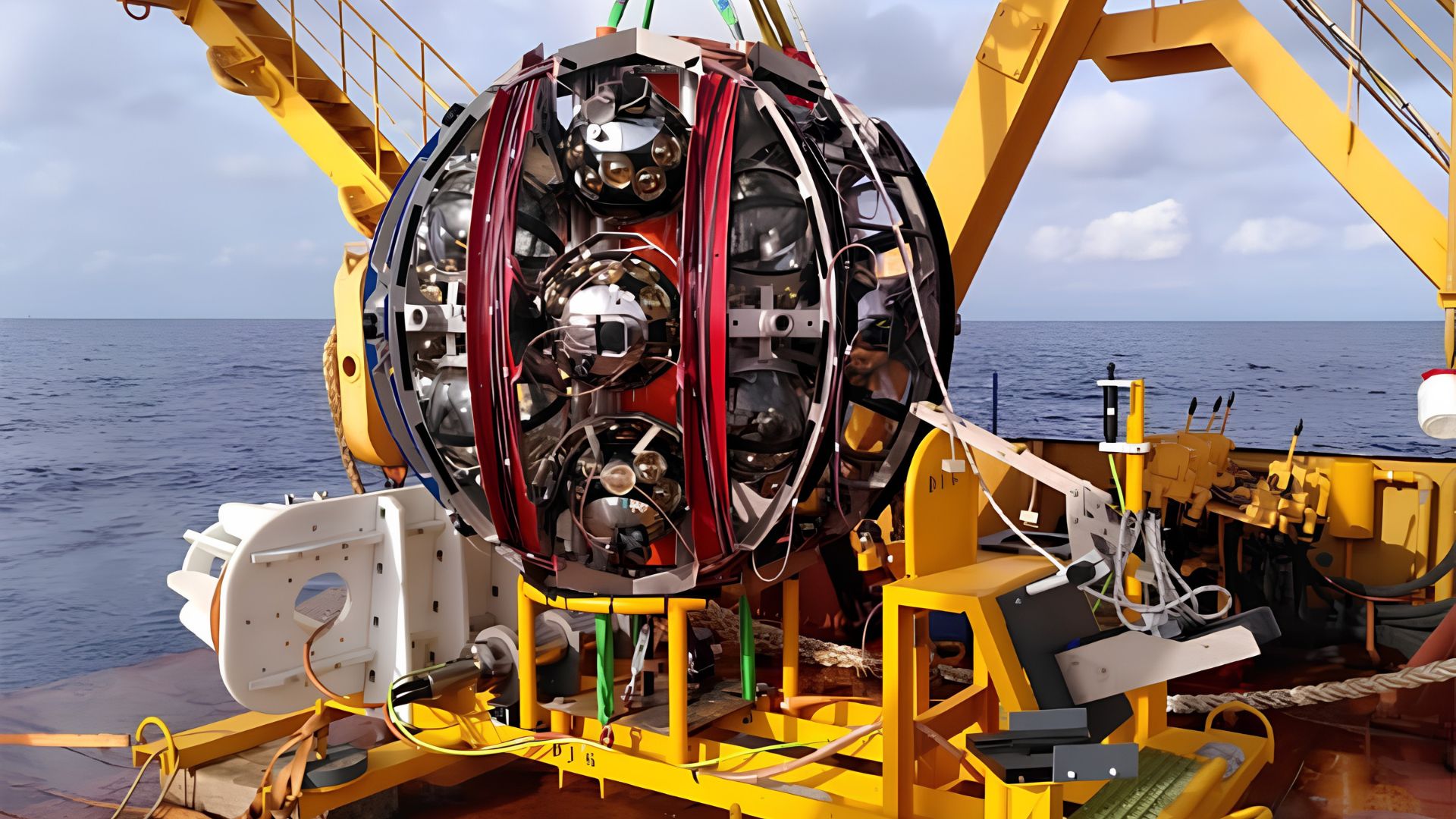


KM3NeT detected a record cosmic neutrino of 220 PeV in the Mediterranean, energy 16 thousand times greater than that of the LHC, using an underwater detector at 3,500 meters.
According to KM3NeT, on February 13, 2023, the ARCA detector recorded an extraordinary event at the bottom of the Mediterranean Sea: a cosmic neutrino with an estimated energy of 220 PeV, or 220 million billion electron-volts. The event, called KM3-230213A, was published in the journal Nature in February 2025 after two years of analysis. The neutrino traveled almost horizontally for approximately 140 km through rock and water before interacting with the Mediterranean and lighting up more than a third of the detector’s photomultipliers. The signature was clear, bright, and compatible with a cosmic origin.
KM3NeT is a European infrastructure formed by two detectors at the bottom of the Mediterranean: the ARCA, installed off the coast of Sicily, at a depth of 3,500 meters, and the ORCA, installed 40 km off the coast of Toulon, France, at 2,450 meters.
KM3NeT detected the most energetic neutrino ever observed in the Mediterranean
The KM3-230213A event is considered the most energetic neutrino ever observed. The data is even more impressive because it was detected when only a fraction of the final detector was in operation.
-
The Trap of Modern Technology: How Screen Overload and Digital Connections Can Impact Your Mental Health and Well-being

-
Wyoming Couple Grows Tropical Fruits Year-Round in -40°C Using Geothermal Greenhouse, Demonstrating Earth’s Heat Can Produce Oranges and Lemons in Snow Without Traditional Heating

-
Ship Returns from Brazilian Coast with Thirty Newly Discovered Life Forms
-
Nigerian Professor Invents Electricity-Free Refrigerator Using Clay Pots and Wet Sand, Extending Shelf Life of Vegetables to 27 Days; 7,000 Units Distributed in Energy-Deprived Villages



The energy of 220 PeV places this neutrino far above the scales produced by human-made machines. For comparison, the LHC, in Geneva, collides protons at 13.6 TeV, while the neutrino detected by KM3NeT had energy about 16 thousand times greater.

This difference shows that some natural cosmic process was able to accelerate particles to levels far beyond current human technology. The source may be linked to supermassive black holes, active galaxies, magnetars, or other extreme phenomena of the universe.
Cosmic neutrinos pass through planets, stars, and galaxies almost without interacting
Neutrinos are some of the most difficult particles to detect in the universe. They have almost zero mass, no electric charge, and rarely interact with matter.
Every second, trillions of solar neutrinos pass through every square centimeter of the human body without producing any noticeable effect. Most pass through the entire Earth as if the planet were almost transparent.
This characteristic makes neutrinos extremely difficult to capture. To detect a few events per year, it is necessary to transform gigantic volumes of water, ice, or another transparent medium into particle detectors.
Underwater detector needs to be gigantic in scale because neutrinos almost never collide
A common energy neutrino would need to pass through an immense amount of matter to have a reasonable chance of interacting with an atom. Therefore, detectors like KM3NeT need to use the sea itself as part of the scientific instrument.

When a very high-energy neutrino finally interacts with an atomic nucleus in the water, it produces a cascade of secondary particles. These particles generate a blue flash of light called Cherenkov radiation.
This light lasts fractions of a nanosecond but can be captured by extremely sensitive sensors. The KM3NeT was built to record this tiny flash in the absolute darkness of the Mediterranean seabed.
Cherenkov radiation works like a sonic boom inside the water
Cherenkov radiation occurs when charged particles travel through water faster than light can propagate in that medium. This does not violate the speed of light in a vacuum but creates an effect similar to the sonic boom of a supersonic plane.
In the case of KM3NeT, this effect appears as a bluish emission. Photomultipliers record the arrival of photons with nanosecond precision.
By comparing the arrival time of light at different sensors, physicists can reconstruct the trajectory of the secondary particle. From this, they infer the original direction of the cosmic neutrino.
ARCA and ORCA study different questions about neutrinos and the universe
The KM3NeT is composed of two independent detectors. ARCA, an acronym for Astroparticle Research with Cosmics in the Abyss, is located off the coast of Portopalo di Capo Passero, Sicily, and is designed to detect high-energy cosmic neutrinos.

The ORCA, acronym for Oscillation Research with Cosmics in the Abyss, is located near Toulon, France, and has another objective: to study fundamental properties of atmospheric neutrinos produced by the interaction of cosmic rays with the Earth’s atmosphere.
The difference between the two lies in the geometry. The ARCA covers a larger volume to capture rare and energetic events, while the ORCA uses closer sensors to measure less energetic neutrinos with greater precision.
ARCA will have 128 thousand photomultipliers to observe high-energy neutrinos
In the final configuration, the ARCA will have 230 vertical strings, each with 18 digital optical modules. Each module contains 31 photomultipliers, tubes capable of converting a single photon into an electrical signal amplified billions of times.
This results in 128,340 photomultipliers just in the ARCA. They will be distributed on the seabed, forming a three-dimensional network of sensors aimed at detecting Cherenkov flashes.
The spacing between the ARCA strings is 95 meters, with modules separated by 36 meters. This architecture was designed for ultra-high-energy cosmic neutrinos, which produce bright enough signals to be detected over great distances.
ORCA will measure neutrino oscillations and investigate mass hierarchy
The ORCA has a denser geometry, with strings spaced only 20 meters apart. Its objective is to measure atmospheric neutrinos of much lower energy, in the GeV range, which generate weaker signals.
This detector studies neutrino oscillation, a phenomenon in which the three known types of these particles transform into each other as they travel. The way this oscillation occurs can reveal the mass hierarchy of neutrinos.
This is a fundamental question in particle physics. The Standard Model describes neutrinos but does not completely explain their masses or the exact order among them.
KM3NeT will have 200 thousand electronic eyes at the bottom of the Mediterranean Sea
When complete, the KM3NeT will instrument more than a cubic kilometer of Mediterranean water with about 200 thousand photomultipliers, distributed across 345 vertical strings.
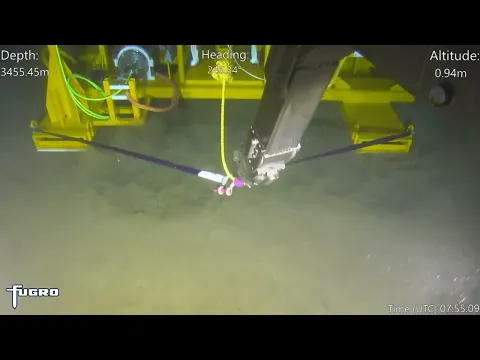
Each string is anchored to the seabed and kept extended by floating glass spheres at the top. In the ARCA, the strings are 800 meters long; in the ORCA, 400 meters.
The environment is extreme: pressure of hundreds of atmospheres, absolute darkness, constant temperature, and maintenance possible only with ships and remotely operated vehicles. Even so, it is precisely this isolation that makes the seabed ideal for hunting rare flashes of neutrinos.
Neutrino KM3-230213A crossed 140 km of rock before interacting
The neutrino detected in February 2023 did not come from above, but almost horizontally. It crossed about 140 km of rock and water before interacting near the ARCA detector.
This trajectory is scientifically important. Extreme energy neutrinos can be absorbed if they travel too long distances within the Earth, because the chance of interaction increases with energy.
The almost horizontal angle created a rare condition: enough material to favor detection, but not so much as to completely absorb the particle. The arrival direction now helps scientists search for the cosmic source responsible for the event.
Neutrino energy exceeded the scale of the largest human accelerator by 16,000 times
The neutrino KM3-230213A had an estimated energy of 220 PeV. This scale is difficult to imagine, but the comparison with the LHC helps to size the phenomenon.
The world’s largest particle accelerator operates in the teraelectronvolt range, while this neutrino reached the detector with energy in the petaelectronvolt range. The difference is of several orders of magnitude.
This means that the universe produces natural accelerators far more extreme than any human machine. KM3NeT did not create this particle; it merely recorded the passage of a cosmic messenger coming from some of the most violent environments in the cosmos.
Mediterranean seabed becomes a laboratory for neutrino astronomy
The choice of the deep Mediterranean was not accidental. Absolute darkness reduces light interference, the water has adequate transparency for blue light propagation, and thermal stability helps keep the sensors operating accurately.
Each detection string is connected to junction units on the seabed by electro-optical cables. These cables supply power to the modules and transmit data in real-time to laboratories on land.
In ARCA, the data goes to the INFN laboratory in Catania, Sicily. In ORCA, it goes to La Seyne-sur-Mer, near Toulon. Millions of signals are filtered to separate bioluminescent noise, cosmic rays, and rare neutrino events.
KM3NeT and IceCube can form a global neutrino network
With the detector complete, KM3NeT will have the sensitivity to confirm or refute candidate sources of cosmic neutrinos identified by other observatories, such as IceCube, installed in the ice of the South Pole.
This complementarity is essential. IceCube observes the sky from the southern hemisphere, while KM3NeT, in the Mediterranean, offers another perspective for detection and trajectory reconstruction.
Together, these detectors can form a global network of neutrino astronomy. For the first time, scientists will be able to better triangulate the origin of the most energetic particles in the universe, using not light, but almost invisible messengers that traverse entire galaxies.