Portuguese
  Spanish


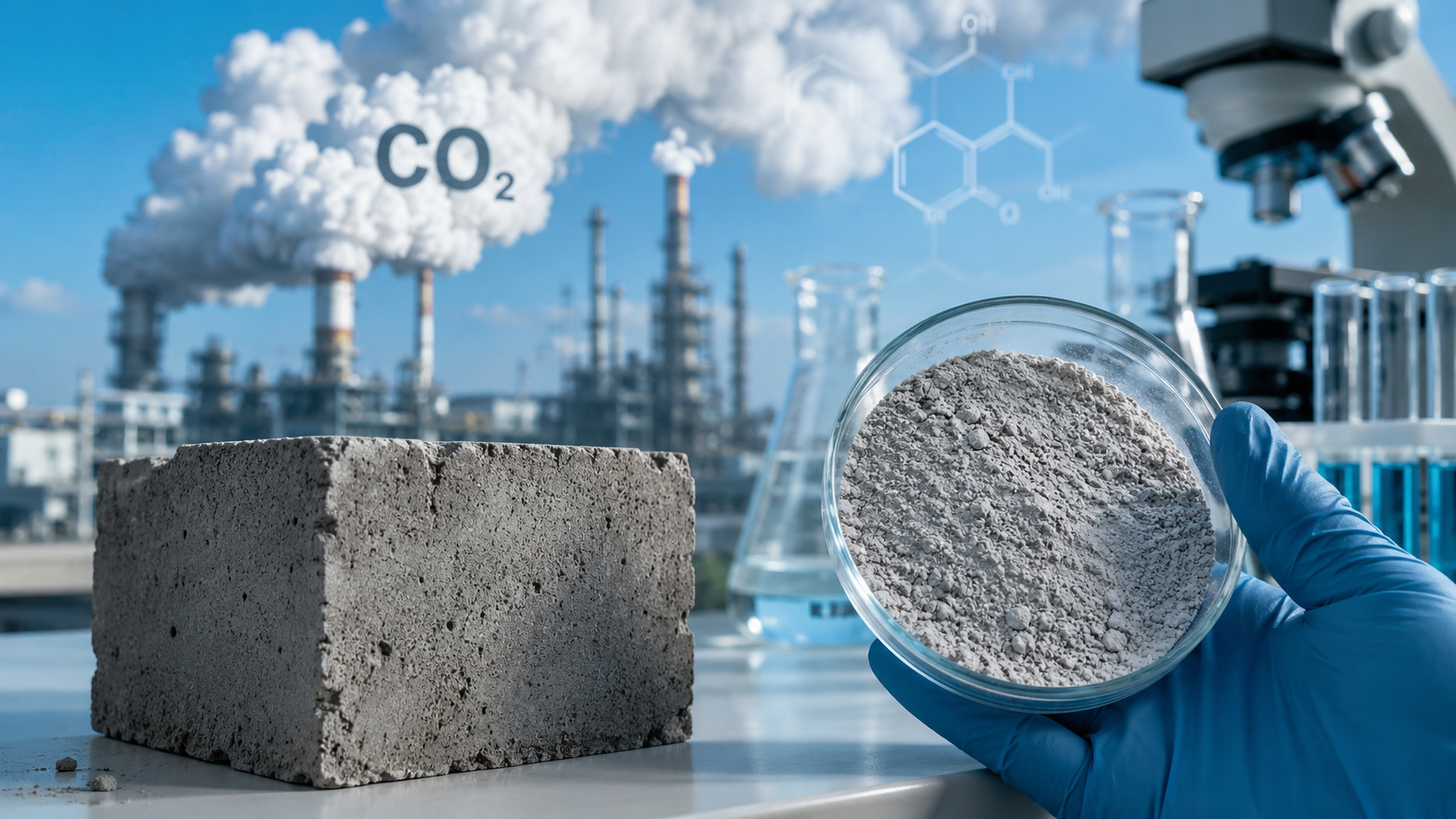


The material that absorbs CO₂ emerges as an experimental alternative to concrete, promises sustainable construction, quick curing, lower environmental impact, and future use in modular pieces
A new material created by scientists uses an enzyme to transform CO₂ into solid minerals and harden in a few hours, paving the way for a possible alternative to traditional concrete.
The information was published by Phys.org, a scientific news portal. The material is called enzymatic structural material and was developed by researchers at the Worcester Polytechnic Institute in the United States.
The advancement draws attention because concrete is at the center of modern construction, but its production accounts for nearly 8% of global CO₂ emissions.
-
Abandoned House Renovation Fixes Decades-Long Leak in Two Days with Red Steel Roof Installation

-
Man Builds Entire House by Hand from Abandoned Pallets Found in Brazilian Forest, Complete with Round Door and Matching Doghouse
-
California Diverts 65% of Construction Waste from Landfills, Repurposing Millions of Tons into Road Base, New Asphalt, and Wood Chips
-
Japan Constructs World’s Deepest Sea Wall in the Pacific, Sinking Massive Concrete Structures for Three Decades




How the enzyme transforms CO₂ into solid mineral particles
The material uses an enzyme to accelerate a reaction that transforms carbon dioxide into mineral particles. In simple terms, CO₂ stops being just a gas and becomes part of a solid structure.


These particles help form a strong material that can be molded and hardened in a few hours. This curing time is one of the most important points of the research.
The proposal is not just to emit less pollution. The process seeks to capture carbon during production, something that changes the logic of materials used in construction.
Why this material draws attention compared to traditional concrete
Common concrete requires cement, energy, and heavy industrial processes. This combination weighs on the environmental impact of civil construction.
The new material enters as an experimental alternative to concrete, with the promise of lower energy consumption and the ability to store carbon in mineral form.
Even so, it should not be treated as an immediate substitute for all constructions. The technology needs to advance in scale, cost, durability, and real market use.
The number that shows the size of the environmental difference
Phys.org, a scientific news portal, detailed that 1 cubic meter of the new material sequesters more than 6 kg of CO₂.
The comparison becomes stronger in the face of conventional concrete. 1 cubic meter of traditional concrete can emit about 330 kg of CO₂.
This difference explains why the discovery has entered the radar of sustainable construction. The material attempts to tackle an old problem: building without significantly increasing the environmental cost.
Researcher points out the global weight of concrete in emissions
Nima Rahbar, professor at Worcester Polytechnic Institute, stated that “concrete is the most used building material on Earth, and its production accounts for almost 8% of global CO₂ emissions.”
The statement puts the discovery in context. It is not just about creating a different product, but seeking a solution for a sector that drives entire cities and consumes a large volume of resources.
The researcher also presented the proposal as a practical and scalable alternative, capable of reducing emissions and capturing carbon during the process.
Where this material can be used in the future
The cited applications include wall panels, roof decks, and modular components. These pieces can be used in faster and standardized constructions.
The material also appears as a possibility for affordable housing, climate-resistant works, and post-disaster reconstruction.
Another relevant point is the chance of repair and recycling. This can reduce waste and decrease the disposal of construction debris.
What is still needed to become a reality in construction
Even with promising results, the material remains in the experimental phase. Science has shown the way, but the industry still needs to prove that it works on a large scale.
Cost, long-term resistance, volume production, and market acceptance will be decisive points. Without this, the innovation may remain confined to the laboratory.
The new CO₂-absorbing material shows a possible route to reduce the impact of civil construction. It hardens quickly, uses enzymes, and transforms carbon into solid minerals.
The discovery does not yet replace concrete in current constructions, but it raises an important question at the center of the debate: could building in the future also mean removing carbon from the air?
Would you trust living or working in a building made with a material that captures CO₂, or do you think traditional concrete still seems safer?