Portuguese
  Spanish


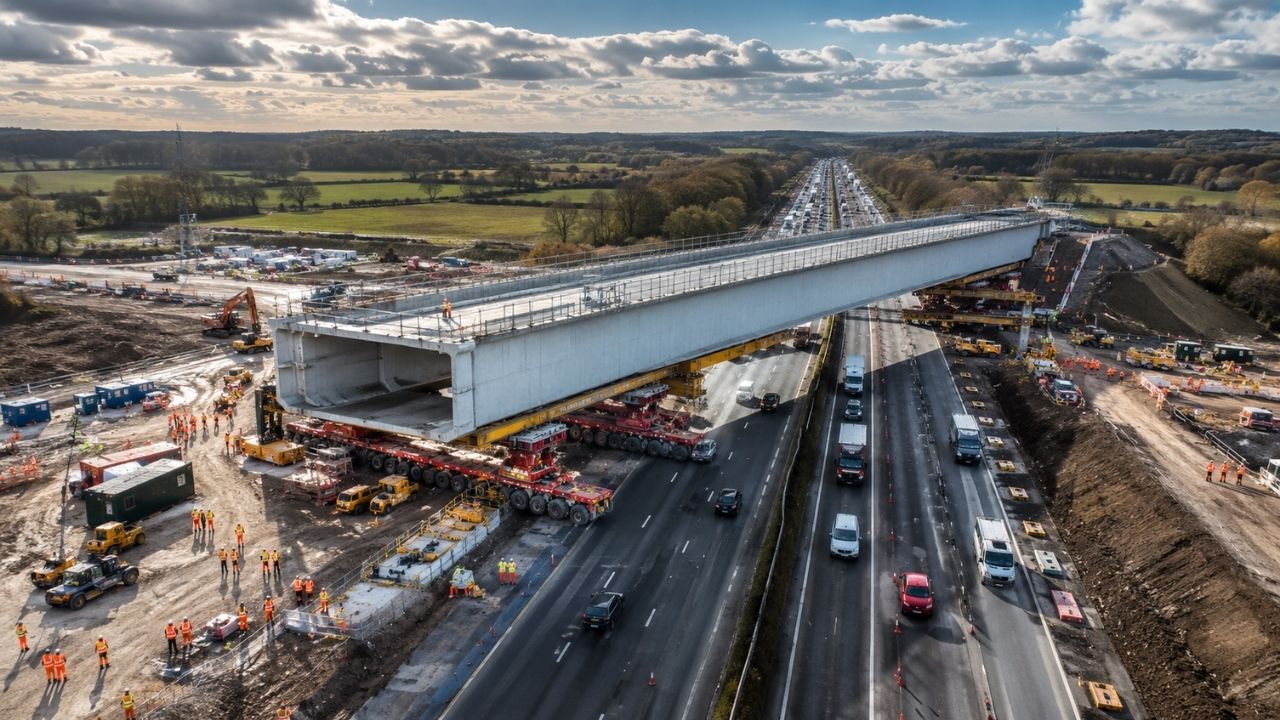

The HS2 Marston Box bridge was pushed over the M42 highway in Warwickshire during a 40-hour operation at Christmas, using box sliding method to position 12,600 tons, reduce prolonged closures, and maintain railway progress between Birmingham, Crewe, and London with less impact on drivers.
The HS2 Marston Box bridge was slid over the M42 highway in Warwickshire, England, between December 24 and 26, 2022. The operation involved around 450 workers from Balfour Beatty VINCI, the contractor responsible for HS2 works in the Midlands region.
According to HS2 Ltd, the 12,600-ton structure traveled 165 meters at a speed of approximately 4 meters per hour. The goal was to position the railway bridge over the M42 during the Christmas period, chosen for having less road traffic, reducing disruptions for drivers and nearby communities.
12,600-ton bridge was moved over a strategically operating highway

The operation drew attention because the bridge was not assembled directly over the M42 from the start. Over six months, the 86-meter structure was built on land next to the highway before being pushed to its final position.
-
400 km² of Greenhouses in Almería, Spain, Astonish American Visitor by Producing Millions of Tons of Produce for Cold-Weather Markets

-
Antarctic Volcano Emits Microscopic Gold Particles That Travel Up to 1,000 Kilometers Across the Continent
-
Little-known Japanese factory is the world’s largest zipper manufacturer, producing 7 billion pieces annually and closing half the world’s pants.

-
Brazilian Factory Recycles One-Third of the Country’s Styrofoam Waste, Matching European Levels with 51,000 Tons Reused Since 2007


This method avoided a longer sequence of roadblocks. Instead of constructing the structure piece by piece over the highway, the team prepared the bridge alongside and then performed the slide in a controlled work window.
Operation took place during Christmas to reduce traffic impact

The sliding occurred during a planned 10-day closure of the M42 between junctions J9 and J10, in both directions. Within this interval, the main movement of the bridge took 40 hours, between Saturday, December 24, and Monday, December 26.
The choice of the Christmas period had a practical reason. The week of Christmas usually records lower traffic in certain road sections, which allowed concentrating a complex work at a time of relatively lower impact for road users.
Structure advanced 165 meters at only 4 meters per hour

Despite the size of the operation, the movement was slow and controlled. The bridge advanced at about 4 meters per hour over a guide platform, covering 165 meters until it was aligned over the highway.
The slowness was part of the safety of the process. In a 12,600-ton structure, speed is not a priority; the essential is to maintain stability, direction, leveling, and control during each stage of the movement.
Box sliding method was treated as a milestone for HS2

HS2 described the operation as the first box slide of its kind over a motorway in the UK. The company also pointed out that the movement may be among the longest in the world for this type of structure.
The sliding mechanism was designed by Freyssinet, a company specialized in civil and structural engineering. The solution allowed the bridge to be pushed to its final location in a single operation, reducing the need for lengthy interventions directly on the M42.
Project involved engineering, construction, and highway companies
The operation brought together different technical fronts. The structure was developed by a project joint venture formed by Mott MacDonald and Systra, at the request of Balfour Beatty VINCI. The installation also involved collaboration from National Highways.
This type of coordination is necessary because the work does not only involve railway construction. It also interferes with a busy highway, local routes, worker safety, and the routine of drivers who depend on the stretch.
Bridge is part of HS2’s railway advancement towards the north and south

Once completed, the structure will be about 190 meters long and will allow the HS2 line to pass over the highway. The route will head north towards Crewe or south when connecting to Birmingham Curzon Street, Solihull, Old Oak Common, and Euston in London.
The railway bridge will also connect between the Dunton Wood embankment to the south and the Birmingham and Fazeley Canal viaduct to the north. Thus, the structure functions as a connecting piece within a larger railway infrastructure system.
Technique reduced closures over 12 months
According to HS2, the method used allowed the operation to be limited to two one-week closures over 12 months. In conventional works of this size, the interference on the road could be longer and more difficult to manage.
This is the central point of the operation: it was not just about moving a heavy bridge, but reducing the impact of construction on those who use the highway. The choice of box sliding aimed to balance construction speed, safety, and less disruption.
HS2 site in Kingsbury already gathered more than 1,000 workers


The operation was part of the HS2 construction site in Kingsbury, covering about 550,000 square meters. At the time, more than 1,000 people were working on-site, within a broader set of railway construction activities.
In the West Midlands region, the construction of HS2 also employed thousands of people, including workers directly linked to the works and other professionals in the supply chain. The bridge over the M42 was therefore just one of the visible stages of a larger project.
Images of the slide show the rare scale of railway engineering

The video of the operation helps to understand the scale of the work. The structure appears advancing slowly over the highway, while teams monitor the movement and control the positioning of the bridge over the M42.
In works of this type, the visual impact is significant because the movement contradicts the common perception of concrete and steel structures. A 12,600-ton bridge, which would normally seem immobile, was moved as a single piece over 165 meters.
A bridge sliding at Christmas shows how far heavy engineering can go
The HS2 operation in Warwickshire shows how large transport projects can rely on uncommon solutions to reduce urban and road impacts. The Marston Box bridge was built next to the M42, slowly slid into its final place, and positioned during a planned window at Christmas.
Now the question remains: is it worth concentrating a project of this magnitude during holidays to reduce disruptions throughout the year, even if it requires hundreds of workers in continuous operation? Do you think this type of method should be used more on busy highways? Share your opinion.