Portuguese
  Spanish


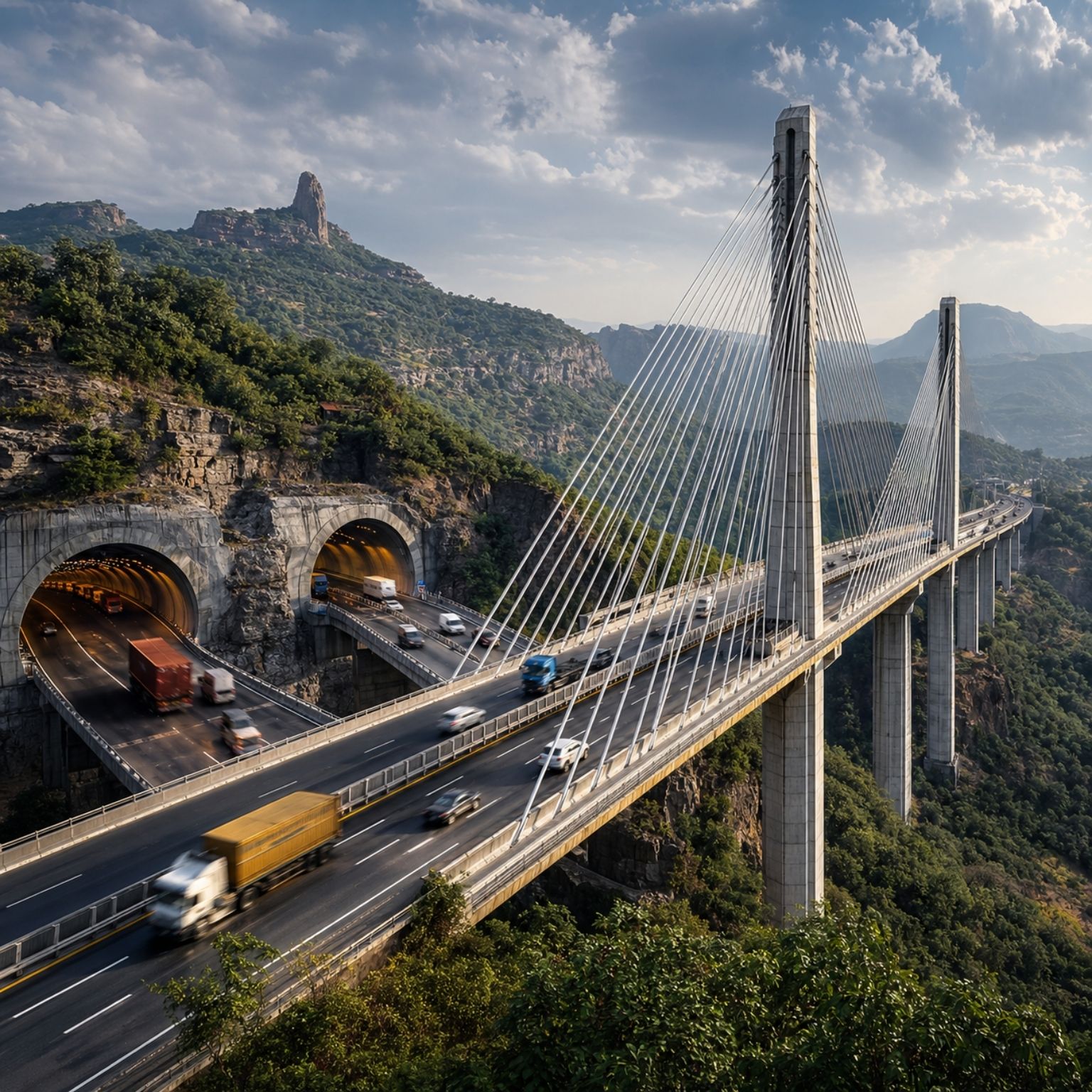

Record-breaking cable-stayed bridge, giant tunnels, and a new 13.3 km route place the Missing Link of the Mumbai-Pune Expressway at the center of a project that promises to relieve historical bottlenecks, reduce congestion, and speed up the connection between Mumbai and Pune
India will inaugurate on May 1st the long-awaited Missing Link of the Mumbai-Pune Expressway, a new 13.3 km section connecting Khopoli, on the Mumbai side, to Kusgaon, near Lonavla. The highlight of the project is the road cable-stayed bridge built over Tiger Valley, along with large tunnels and a route designed to bypass the old Khandala ghat section, known for its curves, slowness, and safety risks.
The project draws attention because it operates in one of the most important interurban corridors in India and combines immediate practical gain with engineering scale. With the opening of the new alignment, the expectation is to reduce travel time between Pune and Mumbai by at least 30 minutes, shorten the route by about 6 km, and relieve up to 70% of traffic on the old section, without additional toll charges for users.
What is the Missing Link and why this bridge became the symbol of the project
The Missing Link is a new segment built to modernize the connection between Mumbai and Pune and eliminate one of the most problematic points of the expressway. Instead of keeping traffic concentrated on the old Khandala ghat section, the project creates a more direct, predictable, and safe route for a significant portion of the vehicles traveling between the two cities.
-
72-Year-Old Man Spends Six Years Building a Rotating House for His Wife, Completing a Full Turn in 22 Seconds

-
Chinese Residential Building Surrounded by Circular Overpass After Residents Reject Compensation

-
After 79 Months and $145 Million Investment, Nepal Set to Open First 2.7 km Road Tunnel to Ease Traffic in Kathmandu Valley

-
In China, 23 Families Spent Over 4 Years Carving a 1.2 km Road Through a Cliff to Overcome Isolation and Transform a Remote Village

Within this set, the bridge over Tiger Valley became the most symbolic element. With 650 meters in length and more than 180 meters in height, the structure is among the highest road bridges in India and stands as one of the visual and technical landmarks of the entire intervention.
The numbers that explain the scale of the project

The new link is 13.3 km long and was built at a cost of about Rs 6,695 crore. The route was developed to cut approximately 6 km from the current route and generate a minimum saving of 30 minutes in travel time, with the possibility of even greater gains during peak hours and holidays.
Another number that helps measure the project’s impact is the expected effect on the old section. According to project information, the new alignment could reduce congestion by up to 70% in the Khandala ghat region, a bottleneck that has slowed down traffic on one of the busiest road axes in the country for years.
The 8.9 km tunnel and the bridge over Tiger Valley concentrate the major engineering highlights
The tunnels of the Missing Link are among the most impressive components of the project. The largest one is 8.9 km long, while the second reaches 1.9 km. Both were built with a 23.5-meter width, a measure that could take the project to the Guinness World Records as the widest road tunnel.
The cable-stayed bridge over Tiger Valley reinforces this technical weight. The structure was erected with advanced techniques such as jump formwork, in a scenario that required overcoming difficult terrain, severe weather, and operational challenges in a mountainous area. The result is a centerpiece that transformed the project into a national showcase of road infrastructure.
Why the new link can change the journey between Mumbai and Pune

The main practical effect of the inauguration will be **improved fluidity**. The old **Khandala ghat** stretch has long been seen as a critical point due to **steep inclines** and **sharp curves**, factors that slow down traffic and make it more susceptible to congestion and risks.
With the Missing Link, the trend is towards **faster**, **stable**, and **predictable** journeys. For those who frequently use the **Mumbai-Pune Expressway**, the gain is not only in time saved but also in reducing **uncertainty along the route**, especially during peak periods.
What changes for the user in the first phase of operation
Despite the scale of the work, drivers will not have to pay **extra toll** to use the new section. The existing toll collection system in **Talegaon** and **Khalapur** will be maintained, meaning users can access the new link **without specific additional cost** for the new feature.
At the same time, the opening will not be total for all vehicles right from the start. For the **first six months**, authorities will only allow **cars and buses** on the Missing Link. **Heavy vehicles** and those transporting **hazardous materials** will continue to use the old ghat section, in a strategy designed to observe traffic behavior and reinforce safety before expanding access.
A project delayed for years, extreme weather, and execution challenges
The project has been under development since **2019** and accumulated delays along the way. After the slowdown caused by **Covid-19**, construction gained new momentum but still faced significant obstacles related to the **extreme conditions of the mountainous region**.
Factors that delayed delivery include **intense rains**, **strong winds**, and also **supply chain disruptions** associated with global factors. This history helps explain why the opening scheduled for **May 1st** was treated as such a highly anticipated moment within the state’s infrastructure calendar.
Next steps and what authorities will observe after the inauguration

The inauguration will be held on **Maharashtra Day** by Chief Minister **Devendra Fadnavis**. After the opening, the expectation is for close monitoring of **safety conditions** and **traffic dynamics** throughout the first months of operation.
This monitoring will be decisive in determining when **other types of vehicles** can use the new section. The initial, more restricted phase functions as an **operational test** on a high-demand corridor, allowing for adjustments before a **broader release**.
Why this bridge and the Missing Link can gain prominence beyond India
The project brings together characteristics that go beyond regional impact. The combination of a prominent cable-stayed road **bridge**, **giant tunnels**, a **significant reduction in travel time**, and **potential for international recognition** makes the Missing Link a project that can attract attention far beyond the Indian market.
Beyond the direct gain for mobility between **Mumbai and Pune**, the intervention projects an image of **technical capability** and **ambition in infrastructure**. In a country with growing demand for more efficient corridors, projects like this tend to become a benchmark both for their **size** and for the **practical effect** they deliver in daily life.
Do you believe that projects like this, with a record-breaking bridge and a giant tunnel, are the most efficient way to unlock India’s major road corridors?