Portuguese
  Spanish


Highway NH-45 received unique red marking to protect drivers, wild animals, and the ecosystem of the Veerangana Durgavati Tiger Reserve.
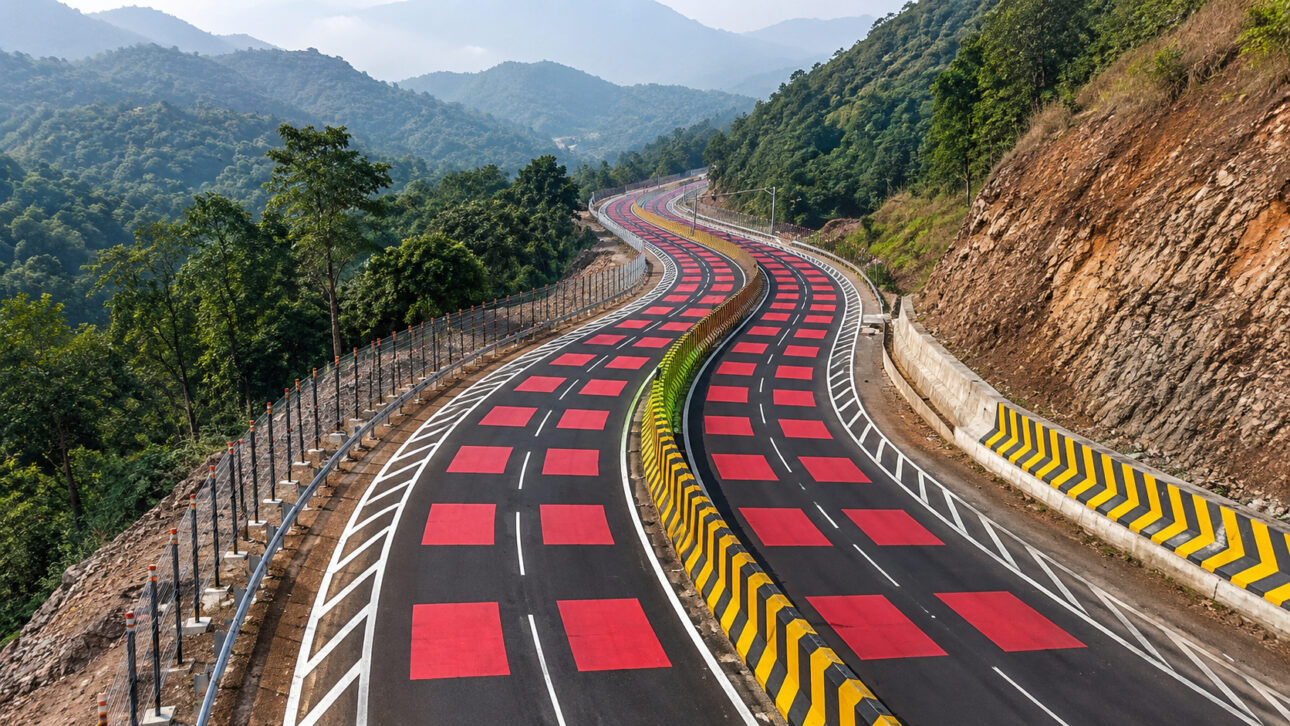
In December 2025, India implemented its first elevated red marking on a national highway, according to the National Highways Authority of India, linked to the Ministry of Road Transport and Highways. The initiative was applied on NH-45, in Madhya Pradesh, on a section that passes through the Veerangana Durgavati Tiger Reserve.
The project attracted attention because it does not rely solely on fences, radars, or traditional speed bumps. The solution uses a red layer of thermoplastic, with 5 millimeters of thickness, applied on the road to alert drivers visually, tactilely, and audibly.
The proposal is straightforward: make the driver realize they have entered a sensitive corridor for wildlife. Thus, speed tends to be naturally reduced, without sudden braking and without excessive discomfort.
-
Yellow vs. White Fat: The Little-Known Difference That Can Impact the Quality and Flavor of Your Barbecue

-
60-Year-Old Kurt Kromm Fired Over $1.95 Cookie After 11 Years at Ford, Proves Payment and Lands Better Job

-
Einstein’s Lasting Advice: “Strive to Be a Person of Value, Not Just Success” Inspires Many Seeking Life’s Meaning
-
Man Spends Weeks Clearing Overgrown Land, Faces Equipment Failures, and His Story on Scott Harrison’s Channel Reaches 94,000 Views



India’s red asphalt combines road safety and wildlife protection
The intervention was installed on a 2 km stretch within an 11.96 km road project. The area was classified as a risk zone due to the geometric conditions of the road and the presence of wildlife in a sensitive forest region.
According to the NHAI, the marking was inspired by Sheikh Zayed Road in Dubai, as well as international research and guidelines. Even so, the application on NH-45 became unprecedented on an Indian national highway.
The strong red breaks the visual repetition of common asphalt. In this way, the driver receives an immediate alert and understands that they need to drive more attentively.
How the red road makes the driver slow down unconsciously
The logic of the red road combines visual perception and behavioral response. Firstly, the color highlights the danger section. Then, the slight elevation of the surface creates a tactile sensation and a subtle sound during the vehicle’s passage.
This set helps the driver reduce speed without relying solely on signs. Additionally, it avoids the more aggressive impact of devices like speed bumps or strong undulations.
The measure also reinforces three important effects:
- increased attention while driving;
- association of the color red with caution;
- better identification of areas sensitive to animal crossings.
Underpasses and fences complete animal protection
The red road does not act alone. According to the NHAI, the project includes 25 exclusive underpasses for animals along the 11.96 km of the highway.
These underpasses follow the natural level of the terrain and drainage paths. This way, animals can use safer routes without entering directly onto the road.
Continuous wire mesh fences run along both sides of the highway, except in deep cut areas. The structure guides wildlife to the underpasses and reduces dangerous crossings on the road.
Project also reduces environmental impact on the reserve
The NHAI states that the solution seeks low environmental impact. The pavement maintains the main structure of the road, preserves the drainage system, and allows for future improvements.
Additionally, the red marking generates less noise than conventional rumble strips. White lines on the shoulders also guide drivers and prevent vehicles from encroaching on green areas.
Cameras on small bridges help monitor animal movement. Meanwhile, solar lighting on bridges and intersections improves visibility at conflict points without heavily increasing the environmental load.

Red road becomes a model of sustainable infrastructure
The experience on NH-45 shows how a highway can serve both humans and animals simultaneously. The goal is to reduce accidents, protect biodiversity, and preserve the forest ecosystem.
More than an aesthetic change, the red road functions as a road engineering tool. The color, texture, wildlife crossings, and fences form an integrated safety system.
With this, India presents an infrastructure model that combines mobility, environmental conservation, and simple innovation. Instead of treating nature as an obstacle, the highway acknowledges the presence of wildlife in the very design of the road.