





 Portuguese
  English
  Spanish
  3 min of reading
  0 comments


New Chinese Hypersonic Engine Increases Efficiency and Feasibility of Traveling at Extremely High Speeds
Researchers in China have introduced an innovative concept for hypersonic engines, combining detonation and ramjet technologies to create a more efficient engine. A team from Tsinghua University in Beijing developed the Ram-Rotor Detonation Engine (RRDE), which integrates a detonation engine with a rotor compressor inspired by ramjets (a type of jet engine that has no moving parts).
This combination aims to provide continuous thrust and enhance overall performance in high-speed flights, overcoming the limitations of current engines.
Versatile Hypersonic Engine Design and Innovative Structure
The new design of the RRDE seeks to provide a more efficient and reliable propulsion cycle. Detonation, characterized by its rapid combustion, generates high pressures, compressing fuel and air with shock waves and releasing intense energy.
-
Smaller than a grain of salt and invisible to the naked eye, scientists have created robots measuring 200 micrometers that swim, sense temperature, make decisions, and usher in a new scale of autonomous machines within the human body.

-
Scientists discover that microbes trapped 1 kilometer beneath the ocean floor can come back to life when earthquakes open fractures, push fluids upward, and reactivate organisms after millions of years.

-
Buried for centuries in the North Sea, it has now surprised archaeologists: a 2,000-year-old anchor appears almost intact beneath the sand.

-
Just 6 light-years from Earth, the closest solitary star to the Solar System has revealed, after 20 years of observations, a super-Earth that completes an orbit every 233 days and faces temperatures of -170°C beyond the habitable zone.




This concept is an evolution compared to pulsed detonation engines (PDE) and rotating detonation engines (RDE), which face challenges in maintaining constant thrust under practical conditions.
How Does the RRDE Work?
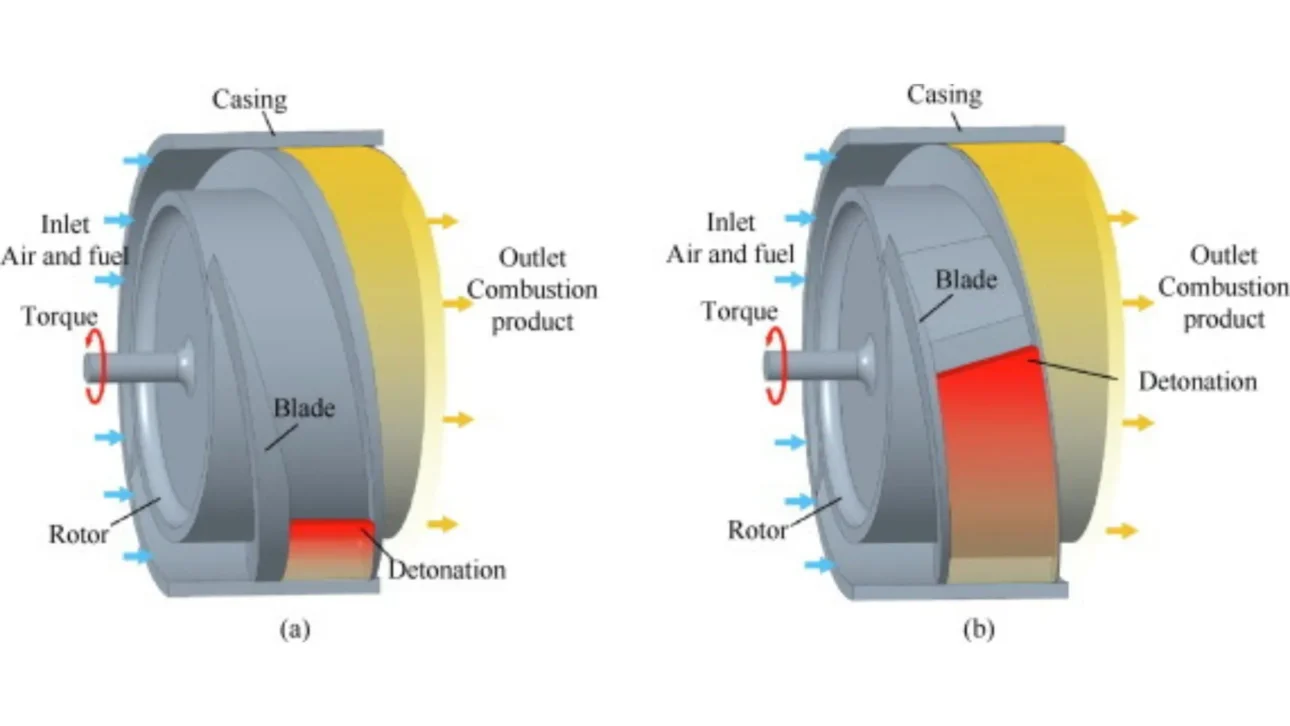
The RRDE utilizes rotating blades that compress, ignite, and expand gases continuously. Inspired by sheep rotor compressors, it allows for the stabilization of shock waves, optimally increasing pressure and thrust.
The structure of the RRDE includes a rotor with helical blade patterns, housed in a stationary shell. As fuel and air pass through the channels between the blades, extension, interference, and expansion occur in a compact system.
Key Benefits of the RRDE
- Continuous and Stable Operation: The design allows for continuous detonations and results, providing high pressure and efficiency.
- Speed Flexibility: Capable of operating at different speeds, the RRDE adapts to rotor speed, making it more versatile.
- Reduction of Disruptive Shocks: Minimizes the formation of disturbing shock waves, ensuring enhanced performance.
This system differs from intended detonation engines by offering more reliable propulsion, capable of operating at low starting speeds.
For hypersonic aircraft, the RRDE represents a significant advancement, given that previous engines, such as the oblique detonation engine and the pulsed detonation engine, were not as effective.
Test Results and Impact on RRDE Performance
The tests conducted allowed the RRDE to achieve combination, fusion, and expansion processes in a single rotor. It utilizes a fixed detonation wave relative to the rotor, increasing pressure and efficiency, highlighting the current systems.
The RRDE operates smoothly at various speeds, simplifying the combustion process. The main factors determining engine performance are the relative inlet velocity (V0), the absolute inlet velocity, and the fuel-air ratio (ϕ).
Challenges and Limitations Faced
Despite the advantages, the development of the RRDE still faces challenges. Researchers have identified that maintaining stable detonation at lower speeds is a barrier to be overcome.
Protecting the blades from intense heat and the rotor’s durability at hypersonic speeds also pose difficulties for full engine predictions.
Numerical simulations have shown that the RRDE has the capability to stabilize detonation waves and adjust to various inlet configurations.
Practical tests using a hydrogen mixture provide a significant pressure increase, with a rise of 1.6. This performance is further strengthened by achieving injection speeds of up to Mach 4.2 and combustion gas temperatures close to 2,100 Kelvin (approximately 1,827 °C).
A team of Tsinghua researchers is committed to addressing the outstanding issues by exploring new materials and cooling methods that can enhance the RRDE design.
These advancements position the RRDE as a viable option for hypersonic propulsion, opening new possibilities for high-speed travel and aerospace applications.





Seja o primeiro a reagir!