Portuguese
  Spanish


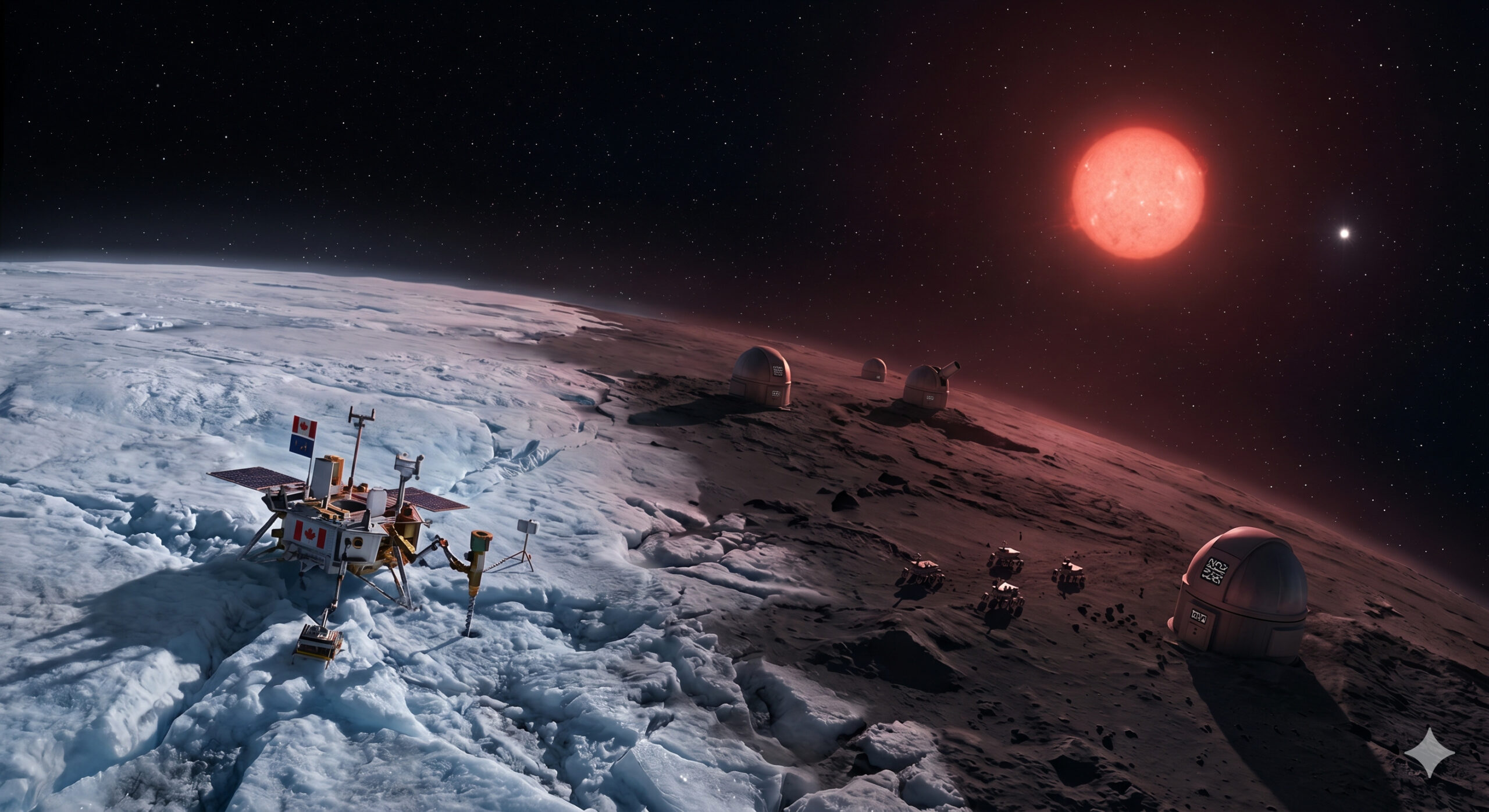

Super-Earth discovered 6 light-years away orbits Barnard’s Star every 233 days and presents extreme temperatures outside the habitable zone.
In November 2018, an international consortium of astronomers announced the detection of an exoplanet orbiting Barnard’s Star, a red dwarf located approximately 6 light-years from Earth in the constellation Ophiuchus. The result was published in the scientific journal Nature and widely reported by institutions such as the European Southern Observatory and media outlets like the BBC. The discovery drew attention not only for its proximity but also because it is the closest known exoplanet orbiting a solitary star, as systems like Alpha Centauri are composed of multiple stars.
The planet was named Barnard’s Star b and classified as a super-Earth, a category that includes planets with a mass greater than that of Earth but less than that of gas giants like Neptune. The relative proximity of the system and the nature of the star made this discovery one of the most significant in recent astronomy.
Barnard’s Star is a low-luminosity red dwarf with high longevity, unlike the Sun
Barnard’s Star is a red dwarf, a type of star very common in the Milky Way, but significantly different from the Sun in terms of mass, temperature, and luminosity.
-
EcoFlow’s Portable Fridge Offers 43 Hours Off-Grid, Reaches -25°C, App-Controlled, Solar-Powered for Camping and RV Adventures

-
Vietnamese Inventor Overcomes Debt and Develops Agricultural Robot Sold in 15 Countries
-
3,000 Sheep Maintain 900 MW Solar Farm Transforming Texas Fields into Energy for Data Centers

-
Distant Galaxy Shaped Like a Giant Jellyfish Sheds Gas, Forming New Stars as It Moves Through Hot Cosmic Gas




It has about 14% of solar mass and emits a much smaller fraction of energy, making it extremely dim. On the other hand, this type of star tends to have a very long lifespan, potentially existing for trillions of years.


This low luminosity has a direct impact on the conditions of the planets around it, especially regarding temperature and the habitable zone.
Additionally, Barnard’s Star exhibits one of the largest proper motions ever recorded, moving rapidly against the background of stars, which has contributed to its detailed study over the decades.
Radial velocity method allowed the detection of the planet after two decades of precise observations
The detection of Barnard’s Star b was the result of a long-term effort, involving more than 20 years of observations conducted by different telescopes around the world. The method used was the radial velocity method, which consists of measuring small variations in the star’s motion caused by the gravity of an orbiting planet.
These variations are extremely subtle and require high-precision instruments, such as the HARPS spectrograph, installed at the La Silla Observatory in Chile, operated by ESO.
The detection was only possible thanks to the combination of data collected over decades and the technological evolution of measurement instruments.
This type of discovery illustrates the complexity of the search for exoplanets, especially in nearby systems, where signals can be difficult to distinguish.
Planet completes orbit in 233 days and is located beyond the habitable zone of the star
Barnard’s Star b has an orbital period of approximately 233 Earth days, which means it takes this time to complete one orbit around its star.
Although it is relatively close to the star in absolute distance, it is located beyond the so-called habitable zone, the region where conditions could allow for the existence of liquid water on the surface.

Due to the low luminosity of the star, the habitable zone is much closer than in the case of the Sun, and the planet is outside this range. This places Barnard’s Star b in a cold region of the system, with conditions quite different from those found on Earth.
Estimated temperature of -170°C indicates an extremely cold and possibly inhospitable environment
Theoretical models indicate that the average temperature of the planet may reach around -170°C, making it an extremely cold environment.
This estimate considers the planet’s distance from the star and the amount of energy received. However, the actual temperature may vary depending on factors such as:
- presence of atmosphere
- chemical composition
- geological activity
Even with these uncertainties, there is consensus that the planet is far from conditions favorable to life as we know it.
The low temperature suggests a possibly frozen environment, similar to some bodies in the Solar System, such as icy moons.
Classification as a super-Earth indicates a mass greater than Earth, but we still do not know its exact composition
Barnard’s Star b is classified as a super-Earth, with an estimated mass of about 3.2 times the mass of Earth. This classification does not define the planet’s composition, only its mass. It may be rocky, like Earth, or have intermediate characteristics between rocky and gaseous planets.

The lack of direct data about its atmosphere and surface limits the complete understanding of its characteristics. New technologies and telescopes may, in the future, provide more detailed information about this type of planet.
Proximity of 6 light-years makes the system a priority target for future missions and astronomical studies
Barnard’s Star is among the closest stars to the Solar System, making it a priority target for future studies.
Although it is still too far for direct exploration with current technology, its proximity facilitates more detailed observations compared to more distant systems.
This factor increases scientific interest in the system, especially for studies on planetary formation and stellar evolution.
Future projects, including more advanced telescopes, may investigate the properties of the planet and the star with greater precision.
Discovery reinforces the importance of red dwarf stars in the search for exoplanets in the Milky Way
Red dwarfs represent the majority of stars in the galaxy, and studies indicate that many of them have planetary systems.
The discovery of Barnard’s Star b reinforces the idea that planets are common even in low-mass and low-luminosity stellar systems. This significantly increases the potential number of worlds outside the Solar System.

The diversity of environments found in these systems challenges traditional models of planetary formation.
What the discovery of Barnard’s Star b reveals about the limits of space exploration and modern science
The identification of a planet so close, yet still inaccessible, highlights the current limits of space exploration. Even at just 6 light-years away, the system is far beyond the reach of manned missions or conventional probes.
This underscores the importance of indirect observation methods and technological evolution in astronomy. The discovery also shows how science can advance through collaborative and long-term efforts.
Do you believe that future telescopes will be able to reveal details of the atmosphere and surface of this nearby exoplanet?
The case of Barnard’s Star b raises a central question for modern astronomy. If we have already managed to detect a planet just 6 light-years away, to what extent will the next generations of telescopes be able to reveal deeper details about these worlds and their true nature?