Portuguese
  Spanish


The panel uses only sunlight to evaporate water and was tested with samples from three different oceans. Instead of returning the salty waste from traditional plants to the sea, it retains solid salts and even part of the lithium. For now, however, the system exists only in small laboratory prototypes.
A scientific innovation promises to tackle two global problems at the same time, even though it is in its initial phase. A solar panel created in the United States transforms real seawater into drinking water without generating the toxic brine that pollutes the oceans, and it can still recover salt and valuable minerals like lithium, an advancement that, in the future, could help alleviate water scarcity and the search for batteries.
The technology was developed by researchers at the University of Rochester, in the United States, in the laboratory of optics and physics professor Chunlei Guo, and described in May 2026 in the scientific journal Light: Science & Applications. It is important to highlight, from the outset, that the system has only been demonstrated in small proof-of-concept devices, and its large-scale application still depends on advancements. Below, we explain how the equipment works, what it has already achieved, and what challenges it needs to overcome.
How the solar panel that desalinates water works
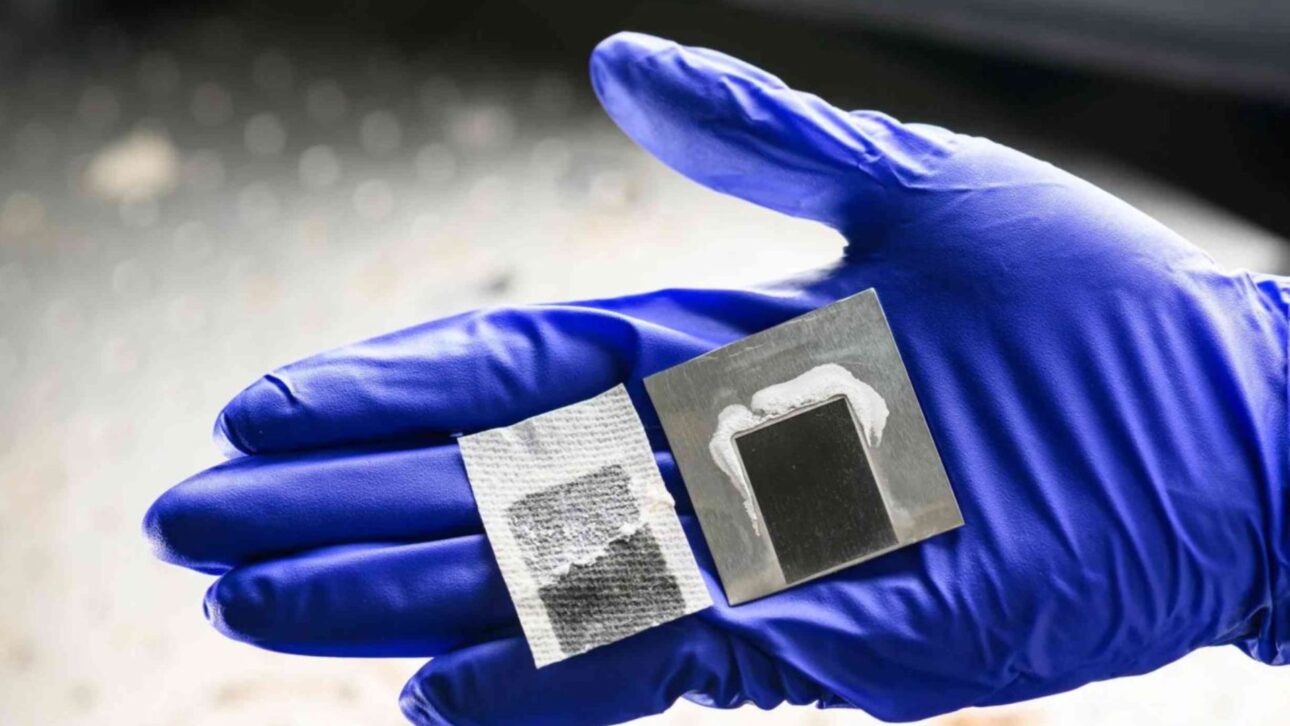
The solar panel is made of a dark metal textured with ultra-precise lasers, which absorbs sunlight and uses it to evaporate seawater directly on its surface, separating fresh water from salt without needing chemicals for pre-treatment, in a process known as interfacial evaporation.
-
NASA’s Plan to Dump ISS Debris in Ocean Sparks Environmental Concerns Among Scientists

-
14-Year-Old Invents Eco-Friendly Water Pump Using Recycled Materials to Aid Communities Without Water Access
-
Pigeons Trained to Detect Cancerous Changes in Medical Images Astonish Scientific Community

-
Plastic Waste from Beaches and Poor Communities in Kenya Transformed into School Desks, Replacing Wood in Classrooms and Turning Marine Litter into Durable Study Tables


The major difference lies in what happens with the salt.
As the water evaporates, the salts crystallize and, instead of accumulating and clogging the panel, are naturally pushed to the edges of the panel, in a movement similar to the so-called coffee ring effect, that mark a drop of coffee leaves when it dries.
With this, the system practically self-cleans and can operate for long periods without interruption, according to the researchers.
The end of toxic brine
This is precisely where the greatest environmental benefit lies.
Traditional desalination plants, based on methods such as reverse osmosis, often discharge back into the sea a highly concentrated and toxic brine, which increases the water’s salinity and reduces oxygen in the discharge areas, harming fish, corals, and other marine organisms, one of the biggest environmental problems of this sector.
In the University of Rochester’s system, instead of this liquid brine, what remains are salts and minerals in solid form, which can be collected and reused.
According to the study, the equipment can recover almost all of the salts as solids, which eliminates the discharge of toxic waste into the ocean and also opens an interesting possibility: turning what would be waste into useful raw material.
The promise of lithium for batteries
Among the minerals that can be utilized, one draws special attention.
In a complementary study, the team incorporated special nanoparticles into the grooves of the solar panel to selectively capture lithium, an essential metal in battery manufacturing, and managed to recover about 50% of the lithium present in samples of water from the Great Salt Lake, in Utah, United States.
This result is promising because lithium is a strategic and increasingly contested input for the production of electric car batteries and energy storage.
Even so, caution is needed: this is a partial recovery percentage, obtained in laboratory tests with water from a salt lake, and not a ready-made solution to extract lithium on an industrial scale directly from the sea.
The potential exists, but there is still a way to go.
The challenges before reaching the real world
Despite the enthusiasm, the scientists themselves acknowledge the limitations.
The biggest obstacle is the scale, as the laser texturing process still limits the size of the panels, and bringing the technology to industrial production will require investment, as well as proving the equipment’s stability over time, under constant exposure to salt and ultraviolet radiation, harsh conditions of the marine environment.
Professor Chunlei Guo believes that the technology can be scaled up for larger applications, but for now, the results come from small prototypes.
Therefore, it is more honest to treat the advancement as a very promising scientific demonstration rather than as a ready-made product to immediately solve the water crisis or lithium supply.
Science has taken an important step, and the coming years will tell if it holds up outside the laboratory.
Why This Matters
The context helps to understand the relevance of the research.
According to the United Nations, about 2.2 billion people worldwide still do not have safe access to drinking water, and many regions, from California to the Middle East, already rely on desalination to supplement supply, making the development of cleaner and more efficient methods urgent.
A technology that produces fresh water using only solar energy, without chemicals and without toxic waste, and that also recovers useful minerals, has the potential to make a difference in places with water and resource scarcity, such as island nations and arid coastal regions.
The value of the study lies in showing a possible path, combining water security and sustainable production of raw materials, even if its large-scale adoption still depends on overcoming technical and economic challenges.
The solar panel developed in the United States represents an exciting advancement in the search for drinking water and more sustainable sources of minerals, by combining clean desalination, the end of toxic brine, and lithium recovery in a single concept.
For now, it is a promising proof of concept in the laboratory, and not a ready solution, but it is precisely this type of research that often leads to major technological transformations.
Following these developments helps to understand how science and innovation can, in the future, tackle some of humanity’s greatest challenges.
And you, do you believe that technologies like this solar panel can help solve the lack of drinking water in the world? What do you think about the idea of extracting lithium from the sea while producing fresh water? Leave your comment, share your opinion, and help spread the article to those interested in science, solar energy, and sustainable innovation.