Portuguese
  Spanish


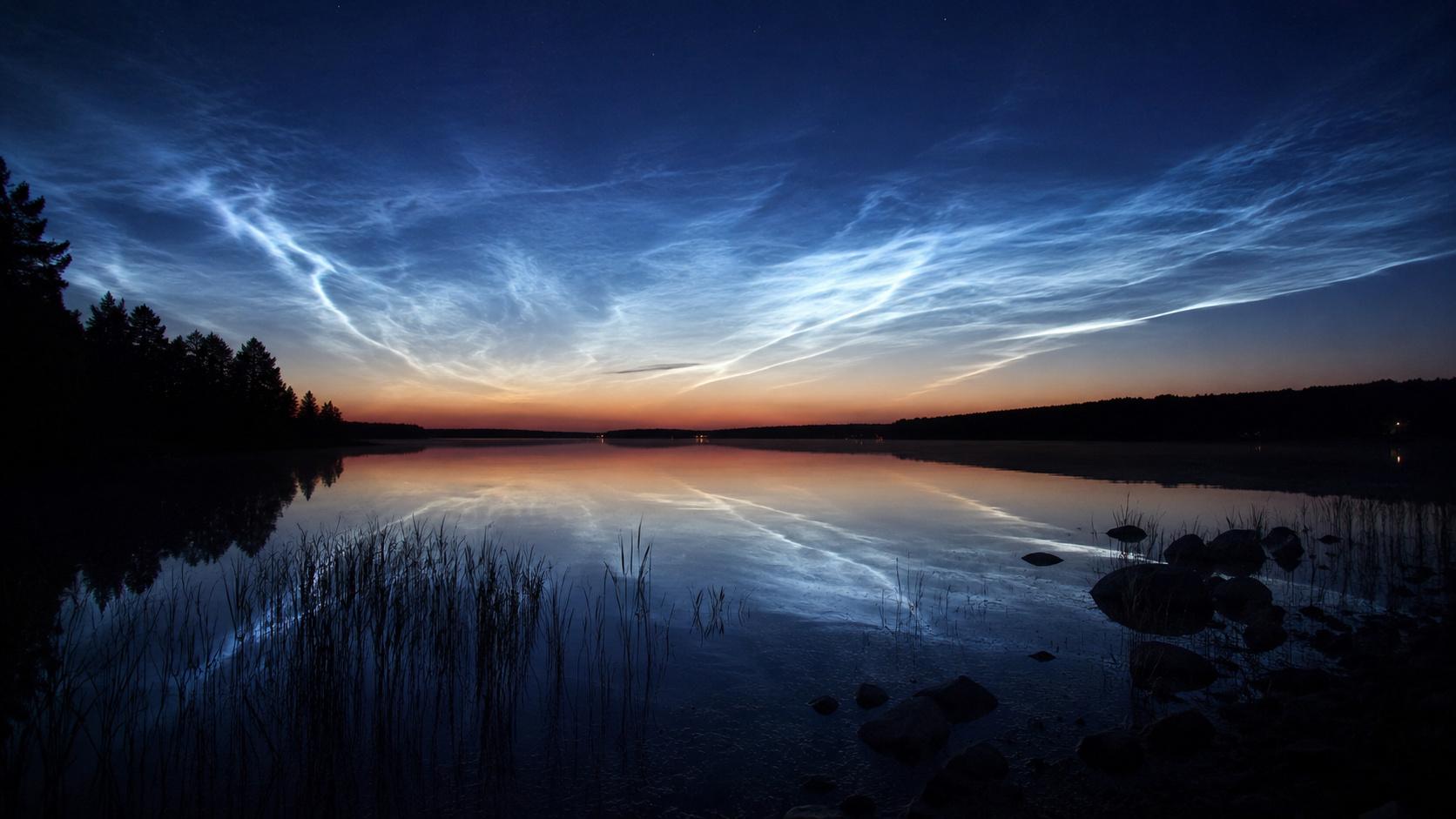

Phenomenon observed in the United States and Germany marks the beginning of the noctilucent cloud season, bluish and silver formations that appear about 80 kilometers above altitude
The noctilucent cloud season has begun in the Northern Hemisphere and has already led to impressive sightings in the United States and Europe.
The phenomenon was observed at the end of May and the beginning of June, marking the start of the period when these rare formations appear more frequently in the evening sky.
These clouds draw attention because they shine even after sunset, when common clouds are already dark.
-
Boat Made from 10 Tons of Plastic and 30,000 Discarded Flip-Flops Sails Along African Coast, Serving as a Floating Classroom on Ocean Pollution

-
Welder Discovers 16th-Century Diamond Ring in England After 7 Hours with Metal Detector; Gold Jewel Linked to Edward I Pattern Auctioned for £17,000
-
Former Merchant Marine Captain Invents Fuel-Free Barrier, Removes 20,000 Tons of Trash from Chennai Rivers
-
14-Year-Old Maxim Harris Turns School Project into Anti-Rage Gaming Accessory, Sells 1,000 Units Across 46 U.S. States, Donates 20% of Profits to Charity




The formations appear in bluish and silver tones, creating an unusual contrast in the twilight sky.
First sightings draw attention in the United States
One of the first sightings was recorded on June 2, by photographer John Clement, in Kennewick, Washington state, United States.
Initially, Clement had gone out to photograph a conjunction between Venus and Jupiter.
Shortly after, he noticed luminous formations appearing over Badger Mountain, a hill near his home.
According to a report sent to Space.com, the photographer began to notice possible noctilucent objects as twilight advanced.
At 9:58 PM, he pointed the camera at the hill and confirmed the presence of noctilucent clouds.
The images were taken with an Olympus OM-D E-M1 Mark III and a 150 mm lens.
Subsequently, Clement produced a panorama with three photos from his own backyard, in southwest Kennewick.
Phenomenon also appears in northern Germany
Another recent sighting was published by astronomy enthusiast Daniel Fischer, on the social network X.
The image showed noctilucent clouds over Flensburg, a city located in northern Germany.
The sighting occurred during a live broadcast on May 31.
The sightings reinforced the start of the observation season in the Northern Hemisphere.
The cases also show how the phenomenon can be perceived in different regions of high latitude.

What are noctilucent clouds
Noctilucent clouds form at much higher altitudes than common clouds.
According to NASA, they appear in the mesosphere, about 80 kilometers above the Earth’s surface.
This region is near the boundary with space.
Therefore, these formations are also known as polar mesospheric clouds.
According to NOAA/NESDIS, the phenomenon occurs when small ice crystals accumulate in this elevated layer of the atmosphere.
Because they are very high, these clouds still reflect sunlight after sunset.
Consequently, they remain illuminated while the rest of the sky has already darkened.
This effect creates thin, delicate, and bright structures, usually seen in silvery or bluish tones.
Season occurs between May and August
Observation usually happens between mid-May and mid-August.
However, sightings tend to become more frequent in July, during the summer in the Northern Hemisphere.
Noctilucent clouds appear more easily in areas near the poles.
This is because the mesosphere is colder in these regions.
For this reason, they are generally seen between 45 and 80 degrees north latitude.
How to observe the phenomenon in the sky
To try to observe the clouds, the recommendation is to look to the west after sunset.
This time favors viewing because the brightest stars begin to appear.
At the same time, the darker sky highlights the luminous structures.
Noctilucent clouds usually appear as thin, wavy, and light bands.
Those living in high latitude regions may have more chances to witness this rare spectacle.
After all, how many times does the sky reveal clouds shining almost at the border between the Earth’s atmosphere and space?