






 Portuguese
  Spanish


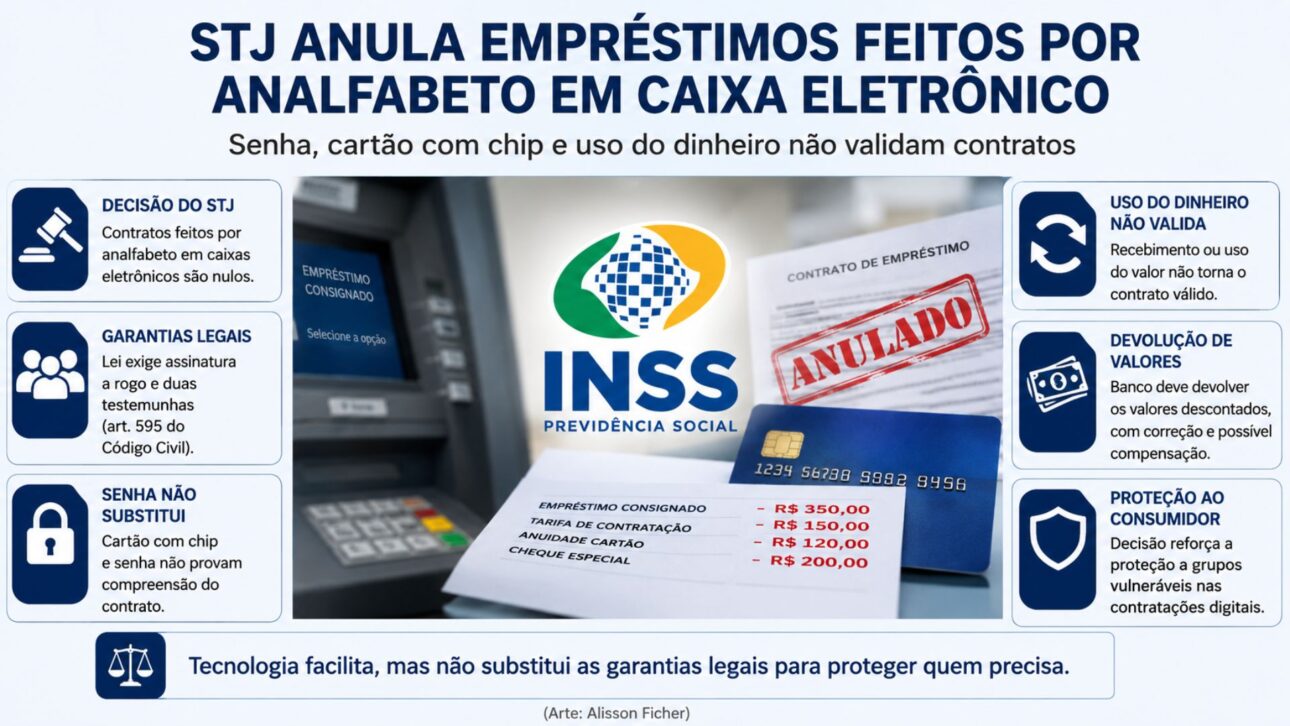
STJ decision on bank contracts made by illiterate person at ATM reinforces limits for digital loans, use of password and fee charges, with direct impact on the validity of operations contracted without formal guarantees provided in the Civil Code.
The Third Panel of the Superior Court of Justice annulled bank contracts signed by an illiterate person at ATMs and ordered the refund of the amounts deducted from their account, in a decision released by the court on June 9, 2026.
Applied in REsp 2.016.029, the understanding reached loans, fees, and charges related to the questioned operations, reinforcing that digital contracting does not waive legal formalities when involving an illiterate person.
The panel concluded that the use of chip card, personal password, and self-service terminal does not replace the requirements provided in article 595 of the Civil Code for private contracts signed by illiterate persons.
-
Brazil to Issue “Panda Bonds” in China, Aiming to Raise Up to 5 Billion Yuan at Lower Interest Rates Than Dollar Debt
-
NATO Faces Internal Tensions as U.S. Pushes for Increased Defense Spending, Targeting 5% of GDP by 2035, with Warnings for Countries Near 2% Level

-
Brazil to Introduce B16 Diesel with Increased Soybean Oil Content for Trucks by 2026
-
Brazil’s July Bolsa Família Payments May Include Extra $150 and $50 for Families with Children, Pregnant Women, and Updated CadÚnico Registration


It was also defined that the mere receipt or use of money does not validate a contract considered null for lack of legal form, even if the operation produced practical effects.
According to the STJ, the controversy began after the plaintiff identified deductions he considered undue from his social security benefit and began to question the origin of the charges made by the financial institution.
When taking legal action, he requested the annulment of the contracts, the return of the amounts withdrawn from his account, and compensation for moral damages, arguing that there was no legally valid expression of will.
STJ invalidates loans made by illiterate person at ATM
The case reached the court after divergent decisions in previous instances, as the requests were partially granted in the first instance, but then had a new outcome in the Court of Justice of Minas Gerais.
In the second instance, the TJMG overturned the sentence and validated the contracts made through digital channels, arguing that the operations occurred with a card equipped with a chip and personal password.
For the Minas Gerais court, this form of authentication would be equivalent to the account holder’s digital signature and would allow recognizing the validity of operations completed at an electronic terminal, even in the face of the consumer’s illiteracy condition.
Still according to the understanding then adopted by the TJMG, the personal and non-transferable password would be sufficient to demonstrate the user’s authorization in the banking system, as the terminal required authentication to complete the contracting.
In the appeal to the STJ, the consumer argued that contracting via ATM did not ensure adequate understanding of the clauses nor valid expression of will, especially because specific formalities provided by law were not observed.
The defense argued that the contracts should be annulled due to the lack of applicable requirements for private documents signed by illiterate persons, as a way to ensure that the content was properly understood.
Password and chip card do not replace legal formalities
Reporter of the appeal, Minister Ricardo Villas Bôas Cueva highlighted that an illiterate person has full capacity to perform civil acts, but written contracts require specific formal protection.
Among these guarantees, the legislation provides for signature by proxy and participation of two witnesses, mechanisms aimed at ensuring that the contractor understands the content of the document and expresses their will securely.
In the minister’s assessment, bank authentication proves access to the system, but does not demonstrate, by itself, that the consumer understood all the obligations assumed in the contracting of loans or financial services.
This difference was decisive to dismiss the thesis that password and card would suffice to validate operations in a digital environment, especially when there was no human mediation capable of explaining the contracted clauses.
Cueva stated that the modernization of financial services does not eliminate the safeguards created to protect vulnerable groups, even if digital tools meet the social demand for efficiency in banking relationships.
Addressing the issue, the minister noted that it is “essential to preserve the legal guarantees instituted in favor of vulnerable minority groups,” a point considered central to the resolution of the case.
With this reasoning, the Third Chamber rejected the idea that authorization to operate a bank account automatically allows contracting loans, cards, overdrafts, or other financial products.
The everyday use of the account, according to the understanding, does not equate to the valid acceptance of complex and ongoing obligations, especially when the law requires specific formalities for the validity of the contract.
Use of money does not validate null bank contract
Another point analyzed by the STJ was the argument that the contracts should be preserved because the money was made available to the consumer and, to some extent, had practical effects.
The rapporteur dismissed this conclusion by stating that amounts released or used do not validate a contract formed without the formalities required by law, as nullity arises from the absence of an essential requirement.
For the minister, accepting validity just because the transaction had practical effects would mean recognizing legal effectiveness to null contracts, a conclusion incompatible with civil law rules on legal transactions.
By granting the special appeal, Cueva advocated for the declaration of nullity of the contracts described in the sentence and the restitution of amounts charged due to the operations considered invalid.
The decision noted, however, the possibility of simple repetition and compensation with amounts effectively made available by the financial institution to the consumer, as mentioned in the judgment.
Bank will have to return deducted amounts
With the annulment, loans and charges arising from the contracts were affected, including credit and debit card annual fees, card contracting fees, and overdraft availability fees.
The official disclosure from the STJ did not identify the bank involved nor detailed the exact date when the contracts occurred, maintaining the focus on the legal validity of operations conducted at electronic terminals.
In practice, the judgment reinforces that financial institutions must observe specific legal requirements when contracting with illiterate individuals, including in digital channels and automated operations via ATMs.
The decision does not prevent electronic banking operations but establishes that password authentication does not replace formal guarantees required to validate written contracts in these cases.







